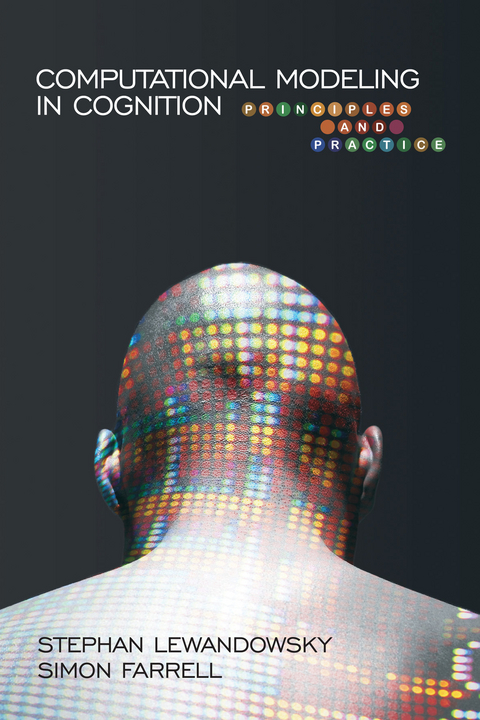
Computational Modeling in Cognition (eBook)
376 Seiten
Sage Publications, Inc (Verlag)
978-1-4522-3619-3 (ISBN)
Preface
1. Introduction
1.1 Models and Theories in Science
1.2 Why Quantitative Modeling?
1.3 Quantitative Modeling in Cognition
1.4 The Ideas Underlying Modeling and Its Distinct Applications
1.5 What Can We Expect From Models?
1.6 Potential Problems
2. From Words to Models: Building a Toolkit
2.1 Working Memory
2.2 The Phonological Loop: 144 Models of Working Memory
2.3 Building a Simulation
2.4 What Can We Learn From These Simulations?
2.5 The Basic Toolkit
2.6 Models and Data: Sufficiency and Explanation
3. Basic Parameter Estimation Techniques
3.1 Fitting Models to Data: Parameter Estimation
3.2 Considering the Data: What Level of Analysis?
4. Maximum Likelihood Estimation
4.1 Basics of Probabilities
4.2 What Is a Likelihood?
4.3 Defining a Probability Function
4.4 Finding the Maximum Likelihood
4.5 Maximum Likelihood Estimation for Multiple Participants
4.6 Properties of Maximum Likelihood Estimators
5. Parameter Uncertainty and Model Comparison
5.1 Error on Maximum Likelihood Estimates
5.2 Introduction to Model Selection
5.3 The Likelihood Ratio Test
5.4 Information Criteria and Model Comparison
5.5 Conclusion
6. Not Everything That Fits Is Gold: Interpreting the Modeling
6.1 Psychological Data and The Very Bad Good Fit
6.2 Parameter Identifiability and Model Testability
6.3 Drawing Lessons and Conclusions From Modeling
7. Drawing It All Together: Two Examples
7.1 WITNESS: Simulating Eyewitness Identification
7.2 Exemplar Versus Boundary Models: Choosing Between Candidates
7.3 Conclusion
8. Modeling in a Broader Context
8.1 Bayesian Theories of Cognition
8.2 Neural Networks
8.3 Neuroscientific Modeling
8.4 Cognitive Architectures
8.5 Conclusion
References
Author Index
Subject Index
About the Authors
| Verlagsort | Thousand Oaks |
|---|---|
| Sprache | englisch |
| Themenwelt | Geisteswissenschaften ► Psychologie ► Allgemeine Psychologie |
| Geisteswissenschaften ► Psychologie ► Verhaltenstherapie | |
| Schlagworte | farrell • Lewandowsky |
| ISBN-10 | 1-4522-3619-4 / 1452236194 |
| ISBN-13 | 978-1-4522-3619-3 / 9781452236193 |
| Informationen gemäß Produktsicherheitsverordnung (GPSR) | |
| Haben Sie eine Frage zum Produkt? |
 EPUB (Adobe DRM)
Kopierschutz: Adobe-DRM
Adobe-DRM ist ein Kopierschutz, der das eBook vor Mißbrauch schützen soll. Dabei wird das eBook bereits beim Download auf Ihre persönliche Adobe-ID autorisiert. Lesen können Sie das eBook dann nur auf den Geräten, welche ebenfalls auf Ihre Adobe-ID registriert sind.
Details zum Adobe-DRM
Dateiformat: EPUB (Electronic Publication)
EPUB ist ein offener Standard für eBooks und eignet sich besonders zur Darstellung von Belletristik und Sachbüchern. Der Fließtext wird dynamisch an die Display- und Schriftgröße angepasst. Auch für mobile Lesegeräte ist EPUB daher gut geeignet.
Systemvoraussetzungen:
PC/Mac: Mit einem PC oder Mac können Sie dieses eBook lesen. Sie benötigen eine
eReader: Dieses eBook kann mit (fast) allen eBook-Readern gelesen werden. Mit dem amazon-Kindle ist es aber nicht kompatibel.
Smartphone/Tablet: Egal ob Apple oder Android, dieses eBook können Sie lesen. Sie benötigen eine
Geräteliste und zusätzliche Hinweise
Buying eBooks from abroad
For tax law reasons we can sell eBooks just within Germany and Switzerland. Regrettably we cannot fulfill eBook-orders from other countries.
aus dem Bereich