


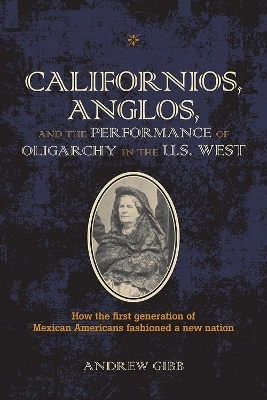
Californios, Anglos, and the Performance of Oligarchy in the U.S. West
Seiten
2018
Southern Illinois University Press (Verlag)
978-0-8093-3647-0 (ISBN)
Southern Illinois University Press (Verlag)
978-0-8093-3647-0 (ISBN)
- Titel z.Zt. nicht lieferbar
- Versandkostenfrei
- Auch auf Rechnung
- Artikel merken
Argues that the mid-nineteenth-century encounter between Anglos and californios - the Spanish-speaking elites who ruled Mexican California between 1821 and 1848 - resulted in both the Americanization of California and the ""Mexicanization"" of Americans. Employing performance studies methodologies in his analysis, Gibb traces how oligarchy evolved and developed in the region.
In Californios, Anglos, and the Performance of Oligarchy in the U.S. West, author Andrew Gibb argues that the mid-nineteenth-century encounter between Anglos and californios— the Spanish-speaking elites who ruled Mexican California between 1821 and 1848—resulted not only in the Americanization of California but also the “Mexicanization” of Americans. Employing performance studies methodologies in his analysis of everyday and historical events, Gibb traces how oligarchy evolved and developed in the region.
The oligarchic rule of the californios has significantly shaped the social and political development of the greater U.S. West from the nineteenth century to the present day. Traces of that power are still visible in the places where California’s elites continue to gather—from the meeting rooms of the California Club in downtown Los Angeles and the Pacific-Union at the top of San Francisco’s Nob Hill, to the dining rooms and parlors of Pasadena mansions and Hillsborough estates. Gibb outlines regional patterns of oligarchic rule that reveal the continuous functioning of an autocratic power structure that traces its roots to Mexican California. While the power of local oligarchs has waned in the years since the Second World War, the significant influence they still wield is a reminder of an era when exceptionally concentrated land ownership ensured elite control of California society.
This interdisciplinary study draws on performance studies, theatre historiography, and New Western History to identify how the unique power relations of historical California were constituted and perpetuated through public performances— not only traditional theatrical productions, but also social events such as elite weddings and community dances—and historical events—the U.S. seizure of the city of Monterey, the feting of Commodore Stockton in San Francisco, and the Bear Flag Revolt.
In Californios, Anglos, and the Performance of Oligarchy in the U.S. West, author Andrew Gibb argues that the mid-nineteenth-century encounter between Anglos and californios— the Spanish-speaking elites who ruled Mexican California between 1821 and 1848—resulted not only in the Americanization of California but also the “Mexicanization” of Americans. Employing performance studies methodologies in his analysis of everyday and historical events, Gibb traces how oligarchy evolved and developed in the region.
The oligarchic rule of the californios has significantly shaped the social and political development of the greater U.S. West from the nineteenth century to the present day. Traces of that power are still visible in the places where California’s elites continue to gather—from the meeting rooms of the California Club in downtown Los Angeles and the Pacific-Union at the top of San Francisco’s Nob Hill, to the dining rooms and parlors of Pasadena mansions and Hillsborough estates. Gibb outlines regional patterns of oligarchic rule that reveal the continuous functioning of an autocratic power structure that traces its roots to Mexican California. While the power of local oligarchs has waned in the years since the Second World War, the significant influence they still wield is a reminder of an era when exceptionally concentrated land ownership ensured elite control of California society.
This interdisciplinary study draws on performance studies, theatre historiography, and New Western History to identify how the unique power relations of historical California were constituted and perpetuated through public performances— not only traditional theatrical productions, but also social events such as elite weddings and community dances—and historical events—the U.S. seizure of the city of Monterey, the feting of Commodore Stockton in San Francisco, and the Bear Flag Revolt.
Andrew Gibb is an assistant professor of theatre history, theory, and criticism at Texas Tech University. He has published work in Theatre History Studies, the Latin American Theatre Review, Theatre Symposium, Comparative Drama, the Journal of Dramatic Theory and Criticism, Texas Theatre Journal, and the edited collection Querying Difference in Theatre History.
| Erscheinungsdatum | 17.07.2018 |
|---|---|
| Zusatzinfo | 22 illustrations |
| Verlagsort | Carbondale |
| Sprache | englisch |
| Maße | 152 x 229 mm |
| Gewicht | 380 g |
| Themenwelt | Kunst / Musik / Theater ► Theater / Ballett |
| Sachbuch/Ratgeber ► Geschichte / Politik ► Allgemeines / Lexika | |
| Geisteswissenschaften ► Geschichte ► Regional- / Ländergeschichte | |
| ISBN-10 | 0-8093-3647-2 / 0809336472 |
| ISBN-13 | 978-0-8093-3647-0 / 9780809336470 |
| Zustand | Neuware |
| Informationen gemäß Produktsicherheitsverordnung (GPSR) | |
| Haben Sie eine Frage zum Produkt? |
Mehr entdecken
aus dem Bereich

aus dem Bereich
Handbuch zum Lesen des Himmels
Buch | Hardcover (2025)
Harpercollins (Verlag)
CHF 30,80
historische Porträts von George Washington bis Donald Trump
Buch | Softcover (2025)
C.H.Beck (Verlag)
CHF 33,55
eine Erfindung der globalen Welt : 4000 Jahre Geschichte
Buch | Hardcover (2025)
Klett-Cotta (Verlag)
CHF 53,20


