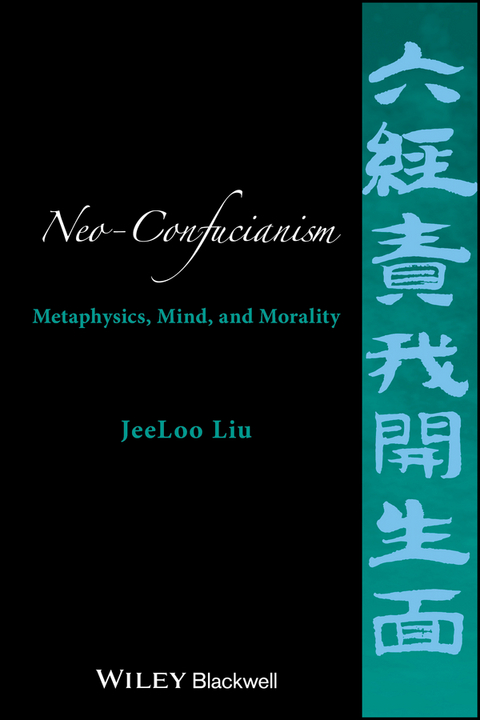
Solidly grounded in Chinese primary sources, Neo Confucianism: Metaphysics, Mind, and Morality engages the latest global scholarship to provide an innovative, rigorous, and clear articulation of neo-Confucianism and its application to Western philosophy.
- Contextualizes neo-Confucianism for contemporary analytic philosophy by engaging with today's philosophical questions and debates
- Based on the most recent and influential scholarship on neo-Confucianism, and supported by primary texts in Chinese and cross-cultural secondary literature
- Presents a cohesive analysis of neo-Confucianism by investigating the metaphysical foundations of neo-Confucian perspectives on the relationship between human nature, human mind, and morality
- Offers innovative interpretations of neo-Confucian terminology and examines the ideas of eight major philosophers, from Zhou Dunyi and Cheng-Zhu to Zhang Zai and Wang Fuzhi
- Approaches neo-Confucian concepts in an penetrating yet accessible way
JeeLoo Liu is Professor of Philosophy at California State University, Fullerton. She is the author of An Introduction to Chinese Philosophy: From Ancient Philosophy to Chinese Buddhism (Wiley-Blackwell 2006), co-editor of Consciousness and the Self (2012), and co-editor of Nothingness in Asian Philosophy (2014). She is currently the Executive Director of the International Society for Chinese Philosophy.
Solidly grounded in Chinese primary sources, Neo Confucianism: Metaphysics, Mind, and Morality engages the latest global scholarship to provide an innovative, rigorous, and clear articulation of neo-Confucianism and its application to Western philosophy. Contextualizes neo-Confucianism for contemporary analytic philosophy by engaging with today s philosophical questions and debates Based on the most recent and influential scholarship on neo-Confucianism, and supported by primary texts in Chinese and cross-cultural secondary literature Presents a cohesive analysis of neo-Confucianism by investigating the metaphysical foundations of neo-Confucian perspectives on the relationship between human nature, human mind, and morality Offers innovative interpretations of neo-Confucian terminology and examines the ideas of eight major philosophers, from Zhou Dunyi and Cheng-Zhu to Zhang Zai and Wang Fuzhi Approaches neo-Confucian concepts in an penetrating yet accessible way
JeeLoo Liu is Professor of Philosophy at California State University, Fullerton. She is the author of An Introduction to Chinese Philosophy: From Ancient Philosophy to Chinese Buddhism (Wiley-Blackwell 2006), co-editor of Consciousness and the Self (2012), and co-editor of Nothingness in Asian Philosophy (2014). She is currently the Executive Director of the International Society for Chinese Philosophy.
Title Page 5
Copyright Page 6
Contents 9
Preface 11
Acknowledgments 13
Introduction 15
Part I Neo-Confucian Metaphysics: From Cosmology to Ontology 43
Chapter 1 From Nothingness to Infinity: The Origin of Zhou Dunyi’s Cosmology 45
Introduction 45
Historical Controversies over Wuji 47
Being (You ?) and Nothingness (Wu ?) 52
The Boundless (Wuji) and the Supreme Ultimate (Taiji) 65
Conclusion 73
Primary Sources 74
Selection in English 74
Chapter 2 The Basic Constituent of Things: Zhang Zai’s Monist Theory of Qi 75
Introduction 75
The Concept of Primordial Qi (Yuanqi) 76
The Initial Cosmic State: The Supreme Vacuity (Taixu ??) 83
Vacuity Versus Vacuum 85
The Supreme Equilibrium (Taihe ??) and the Supreme Ultimate (Taiji) 88
Qi as the Constituent of Material and Immaterial Things 90
A Necessitarian Theory of Principle (Li) in Qi 91
Conclusion: Theory of Qi and Beyond 94
Primary Source 97
Selection in English 97
Chapter 3 Cheng–Zhu School’s Normative Realism: The Principle of the Universe 99
Introduction 99
Cheng Hao’s Conception of Principle (Li): The Principle of Heaven 100
Cheng Yi’s Conception of Principle (Li): Principle is one but its manifestations are many 102
An Ontological Hierarchy of the Cheng Brothers: Non-Reductionism of Principle 105
Zhu Xi’s Notion of Principle as a Holistic Order of the World 108
Zhu Xi’s Notion of the Supreme Ultimate and Its Instantiation in Particular Things 109
Zhu Xi’s Analysis of the Relationship between Principle and Qi 111
Conclusion 116
Primary Sources 116
Selections in English 116
Chapter 4 Wang Fuzhi’s Theory of Principle Inherent in Qi 117
Introduction 117
Wang Fuzhi’s Moral Metaphysics—Principle Inherent in Qi 118
The Unification of Substance and Function 121
Principle as the Necessary Law of the World 126
The Unification of Dao and Concrete Things (Qi ?) 128
The Role of Humans in the World of Nature 132
Conclusion 134
Primary Sources 134
Selection in English 135
Part II Human Nature, Human Mind, and the Foundation of Human Morality 137
Chapter 5 Zhu Xi’s Internal Moral Realism: Human Nature Is Principle 139
Introduction 139
What Is Human Nature (Xing)? 139
The Root of Good and Evil 144
Zhu Xi’s Moral Psychology of Emotion 146
The Role of Human Mind (Xin) in Moral Cultivation 149
Conclusion 151
Primary Sources 151
Selections in English 151
Chapter 6 Lu Xiangshan and Wang Yangming’s Doctrine of Mind Is Principle 153
Introduction 153
The Mind Is Principle and Principle Is in the Mind 154
Humanistic Moral Realism 158
Pragmatist Metaphysics 164
Conclusion 167
Primary Sources 169
Selections in English 169
Chapter 7 Wang Fuzhi’s Theory of Daily Renewal of Human Nature and His Moral Psychology 171
Introduction 171
The Daily Renewal and Daily Completion of Human Essence 172
Wang Fuzhi’s Moral Psychology—Functions of the Mind 175
The Affirmation of Human Desires: The Principle within Human Desires 186
Wang Fuzhi’s Moral Theory Based on His Moral Psychology 188
Conclusion 192
Primary Sources 192
Selection in English 193
Part III The Cultivation of Virtue, Moral Personality, and the Construction of a Moral World 195
Chapter 8 Zhang Zai on Cultivating Moral Personality 197
Introduction 197
The Socio-Cognitive Model of Cultivating Moral Personality 199
Establishing A Moral Identity—How to Define A Moral Self through Volition (Zhi) 203
The Transformation of Moral Personality through Learning (Xue) 205
Cultivating Moral Expertise through the Accumulation of Righteousness (Jiyi) and Habituation (Xi) 206
Identifying the Moral Goal: Moral Exemplars and the Extraordinary Moral Commitment of the Sages 208
Rites and Rules of Propriety (Li) and Situational Fit (Shizhong) 210
Self-Regulation (Keji) and Desire (Yu) 212
The Ultimate Goal: The Effortlessness of Moral Exemplars 213
Final Assessment of Zhang Zai’s Socio-Cognitive Theory in the Contemporary Discourse 214
Conclusion 216
Primary Source 217
Selection in English 217
Chapter 9 The Cheng Brothers’ Globaist Virtue Ethics and Virtue Epistemology 219
Introduction 219
Moral Skepticism and the Cheng Brothers’ Globalist Virtue Ethics 220
The Virtue of Humaneness (Ren): Universal Altruism 222
The Virtue of Authenticity (Cheng) and the Virtue of Respectfulness (Jing) 226
The Cheng Brothers’ Virtue Epistemology 229
The Aim of Knowledge 229
The Conditions for True Knowledge 231
The Methodology of Knowledge: The Investigation of Things 233
Answers to Skepticism about Robust Character Traits 236
Conclusion 239
Primary Source 240
Selection in English 240
Chapter 10 Zhu Xi’s Methodology for Cultivating Sagehood: Moral Cognitivism and Ethical Rationalism 241
Introduction 241
Zhu Xi’s Moral Epistemology: The Investigation of Things for the Extension of Moral Knowledge 242
The Psychological Preparedness for Moral Knowledge: Reverence (Jing) in the Heart 249
Zhu Xi’s Theory of Moral Motivation: From Moral Knowledge to Ethical Action 253
Conclusion 256
Primary Sources 256
Selections in English 257
Chapter 11 Wang Yangming’s Intuitionist Model of Innate Moral Sense and Moral Reflexivism 259
Introduction 259
The Innateness of Morality 260
An Innate Moral Compass: Liangzhi (??) as an A priori Moral Intuition 263
Wang Yangming’s Moral Reflexivism 266
Moral Methodology: The Method of Retrieving One’s Innate Moral Intuition is to Remove Selfish Desires 268
The Unity of Knowledge and Action 272
Conclusion 276
Primary Sources 277
Selections in English 277
Chapter 12 Constructing a Moral World: Wang Fuzhi’s Social Sentimentalism 279
Introduction 279
Wang Fuzhi’s Sentimentalist Theory of Moral Motivation 281
Enlarging Our Circles of Concern—Expanding on Wang Fuzhi’ Social Sentimentalism 288
Conclusion 297
Primary Sources 298
Selection in English 298
References 299
Index 315
EULA 331
"This book is clearly one of the greatest accomplishments among English Neo-Confucian philosophical studies in recent decades. JeeLoo Liu uses clear language and rigorous philosophical reasoning to analyze eight pivotal Neo-Confucian figures regarding three major areas: metaphysics, moral theory and moral practice. The book can be aptly used as both an introduction to Neo-Confucianism for beginners and a top reference for researchers, which is itself a rare achievement."
Reviewed by Bin Song, Washington College
Notre Dame Philosophical Reviews, March 2019
| Erscheint lt. Verlag | 19.5.2017 |
|---|---|
| Sprache | englisch |
| Themenwelt | Geisteswissenschaften ► Philosophie ► Allgemeines / Lexika |
| Geisteswissenschaften ► Philosophie ► Metaphysik / Ontologie | |
| Geisteswissenschaften ► Philosophie ► Östliche Philosophie | |
| Geisteswissenschaften ► Religion / Theologie ► Weitere Religionen | |
| Schlagworte | Comparative & World Religions • moral psychology • Moral Rationalism • moral sentimentalism • Neo-Confucianism • Philosophie • Philosophy • Religion & Theology • Religion u. Theologie • Vergleichende Religionswissenschaft • Virtue Ethics • Weltphilosophie • World philosophy |
| ISBN-10 | 1-118-61932-3 / 1118619323 |
| ISBN-13 | 978-1-118-61932-2 / 9781118619322 |
| Informationen gemäß Produktsicherheitsverordnung (GPSR) | |
| Haben Sie eine Frage zum Produkt? |
 PDF (Adobe DRM)
Kopierschutz: Adobe-DRM
Adobe-DRM ist ein Kopierschutz, der das eBook vor Mißbrauch schützen soll. Dabei wird das eBook bereits beim Download auf Ihre persönliche Adobe-ID autorisiert. Lesen können Sie das eBook dann nur auf den Geräten, welche ebenfalls auf Ihre Adobe-ID registriert sind.
Details zum Adobe-DRM
Dateiformat: PDF (Portable Document Format)
Mit einem festen Seitenlayout eignet sich die PDF besonders für Fachbücher mit Spalten, Tabellen und Abbildungen. Eine PDF kann auf fast allen Geräten angezeigt werden, ist aber für kleine Displays (Smartphone, eReader) nur eingeschränkt geeignet.
Systemvoraussetzungen:
PC/Mac: Mit einem PC oder Mac können Sie dieses eBook lesen. Sie benötigen eine
eReader: Dieses eBook kann mit (fast) allen eBook-Readern gelesen werden. Mit dem amazon-Kindle ist es aber nicht kompatibel.
Smartphone/Tablet: Egal ob Apple oder Android, dieses eBook können Sie lesen. Sie benötigen eine
Geräteliste und zusätzliche Hinweise
Buying eBooks from abroad
For tax law reasons we can sell eBooks just within Germany and Switzerland. Regrettably we cannot fulfill eBook-orders from other countries.
aus dem Bereich