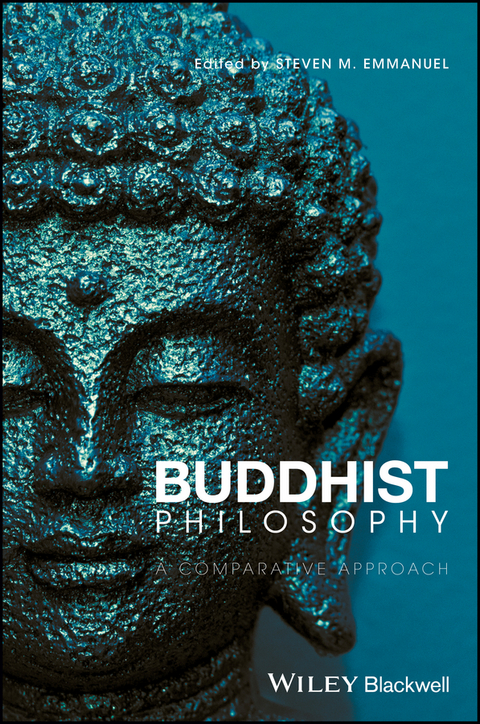
Buddhist Philosophy (eBook)
John Wiley & Sons (Verlag)
978-1-119-06840-2 (ISBN)
Buddhist Philosophy: A Comparative Approach presents a series of readings that examine the prominent thinkers and texts of the Buddhist tradition in the round, introducing contemporary readers to major theories and debates at the intersection of Buddhist and Western thought.
- Takes a comparative, rather than oppositional, approach to Buddhist philosophy, exploring key theories and debates at the intersection of Eastern and Western thought
- Addresses a variety of topics that represent important points of convergence between the Buddhist and Western philosophical traditions
- Features contributions from a wide array of acclaimed international scholars in the discipline
- Provides a much-needed cross-cultural treatment of Buddhist philosophy appropriate for undergraduate students and specialists alike
STEVEN M. EMMANUEL is Professor of Philosophy at Virginia Wesleyan College, USA. He is the author of Kierkegaard and the Concept of Revelation (1995) and editor of A Companion to Buddhist Philosophy (Wiley Blackwell, 2013), The Blackwell Guide to the Modern Philosophers: From Descartes to Nietzsche (Wiley Blackwell, 2001), and Modern Philosophy: An Anthology (2002).
STEVEN M. EMMANUEL is Professor of Philosophy at Virginia Wesleyan College, USA. He is the author of Kierkegaard and the Concept of Revelation (1995) and editor of A Companion to Buddhist Philosophy (Wiley Blackwell, 2013), The Blackwell Guide to the Modern Philosophers: From Descartes to Nietzsche (Wiley Blackwell, 2001), and Modern Philosophy: An Anthology (2002).
Notes on Contributors vii
Acknowledgments xi
Abbreviations xiii
Editor's Introduction 1
Steven M. Emmanuel
1 Buddhist Philosophy as a Way of Life: The Spiritual Exercises of Tsongkhapa 11
Christopher W. Gowans
2 The Other Side of Realism: Panpsychism and Yog¨¡c¨¡ra 29
Douglas Duckworth
3 Emergentist Naturalism in Early Buddhism and Deweyan Pragmatism 45
John J. Holder
4 Metaphysical Dependence, East and West 63
Ricki Bliss and Graham Priest
5 Metaphysics and Metametaphysics with Buddhism: The Lay of the Land 87
Tom J.F. Tillemans
6 Are Reasons Causally Relevant for Action? Dharmak¨rti and the Embodied Cognition Paradigm 109
Christian Coseru
7 Zen's Nonegocentric Perspectivism 123
Bret W. Davis
8 Rhetoric of Uncertainty in Zen Buddhism and Western Literary Modernism 145
Steven Heine
9 From the Five Aggregates to Phenomenal Consciousness: Toward a Cross/Cultural Cognitive Science 165
Jake H. Davis and Evan Thompson
10 Embodying Change: Buddhism and Feminist Philosophy 189
Erin A. McCarthy
11 Buddhist Modernism and Kant on Enlightenment 205
David Cummiskey
12 Compassion and Rebirth: Some Ethical Implications 221
John Powers
Further Reading 239
Index 243
Editor’s Introduction
Steven M. Emmanuel
In 1906, William DeWitt Hyde, then president of Bowdoin College, penned the words to “The Offer of the College,” his inspiring statement of the value of a liberal education. Chief among the benefits he cited was the promise of becoming a citizen of the world – or as Hyde more elegantly put it, the ability to “be at home in all lands and all ages; …to carry the keys of the world’s library in your pocket, and feel its resources behind you in whatever task you undertake” (Hyde 1906, 3). In retrospect, one would have to say that the claim to global literacy was something of an overstatement. For the students of Bowdoin’s class of 1906, the world’s library did not extend beyond the classics of the Western tradition. In the philosophy department, for instance, where Hyde served as a faculty member, the curriculum was comprised mainly of courses in psychology (“treated from the point of view of natural science”), introduction to philosophy (being a survey of the familiar “problems” and their proposed “solutions”), history of philosophy (focused on the formation of “the occidental mind”), and ethics (organized around the writings of Plato, Aristotle, Mill, and Spencer).1
While the curricula of American universities and colleges would, over the course of the twentieth century, gradually expand to include the study of non‐Western civilizations, academic philosophy would remain notably resistant to recognizing the contributions made to its subject matter by other cultures. Indeed, the curriculum taught by Hyde in 1906 was not very different from what we would find in many philosophy departments today, especially in the way it approached the study of mind from “the point of view of natural science.” The insularity of the profession is reflected in the “American Philosophical Association Statement on the Philosophy Major,” which explicitly aligns the discipline with “an intellectual and historical tradition that began some 2,500 years ago in the Greek culture of the eastern Mediterranean region.”2 Although the statement does acknowledge the existence of “similar developments” in other cultures, it goes on to define the scope of the discipline by reference to the prominent figures and texts of the Western canon. Even in the association’s statement regarding the “global character” of philosophy – where one might have expected to find a robust call for greater diversity in the curriculum – the reader is merely cautioned that “[t]erms such as ‘History of Philosophy,’ ‘Ancient Philosophy,’ and even ‘the Classics’ are ambiguous” and can easily give rise to confusion, “as when a specialist in the history of Chinese philosophy applies for a job advertised as ‘history of philosophy,’ in the expectation that his or her specialization is among those sought; usually such expectations will be disappointed.”3
Despite the narrow Eurocentric focus of the profession, interest in Asian philosophy has risen steadily in recent decades. This research has been supported mainly by independent societies and a handful of peer‐reviewed journals dedicated to publishing articles in area and comparative studies. We have also seen a noticeable increase in the number of titles on Asian philosophy coming from the most highly respected academic presses. Yet, philosophy departments have been slow to reflect these developments in their course offerings. Even at some of the nation’s most prominent institutions, which have large, well‐staffed philosophy programs,4 students who wish to become acquainted with Eastern thought must look for opportunities in other departments. When Asian philosophy courses do appear, they are often limited to a single general survey. These courses vary in scope, from presentations of major themes in classical Chinese philosophy or Buddhist thought, to sweeping overviews of the philosophical traditions of South and East Asia. Needless to say, the sheer breadth of such courses does not allow for a very detailed treatment of the material, let alone a substantive engagement with the diversity it represents.
The tendency to treat Western philosophy as though it were coextensive with the history of the subject is not a harmless conceit. For one thing, it fails to appreciate the fact that philosophy is a universal human activity, and that the Western tradition is but one strand of thinking about questions that have preoccupied human beings for millennia. It suggests, moreover, an artificial and misleading picture of the history and transmission of ideas – one that fails to acknowledge the extent to which the philosophical traditions of every culture have been shaped by their interactions with others. As Justin E.H. Smith observed in a New York Times piece on “Philosophy’s Western Bias,” what we call the “Western” tradition of philosophy is “in the end only a historiographical artifact, a result of our habit of beginning our histories when and where we do, for there was always influence from neighboring civilizations” (Smith 2012). One pertinent example of this influence is the crucial role that scholars in the Islamic world played in preserving, interpreting, and transmitting the ideas of ancient Greek philosophers to medieval Europe.5 Smith’s observation is not intended to diminish the value of the Western tradition, but rather to remind us that its richness “has always been a result of its place as a node in a global network through which ideas and things are always flowing. This was true in 500 B.C. and is no less true today” (Smith 2012).
There is a certain irony in the fact that globalization was already creating vibrant and diverse intellectual cultures throughout the pre‐modern world – not least among these the ancient Greco‐Buddhist and medieval Islamic civilizations that flourished in Central Asia6 – and yet, in the present age of unprecedented global interconnectedness, we manage to proceed as though the philosophical traditions of half the world did not exist. This irony is not lost on Smith, who concludes his editorial with an admonition:
Western academic philosophy will likely come to appear utterly parochial in the coming years if it does not find a way to approach non‐Western traditions that is much more rigorous and respectful than the tokenism that reigns at present.
(Smith 2012)
Accomplishing this goal will not be easy. First and foremost, it will mean committing ourselves to a philosophical pluralism that not only welcomes non‐Western voices into the conversation but also engages them on their own terms. Further, it will mean fostering the kind of intellectual humility exhibited in Philip L. Quinn’s acknowledgment that we “have much to learn about and from the philosophical theology of medieval Islam, Indian logic and metaphysics, Buddhist philosophy of mind and language, Confucian and Taoist ethics and social philosophy, Zen spirituality and other non‐Western traditions” (Quinn 1996, 172).7
Progress toward a globalized philosophical curriculum will undoubtedly be incremental at best. But shifting demographics, combined with a growing recognition that we must prepare our students to live and work in a world of increasing economic and political interdependence, will provide added impetus to change. As Quinn noted twenty years ago, “the waxing economic power of Asia provides an argument from prudence for the conclusion that Americans ought to be learning a lot more than they currently are about Asian cultures, including their philosophical traditions” (Quinn 1996, 172). The force of that argument has not diminished.
However, the pluralist faces other, more practical challenges, as decisions about which courses should be offered and the depth of coverage they should receive are invariably tied to programming constraints and the limitation of resources. The literature comprising the Western tradition is vast, and many departments already struggle with questions about how to provide adequate coverage of its history, seminal thinkers, texts, and problems. The prospect of adding the literatures of other cultural traditions complicates this task considerably. For smaller departments, faced with hard decisions about where to concentrate the talents and energies of their faculty, a truly globalized philosophy curriculum may seem virtually impossible to attain.
Even in departments that have the resources to expand, opponents of change may worry that pluralism threatens to undermine the integrity of the curriculum by promoting multiculturalism and inclusiveness at the expense of depth and specialization.8 The preference for depth over breadth is stressed in the American Philosophical Association (APA) statement on the major, which notes that “[a] good understanding of a few important philosophers and central problems of philosophy is better than a mere acquaintance with many of them.” Every philosophy major, we are told, should be introduced to the writings of figures “whose historical importance is beyond dispute, such as Plato, Aristotle, Descartes, Hume, and Kant,” as well as “various problems central to the major areas of philosophical inquiry, pertaining to the world’s and our own nature and existence (metaphysics), the knowledge we may have of them (epistemology), sound reasoning (logic),...
| Erscheint lt. Verlag | 19.5.2017 |
|---|---|
| Sprache | englisch |
| Themenwelt | Geisteswissenschaften ► Philosophie ► Allgemeines / Lexika |
| Geisteswissenschaften ► Philosophie ► Geschichte der Philosophie | |
| Geisteswissenschaften ► Philosophie ► Philosophie der Neuzeit | |
| Geisteswissenschaften ► Religion / Theologie ► Buddhismus | |
| Geisteswissenschaften ► Religion / Theologie ► Judentum | |
| Schlagworte | Buddhism • Buddhismus • Buddhist • Buddhist philosophy • Comparative Philosophy • Eastern philosophy • idealism • Moral judgment • Naturalism • Perspectivism • Philosophie • Philosophy • Philosophy of Religion • Physicalism • Realism • Religion & Theology • Religionsphilosophie • Religion u. Theologie • Weltphilosophie • World philosophy |
| ISBN-10 | 1-119-06840-1 / 1119068401 |
| ISBN-13 | 978-1-119-06840-2 / 9781119068402 |
| Informationen gemäß Produktsicherheitsverordnung (GPSR) | |
| Haben Sie eine Frage zum Produkt? |
 EPUB (Adobe DRM)
Kopierschutz: Adobe-DRM
Adobe-DRM ist ein Kopierschutz, der das eBook vor Mißbrauch schützen soll. Dabei wird das eBook bereits beim Download auf Ihre persönliche Adobe-ID autorisiert. Lesen können Sie das eBook dann nur auf den Geräten, welche ebenfalls auf Ihre Adobe-ID registriert sind.
Details zum Adobe-DRM
Dateiformat: EPUB (Electronic Publication)
EPUB ist ein offener Standard für eBooks und eignet sich besonders zur Darstellung von Belletristik und Sachbüchern. Der Fließtext wird dynamisch an die Display- und Schriftgröße angepasst. Auch für mobile Lesegeräte ist EPUB daher gut geeignet.
Systemvoraussetzungen:
PC/Mac: Mit einem PC oder Mac können Sie dieses eBook lesen. Sie benötigen eine
eReader: Dieses eBook kann mit (fast) allen eBook-Readern gelesen werden. Mit dem amazon-Kindle ist es aber nicht kompatibel.
Smartphone/Tablet: Egal ob Apple oder Android, dieses eBook können Sie lesen. Sie benötigen eine
Geräteliste und zusätzliche Hinweise
Buying eBooks from abroad
For tax law reasons we can sell eBooks just within Germany and Switzerland. Regrettably we cannot fulfill eBook-orders from other countries.
aus dem Bereich