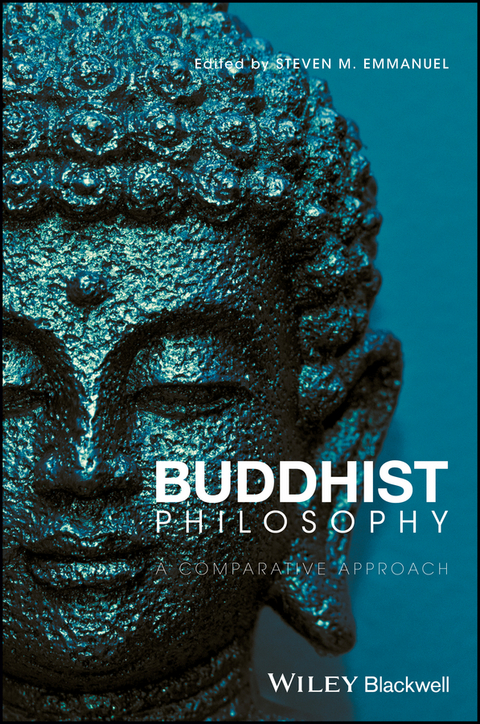
Buddhist Philosophy (eBook)
John Wiley & Sons (Verlag)
978-1-119-06825-9 (ISBN)
Buddhist Philosophy: A Comparative Approach presents a series of readings that examine the prominent thinkers and texts of the Buddhist tradition in the round, introducing contemporary readers to major theories and debates at the intersection of Buddhist and Western thought.
- Takes a comparative, rather than oppositional, approach to Buddhist philosophy, exploring key theories and debates at the intersection of Eastern and Western thought
- Addresses a variety of topics that represent important points of convergence between the Buddhist and Western philosophical traditions
- Features contributions from a wide array of acclaimed international scholars in the discipline
- Provides a much-needed cross-cultural treatment of Buddhist philosophy appropriate for undergraduate students and specialists alike
STEVEN M. EMMANUEL is Professor of Philosophy at Virginia Wesleyan College, USA. He is the author of Kierkegaard and the Concept of Revelation (1995) and editor of A Companion to Buddhist Philosophy (Wiley Blackwell, 2013), The Blackwell Guide to the Modern Philosophers: From Descartes to Nietzsche (Wiley Blackwell, 2001), and Modern Philosophy: An Anthology (2002).
Buddhist Philosophy: A Comparative Approach presents a series of readings that examine the prominent thinkers and texts of the Buddhist tradition in the round, introducing contemporary readers to major theories and debates at the intersection of Buddhist and Western thought. Takes a comparative, rather than oppositional, approach to Buddhist philosophy, exploring key theories and debates at the intersection of Eastern and Western thought Addresses a variety of topics that represent important points of convergence between the Buddhist and Western philosophical traditions Features contributions from a wide array of acclaimed international scholars in the discipline Provides a much-needed cross-cultural treatment of Buddhist philosophy appropriate for undergraduate students and specialists alike
STEVEN M. EMMANUEL is Professor of Philosophy at Virginia Wesleyan College, USA. He is the author of Kierkegaard and the Concept of Revelation (1995) and editor of A Companion to Buddhist Philosophy (Wiley Blackwell, 2013), The Blackwell Guide to the Modern Philosophers: From Descartes to Nietzsche (Wiley Blackwell, 2001), and Modern Philosophy: An Anthology (2002).
Title Page 5
Copyright Page 6
Contents 7
Notes on Contributors 9
Acknowledgments 13
Abbreviations 15
Editor’s Introduction 17
Chapter 1 Buddhist Philosophy as a Way of Life: The Spiritual Exercises of Tsongkhapa 27
Hadot on Philosophy as a Way of Life 28
Tsongkhapa on Philosophy as a Way of Life 32
Convergences and Divergences 39
Notes 42
References 43
Chapter 2 The Other Side of Realism: Panpsychism and Yog?c?ra 45
Buddhism and Panpsychism 46
Subjective and Absolute Idealisms in Yog?c?ra 51
Conclusion 55
Notes 55
References 57
Chapter 3 Emergentist Naturalism in Early Buddhism and Deweyan Pragmatism 61
A Middle Way Between Dualism and Reductive Physicalism 61
Comparing Deweyan Pragmatism and Early Buddhism 63
Defining Emergentist Naturalism 64
A Metaphysics of Causality and Emergent Levels of Reality 65
The Principle of Continuity and Biological Emergence 67
The Human Person: The Emergence of Mind and Consciousness 69
Karma and Moral Agency in Emergentist Naturalism 72
Emergentist Naturalism and Religious Meaning 74
Notes 77
References 77
Chapter 4 Metaphysical Dependence, East and West 79
Introduction 79
A Taxonomy 80
Properties of Dependence Relations 80
The Taxonomy 81
Discussion 81
Metaphysical Dependence in the Buddhist Traditions 83
Orientation 83
Well-Founded Buddhism 84
Non-Well-Founded Buddhism 86
Buddhist Coherentism 87
Metaphysical Dependence in Western Traditions 89
The General Picture 89
Some Historical Views I: Aristotle 90
Some Historical Views II: Leibniz 92
Contemporary Orthodoxy 93
Challenges to Contemporary Orthodoxy 94
The Fruits of Dialogue 96
Conclusion 97
Notes 97
References 99
Chapter 5 Metaphysics and Metametaphysics with Buddhism: The Lay of the Land 103
Buddhist Metaphysical Argumentation: Unqualified and Qualified 103
The Majority View: Metaphysics is Both Legitimate and Necessary 106
A More Promising Metametaphysical Stance: Quietism 110
Qualified Argumentation and Quietism 112
Remaining Matters 115
Notes 116
References 120
Chapter 6 Are Reasons Causally Relevant for Action? Dharmak?rti and the Embodied Cognition Paradigm 125
Causality, Intentionality, and Mental Content 125
Cognition and Pragmatic Efficacy 128
A Theoretical Model for Causal Inference 132
Conclusion 135
Notes 135
References 136
Chapter 7 Zen’s Nonegocentric Perspectivism 139
The Ambivalence of Nietzsche’s Perspectivism 140
Does a Buddha have (Perspectival) Omniscience? 142
Huayan’s Jewel Net of Indra and Leibniz’s Monadology 144
Fazang’s Principal and Satellites, Linji’s Host and Guests 146
Alberti’s Egocentric and Guo Xi’s Floating Perspectivism 147
Cusanus’ Infinite Sphere Whose Center is Everywhere 149
Ecstatic Empathy, Kenotic Compassion 150
The Multiverse of Perspectival Events of Interconnection 152
Nishitani on the Mutual Circulation of Host and Guest 154
Notes 155
Chapter 8 Rhetoric of Uncertainty in Zen Buddhism and Western Literary Modernism 161
Uncertainty as a Model of Self?Realization 161
Evaluative Method of K?an Commentary 164
Song Dynasty Resonances with Modernism 170
Uncertain of Uncertainty 175
Notes 177
Chapter 9 From the Five Aggregates to Phenomenal Consciousness: Toward a Cross-Cultural Cognitive Science 181
The Meaning of Mindfulness 182
A Buddhist Model of the Mind 187
Attention and Consciousness 192
Conclusion 196
Notes 198
References 198
Chapter 10 Embodying Change: Buddhism and Feminist Philosophy 205
Women’s Bodies in Buddhism: A Brief Overview 206
D?gen’s Feminism 209
Nondualism 212
Revalorizing the Maternal Body 213
Notes 218
References 218
Chapter 11 Buddhist Modernism and Kant on Enlightenment 221
What is Buddhist Modernism? 222
What is Enlightenment? 227
The Kantian vs. Scottish Enlightenment 231
Conclusion 234
Note 235
References 235
Chapter 12 Compassion and Rebirth: Some Ethical Implications 237
Buddhism as a Salad Bar 237
Rebirth in the P?li Canon 238
Very Hidden Phenomena 240
Ethical Behavior and Its Consequences 242
The Practice of Compassion 244
Jay Garfield: Team Buddha 246
Conclusions 251
References 253
Further Reading 255
Index 259
EULA 280
| Erscheint lt. Verlag | 19.5.2017 |
|---|---|
| Sprache | englisch |
| Themenwelt | Geisteswissenschaften ► Philosophie ► Allgemeines / Lexika |
| Geisteswissenschaften ► Philosophie ► Geschichte der Philosophie | |
| Geisteswissenschaften ► Philosophie ► Philosophie der Neuzeit | |
| Geisteswissenschaften ► Religion / Theologie ► Buddhismus | |
| Geisteswissenschaften ► Religion / Theologie ► Judentum | |
| Schlagworte | Buddhism • Buddhismus • Buddhist • Buddhist philosophy • Comparative Philosophy • Eastern philosophy • idealism • Moral judgment • Naturalism • Perspectivism • Philosophie • Philosophy • Philosophy of Religion • Physicalism • Realism • Religion & Theology • Religionsphilosophie • Religion u. Theologie • Weltphilosophie • World philosophy |
| ISBN-10 | 1-119-06825-8 / 1119068258 |
| ISBN-13 | 978-1-119-06825-9 / 9781119068259 |
| Informationen gemäß Produktsicherheitsverordnung (GPSR) | |
| Haben Sie eine Frage zum Produkt? |
 PDF (Adobe DRM)
Kopierschutz: Adobe-DRM
Adobe-DRM ist ein Kopierschutz, der das eBook vor Mißbrauch schützen soll. Dabei wird das eBook bereits beim Download auf Ihre persönliche Adobe-ID autorisiert. Lesen können Sie das eBook dann nur auf den Geräten, welche ebenfalls auf Ihre Adobe-ID registriert sind.
Details zum Adobe-DRM
Dateiformat: PDF (Portable Document Format)
Mit einem festen Seitenlayout eignet sich die PDF besonders für Fachbücher mit Spalten, Tabellen und Abbildungen. Eine PDF kann auf fast allen Geräten angezeigt werden, ist aber für kleine Displays (Smartphone, eReader) nur eingeschränkt geeignet.
Systemvoraussetzungen:
PC/Mac: Mit einem PC oder Mac können Sie dieses eBook lesen. Sie benötigen eine
eReader: Dieses eBook kann mit (fast) allen eBook-Readern gelesen werden. Mit dem amazon-Kindle ist es aber nicht kompatibel.
Smartphone/Tablet: Egal ob Apple oder Android, dieses eBook können Sie lesen. Sie benötigen eine
Geräteliste und zusätzliche Hinweise
Buying eBooks from abroad
For tax law reasons we can sell eBooks just within Germany and Switzerland. Regrettably we cannot fulfill eBook-orders from other countries.
aus dem Bereich