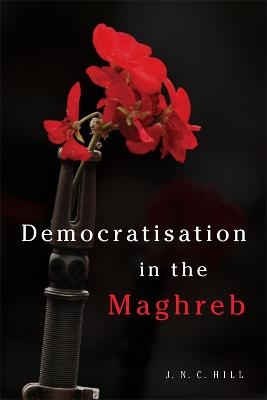
Democratisation in the Maghreb
Edinburgh University Press (Verlag)
9781474432153 (ISBN)
The past few years have been a period of unprecedented political upheaval for the Maghreb. A protest which began in a provincial city in one of North Africa’s quieter corners quickly engulfed the entire region. Presidents of decades standing were swept from office on waves of public discontent while their counterparts elsewhere nervously tried to calm the mob. In several places these protests are still being played out; in the law courts of Egypt, on the battlefields of Libya, and in the leaking tubs carrying migrants to Europe. And even where the winds of change have died down, the political and social landscape is altered from before.
Herein lies a defining paradox of the Arab Spring; its ubiquity and singularity. Nearly all of the region’s countries have been affected. But despite making similar demands in largely the same ways over much the same period, their respective protest movements have achieved different results. Drawing on Steven Levitsky and Lucan Way’s celebrated model for examining political transitions, this book explains these discrepancies, why Tunisia, Algeria, Morocco and Mauritania have reached different outcomes. It does so by contextualising each country’s experiences, by examining and comparing their political development over the past decade.
J.N.C Hill is Reader in Postcolonialism and the Maghreb in the Defence Studies Department at King’s College London. He is also an Associate Member of the Institute of Middle Eastern Studies at King’s College London and a Visiting Fellow of the Middle East Centre at the London School of Economics and Political Science. He is a member of the Board of Advisory Editors for the Middle East Journal and a Fellow of the British Society for Middle Eastern Studies. He is author of Nigeria since Independence: Forever Fragile? (2012) and Identity in Algerian Politics: The Legacy of Colonial Rule (2009).
Acknowledgements; Abbreviations; Introduction; 1. Levitsky and Way and Competitive Authoritarianism; Leverage, Linkage and Organisational Power: An Overview; Leverage; Linkage; Organisational Power; Conclusions; 2. Tunisia; Linkage;Leverage; Organisational Power; Origins and Evolution of the Regime; Conclusions; 3. Algeria; Linkage; Leverage; Organisational Power; Origins and Evolution of the Regime; Conclusions; 4. Morocco; Linkage; Leverage; Organisational Power; Origins and Evolution of the Regime; Conclusions; 5. Mauritania; Linkage; Leverage; Organisational Power; Origins and Evolution of the Regime; Conclusions; Conclusions; Index.
| Erscheinungsdatum | 08.01.2018 |
|---|---|
| Verlagsort | Edinburgh |
| Sprache | englisch |
| Maße | 156 x 234 mm |
| Gewicht | 364 g |
| Themenwelt | Geisteswissenschaften ► Religion / Theologie ► Islam |
| Sozialwissenschaften ► Politik / Verwaltung ► Europäische / Internationale Politik | |
| Sozialwissenschaften ► Politik / Verwaltung ► Politische Systeme | |
| Sozialwissenschaften ► Politik / Verwaltung ► Politische Theorie | |
| Sozialwissenschaften ► Politik / Verwaltung ► Vergleichende Politikwissenschaften | |
| ISBN-13 | 9781474432153 / 9781474432153 |
| Zustand | Neuware |
| Informationen gemäß Produktsicherheitsverordnung (GPSR) | |
| Haben Sie eine Frage zum Produkt? |
aus dem Bereich