


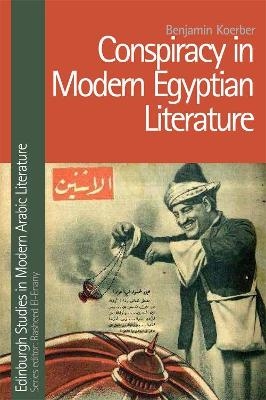
Conspiracy in Modern Egyptian Literature
Seiten
2018
Edinburgh University Press (Verlag)
9781474417440 (ISBN)
Edinburgh University Press (Verlag)
9781474417440 (ISBN)
This book examines the diverse uses of conspiracy theory in Egyptian fiction since the early twentieth century. Read against the historical and intertextual backgrounds of individual authors and their works, conspiracy theory emerges not as a single, rigid ideology, but as a style of writing that is equal parts literary and political.
Conspiracy theory in the Arab World has come to be associated with the rhetoric of Islamist extremists and authoritarian regimes. Yet its principle tropes – omnipotent secret societies, impending apocalypse, heroes who crack codes – have recurred in Arabic literature as well. A number of Egyptian authors, including Ali Ahmad Bakathir, Naguib Surur, Sonallah Ibrahim, Gamal al-Ghitani, and Youssef Rakha have crafted potent narratives of conspiracy that have remained unexamined until now.
In a series of case studies, this book examines the diverse uses of conspiracy theory in Egyptian fiction since the early twentieth century. Read against the historical and intertextual backgrounds of individual authors and their works, conspiracy theory emerges not as a single, rigid ideology, but as a style of writing that is equal parts literary and political.
Conspiracy theory in the Arab World has come to be associated with the rhetoric of Islamist extremists and authoritarian regimes. Yet its principle tropes – omnipotent secret societies, impending apocalypse, heroes who crack codes – have recurred in Arabic literature as well. A number of Egyptian authors, including Ali Ahmad Bakathir, Naguib Surur, Sonallah Ibrahim, Gamal al-Ghitani, and Youssef Rakha have crafted potent narratives of conspiracy that have remained unexamined until now.
In a series of case studies, this book examines the diverse uses of conspiracy theory in Egyptian fiction since the early twentieth century. Read against the historical and intertextual backgrounds of individual authors and their works, conspiracy theory emerges not as a single, rigid ideology, but as a style of writing that is equal parts literary and political.
Benjamin Koerber is Assistant Professor of Arabic language and literature in the Department of African, Middle Eastern, and South Asian Languages and Literatures at Rutgers University.
Note on Transliteration and TranslationAcknowledgementsIntroduction Chapter 1: Dramaturgies of Conspiracy: Bakathir, Idris, and the July RegimeChapter 2: Naguib Surur: The Poetics and Politics of NiyākaChapter 3: Sonallah Ibrahim’s al-Lajna: Between Critical Theory and Conspiracy Theory Chapter 4: Gamal al-Ghitani’s Ḥikāyāt al-Khabīʾa: The Fitna of Sexual DevianceChapter 5: Paranoia in the Second Degree: Three Recent NovelsEpilogueAppendixNotesBibliographyIndex
| Erscheinungsdatum | 13.06.2018 |
|---|---|
| Reihe/Serie | Edinburgh Studies in Modern Arabic Literature |
| Verlagsort | Edinburgh |
| Sprache | englisch |
| Maße | 156 x 234 mm |
| Gewicht | 525 g |
| Themenwelt | Literatur |
| Geisteswissenschaften ► Geschichte ► Regional- / Ländergeschichte | |
| Geisteswissenschaften ► Religion / Theologie ► Islam | |
| Geisteswissenschaften ► Sprach- / Literaturwissenschaft ► Anglistik / Amerikanistik | |
| Geisteswissenschaften ► Sprach- / Literaturwissenschaft ► Literaturwissenschaft | |
| ISBN-13 | 9781474417440 / 9781474417440 |
| Zustand | Neuware |
| Informationen gemäß Produktsicherheitsverordnung (GPSR) | |
| Haben Sie eine Frage zum Produkt? |
Mehr entdecken
aus dem Bereich


aus dem Bereich
die Geschichte meiner Urgroßmutter
Buch | Hardcover (2025)
C.H.Beck (Verlag)
CHF 32,15
Träume und Macht : eine Biografie
Buch | Hardcover (2025)
C.H.Beck (Verlag)
CHF 61,60


