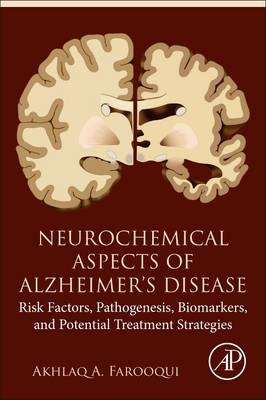
Neurochemical Aspects of Alzheimer's Disease (eBook)
414 Seiten
Elsevier Science (Verlag)
978-0-12-809938-4 (ISBN)
Akhlaq A. Farooqui is a leader in the field of signal transduction processes, lipid mediators, phospholipases, glutamate neurotoxicity, and neurological disorders. He is a research scientist in the Department of Molecular and Cellular Biochemistry at The Ohio State University. He has published cutting edge research on the role of phospholipases A2 in signal transduction processes, generation and identification of lipid mediators during neurodegeneration by lipidomics. He has studied the involvement of glycerophospholipid, sphingolipid-, and cholesterol-derived lipid mediators in kainic acid neurotoxicity, an experimental model of neurodegenerative diseases. Akhlaq A. Farooqui has discovered the stimulation of plasmalogen- selective phospholipase A2 in brains of patients with Alzheimer disease (AD). Stimulation of this enzyme may not only be responsible for the deficiency of plasmalogens in neural membranes of AD patients, but also be related to the loss of synapse in the AD.
Neurochemical Aspects of Alzheimer's Disease provides a comprehensive overview of molecular aspects of risk factors, pathogenesis, biomarkers, and therapeutic strategies. The book focuses on molecular mechanisms and signal transduction processes associated with the pathogenesis, biomarkers, and therapeutic strategies of AD. The comprehensive and cutting edge information in this monograph may not only help in early detection of AD, but also promote discovery of new drugs to treat this chronic disease. Chapters discuss involvement of neural membrane phospholipids, sphingolipids, and cholesterol-derived lipid mediators, abnormal APP processing, and nucleic acid damage, risk factors, biomarker, and therapeutic strategies of Alzheimer's disease. This book is written for neurologists, neuroscientists, neurochemists, neuropharmacologists, and clinicianswho are interested in molecular mechanisms associated with the pathogenesis of age-related neurological disorders. - Provides a comprehensive overview of molecular aspects of risk factors, pathogenesis, biomarkers, and therapeutic strategies for Alzheimer's disease- Written for researchers, clinicians, and advanced graduate students in neurology, neuroscience, neurochemistry, and neuropharmacology- Acts as the first book to provide a comprehensive description of the signal transduction processes associated with pathogenesis of Alzheimer's disease
| Erscheint lt. Verlag | 25.5.2017 |
|---|---|
| Sprache | englisch |
| Themenwelt | Geisteswissenschaften ► Psychologie ► Allgemeine Psychologie |
| Geisteswissenschaften ► Psychologie ► Verhaltenstherapie | |
| Medizin / Pharmazie ► Medizinische Fachgebiete ► Neurologie | |
| Naturwissenschaften ► Biologie ► Humanbiologie | |
| Naturwissenschaften ► Biologie ► Zoologie | |
| ISBN-10 | 0-12-809938-0 / 0128099380 |
| ISBN-13 | 978-0-12-809938-4 / 9780128099384 |
| Informationen gemäß Produktsicherheitsverordnung (GPSR) | |
| Haben Sie eine Frage zum Produkt? |
 EPUB (Adobe DRM)
Kopierschutz: Adobe-DRM
Adobe-DRM ist ein Kopierschutz, der das eBook vor Mißbrauch schützen soll. Dabei wird das eBook bereits beim Download auf Ihre persönliche Adobe-ID autorisiert. Lesen können Sie das eBook dann nur auf den Geräten, welche ebenfalls auf Ihre Adobe-ID registriert sind.
Details zum Adobe-DRM
Dateiformat: EPUB (Electronic Publication)
EPUB ist ein offener Standard für eBooks und eignet sich besonders zur Darstellung von Belletristik und Sachbüchern. Der Fließtext wird dynamisch an die Display- und Schriftgröße angepasst. Auch für mobile Lesegeräte ist EPUB daher gut geeignet.
Systemvoraussetzungen:
PC/Mac: Mit einem PC oder Mac können Sie dieses eBook lesen. Sie benötigen eine
eReader: Dieses eBook kann mit (fast) allen eBook-Readern gelesen werden. Mit dem amazon-Kindle ist es aber nicht kompatibel.
Smartphone/Tablet: Egal ob Apple oder Android, dieses eBook können Sie lesen. Sie benötigen eine
Geräteliste und zusätzliche Hinweise
Buying eBooks from abroad
For tax law reasons we can sell eBooks just within Germany and Switzerland. Regrettably we cannot fulfill eBook-orders from other countries.
aus dem Bereich