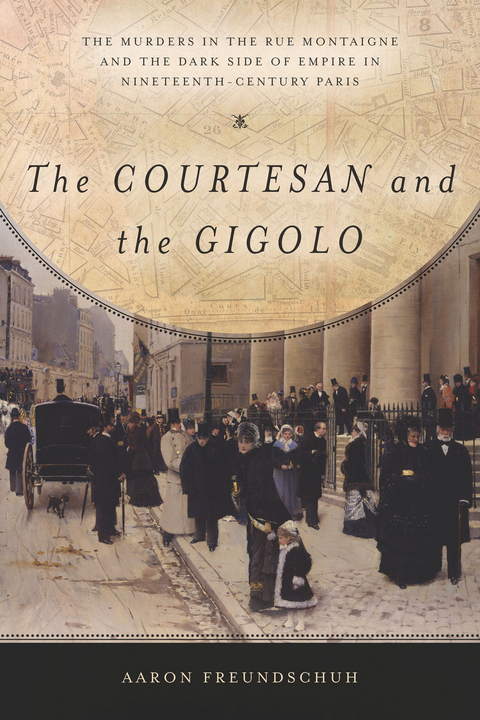
Courtesan and the Gigolo (eBook)
272 Seiten
Stanford University Press (Verlag)
978-1-5036-0097-3 (ISBN)
Aaron Freundschuh is Assistant Professor of History at Queens College, City University of New York.
Contents and Abstracts1Elite Cosmopolitanism and Gentrification in Western Paris chapter abstractThis chapter traces the historical geography of western and west-central Paris in the eighteenth and nineteenth centuries, with particular attention to the neighborhood near the lower Champs-Elysées and the Rue Montaigne, site of the horrific triple homicide that is the book's main focus. The chapter introduces themes pertaining to spatial divisions of modern Paris, highlighting the process of gentrification and the embedding of cosmopolitan and bourgeois social elements in the area. The Paris of Napoleon III and Baron Haussmann reinforced the very fantasies of social-spatial purity that the Pranzini arrest would upend.2The Crime Scene chapter abstractThis chapter tightens the narrative focus around the March 1887 date of the murders and visits the crime scene. The chapter introduces important early investigative findings, as well as the central investigators in the case: the crime reporter Georges Grison, Chief of Security Taylor, Deputy-Chief Goron, the magistrate Adolphe Guillot, and Dr. Paul Brouardel, the renowned forensics doctor and anatomist. The investigative rivalries among these men constitute a narrative arc running through the book. The Pranzini case was considered vital to attempts on the part of the police to fix its tattered reputation as it attempted to "professionalize" in the 1880s and 1890s.3A Reporter's Ambition: Georges Grison and the Rise of Investigative Crime Reporting in Paris chapter abstractThis chapter constitutes the first historical treatment of an important figure in the rise of investigative reporting in Paris: Georges Grison. For decades a fixture at Parisian crime scenes, Grison toiled as a lowly crime reporter of the fait-divers newspaper genre. The argument is that Grison—a deft professional networker, scandal-monger and controversial press advocate who published under the pen name Jean de Paris—pioneered new journalistic techniques as part of an ethos of investigation that appealed to readers of the mass press. Working under the protection of press freedoms guaranteed by the Third Republic and seeing in this case a unique opportunity, Grison used this case to challenge the limits of printable news and the role of the press in investigating crime.4The Courtesan's Objects: Sexual Danger and the High Life of the Demimonde chapter abstractThis chapter retraces the public fascination with, and the police investigation of, Marie Regnault's early life, as well as her rise in the demimonde. How was the life of a courtesan measured by Regnault's contemporaries? Did her murder constitute a mournful public tragedy? Regnault's murder is situated alongside other unsolved cases involving demimondaines going back to 1879. A novel angle on the strategies of the demimonde is in evidence in the so-called "secret archives" of the Vice Squad—a powerful investigative division overseen by Taylor and Goron—as well as in the material history of sex work that unfolded in Paris's most prestigious auction house, the Hôtel Drouot, where Regnault's own belongings were sold one year after her murder.5Colonial Picaresque: The Trans-Mediterranean Investigation of a Migrant chapter abstractThis chapter pieces together the Rue Montaigne investigation's eastward movements through diplomatic, military, and political sources. The French diplomatic corps's pursuit of Pranzini's past—ostensibly undertaken to determine his prior criminal activity and his whereabouts going back to 1879—produced a wealth of data relative to Pranzini's family history, which is here contextualized within the broader historical trend of European colonial migration and settlement in the East during the nineteenth century. In Alexandria, a magnet for southern European colonial settlers, social hierarchies and racial tensions helped transform the exonym "Levantine" into a pejorative—a category that Pranzini, a product of the French empire in important respects, was coming simultaneously to embody in Paris.6Criminal Detection as Colonial War by other Means: Investigative Claims on the Latin-American Rastaquouère chapter abstractThis chapter proceeds along two parallel tracks while carrying the case narrative forward to the interrogation phase. In order to understand how the Pranzini case impacted the investigative imagination in Paris, the chapter picks up Chapter One's discussion of the stakes of the investigation for Security, arguing that this case was an important moment in the agency's history. This was because Deputy Chief, a veteran of colonial settlement and war, saw in the investigation's colonial dimension an opportunity to valorize the colonial experience and culture that were a source of pride within Security's ranks. Pranzini, meanwhile, was held up as an example of a "rastaquouère," a racialized colonial category that evoked European settlement in South America, unwanted social backwash, and forms of criminality such as sex trafficking.7The Trial of a Gigolo: Intimacy, Foreignness, and the Boulangist Crisis chapter abstractThe Pranzini was an extraordinarily rowdy event, replete with outbursts of laughter that are the subject of this chapter's inquiry. Linking the trial to the rise of General Georges Boulanger and the early coalescence of right-wing factions into a movement known to historians as the "New Right," the chapter argues that Pranzini—as a foreigner coded as an infiltrator and sexual threat—became a convenient target for modern French political xenophobia. As a gigolo, Pranzini was typed as risible, effeminate, and recognizable on the butte of Montmartre; at the same time, he infused that social type with hints of the exotic that could appeal to independent-minded Parisian women.8The Skin Affair: Punishment and the Colonial Body chapter abstractChapter Eight recounts the grotesque aftermath of Pranzini's guilty verdict. Georges Grison's revelation that Taylor, Goron, and one of their underlings were each in possession of souvenirs fashioned from the post-cranial cadaver of Enrico Pranzini set off a chain of events that led to the stunning fall of Jules Grévy. More than a sensational anecdote, the so-called "Skin Affair" nourished debates about the procedures surrounding the death penalty, the punishment of the colonial body, and the right of death-row convicts to exempt their cadavers from posthumous medical research.Conclusion: On Imperial Insecurity chapter abstractThe Conclusion revisits the notion that for Parisians in the 1880s, the political themes of criminality and colonial empire were intimately tied. The Pranzini case took social theorists like Gabriel Tarde aback. At the same time, other unwanted reverberations from overseas dealt fatal blows to the careers of pro-colonial politicians like Ferry. Empire's promise of security and stability was left most wanting as it pertained to discourses on crime. In the months following the Pranzini Affair, Enrico Pranzini's name officially entered the French parliamentary record. Xenophobic politicians cited his example in their re-framing of immigration as an imperial question; they cited his example, and the press coverage of the case, as justifications for a stricter regime of immigrant control—one that would endure for generations.
| Erscheint lt. Verlag | 11.1.2017 |
|---|---|
| Sprache | englisch |
| Themenwelt | Literatur ► Biografien / Erfahrungsberichte |
| Literatur ► Romane / Erzählungen | |
| Geschichte ► Allgemeine Geschichte ► Neuzeit (bis 1918) | |
| Geisteswissenschaften ► Geschichte ► Regional- / Ländergeschichte | |
| Geschichte ► Teilgebiete der Geschichte ► Kulturgeschichte | |
| Schlagworte | Cosmopolitanism • Crime • Empire • France • Immigration • Journalism • Murder • Police • Sexuality • Xenophobia |
| ISBN-10 | 1-5036-0097-1 / 1503600971 |
| ISBN-13 | 978-1-5036-0097-3 / 9781503600973 |
| Informationen gemäß Produktsicherheitsverordnung (GPSR) | |
| Haben Sie eine Frage zum Produkt? |
 EPUB (Adobe DRM)
Kopierschutz: Adobe-DRM
Adobe-DRM ist ein Kopierschutz, der das eBook vor Mißbrauch schützen soll. Dabei wird das eBook bereits beim Download auf Ihre persönliche Adobe-ID autorisiert. Lesen können Sie das eBook dann nur auf den Geräten, welche ebenfalls auf Ihre Adobe-ID registriert sind.
Details zum Adobe-DRM
Dateiformat: EPUB (Electronic Publication)
EPUB ist ein offener Standard für eBooks und eignet sich besonders zur Darstellung von Belletristik und Sachbüchern. Der Fließtext wird dynamisch an die Display- und Schriftgröße angepasst. Auch für mobile Lesegeräte ist EPUB daher gut geeignet.
Systemvoraussetzungen:
PC/Mac: Mit einem PC oder Mac können Sie dieses eBook lesen. Sie benötigen eine
eReader: Dieses eBook kann mit (fast) allen eBook-Readern gelesen werden. Mit dem amazon-Kindle ist es aber nicht kompatibel.
Smartphone/Tablet: Egal ob Apple oder Android, dieses eBook können Sie lesen. Sie benötigen eine
Geräteliste und zusätzliche Hinweise
Buying eBooks from abroad
For tax law reasons we can sell eBooks just within Germany and Switzerland. Regrettably we cannot fulfill eBook-orders from other countries.
aus dem Bereich