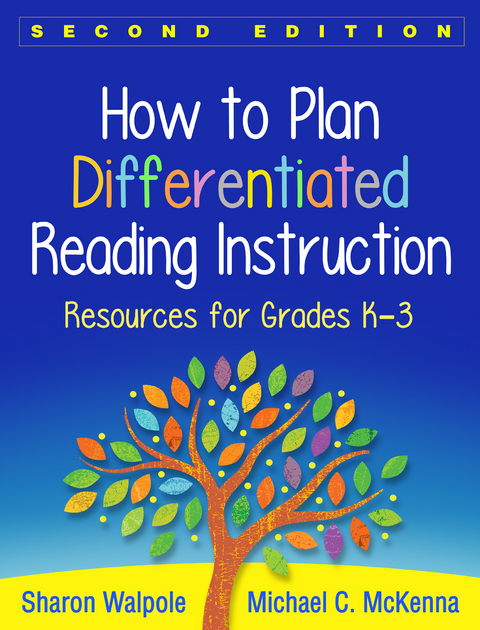
How to Plan Differentiated Reading Instruction, Second Edition (eBook)
284 Seiten
Guilford Publications (Verlag)
978-1-4625-3153-0 (ISBN)
Sharon Walpole, PhD, is Professor in the School of Education at the University of Delaware. She has extensive school-based experience designing and implementing tiered instructional programs. Dr. Walpole has also been involved in federally funded and other schoolwide reform projects. Her current work involves the design and effects of schoolwide reforms. She has coauthored or coedited several books, including How to Plan Differentiated Reading Instruction, Second Edition: Resources for Grades K–3; The Literacy Coach’s Handbook, Second Edition; and Organizing the Early Literacy Classroom. Dr. Walpole is also Series Editor, with Michael C. McKenna, of The Essential Library of PreK–2 Literacy. She is a recipient of the Early Career Award for Significant Contributions to Literacy Research and Education from the Literacy Research Association and the Excellence in Teaching Award from the University of Delaware. Michael C. McKenna, PhD, was Thomas G. Jewell Professor of Reading in the Curry School of Education at the University of Virginia until his death in 2016. He authored, coauthored, or edited more than 20 books, including Assessment for Reading Instruction, Third Edition; How to Plan Differentiated Reading Instruction, Second Edition: Resources for Grades K–3; and Organizing the Early Literacy Classroom; as well as over 100 articles, chapters, and technical reports on a range of literacy topics. Dr. McKenna also served as Series Editor, with Sharon Walpole, of The Essential Library of PreK–2 Literacy. His research was sponsored by the National Reading Research Center and the Center for the Improvement of Early Reading Achievement. He was a corecipient of the Edward B. Fry Book Award from the Literacy Research Association and the Award for Outstanding Academic Books from the American Library Association, and a member of the Reading Hall of Fame.
1. Setting the Stage 2. Models of Differentiation and Tiered Instruction 3. Using Assessments to Guide Differentiation 4. Targeting Phonological Awareness and Word Recognition 5. Targeting Word Recognition and Fluency 6. Targeting Fluency and Comprehension 7. Targeting Vocabulary and Comprehension 8. Making Differentiation Schoolwide
| Erscheint lt. Verlag | 16.5.2017 |
|---|---|
| Sprache | englisch |
| Maße | 200 x 200 mm |
| Themenwelt | Schulbuch / Wörterbuch ► Erwachsenenbildung |
| Geisteswissenschaften ► Sprach- / Literaturwissenschaft ► Sprachwissenschaft | |
| Sozialwissenschaften ► Pädagogik ► Schulpädagogik / Grundschule | |
| Sozialwissenschaften ► Pädagogik ► Vorschulpädagogik | |
| ISBN-10 | 1-4625-3153-9 / 1462531539 |
| ISBN-13 | 978-1-4625-3153-0 / 9781462531530 |
| Informationen gemäß Produktsicherheitsverordnung (GPSR) | |
| Haben Sie eine Frage zum Produkt? |
 PDF (Adobe DRM)
Kopierschutz: Adobe-DRM
Adobe-DRM ist ein Kopierschutz, der das eBook vor Mißbrauch schützen soll. Dabei wird das eBook bereits beim Download auf Ihre persönliche Adobe-ID autorisiert. Lesen können Sie das eBook dann nur auf den Geräten, welche ebenfalls auf Ihre Adobe-ID registriert sind.
Details zum Adobe-DRM
Dateiformat: PDF (Portable Document Format)
Mit einem festen Seitenlayout eignet sich die PDF besonders für Fachbücher mit Spalten, Tabellen und Abbildungen. Eine PDF kann auf fast allen Geräten angezeigt werden, ist aber für kleine Displays (Smartphone, eReader) nur eingeschränkt geeignet.
Systemvoraussetzungen:
PC/Mac: Mit einem PC oder Mac können Sie dieses eBook lesen. Sie benötigen eine
eReader: Dieses eBook kann mit (fast) allen eBook-Readern gelesen werden. Mit dem amazon-Kindle ist es aber nicht kompatibel.
Smartphone/Tablet: Egal ob Apple oder Android, dieses eBook können Sie lesen. Sie benötigen eine
Geräteliste und zusätzliche Hinweise
Buying eBooks from abroad
For tax law reasons we can sell eBooks just within Germany and Switzerland. Regrettably we cannot fulfill eBook-orders from other countries.
aus dem Bereich