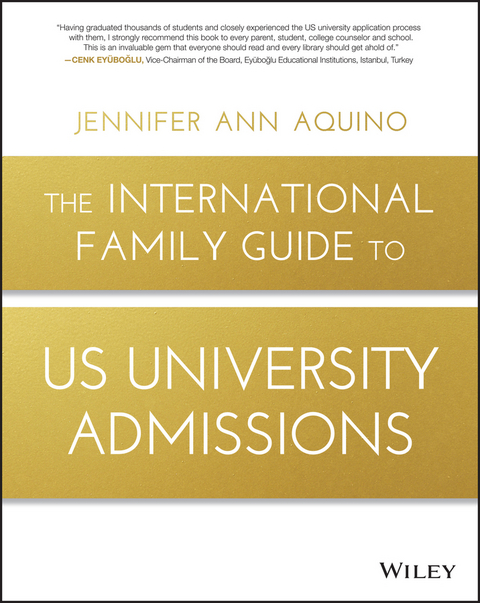
The International Family Guide to US University Admissions (eBook)
John Wiley & Sons (Verlag)
978-1-119-37097-0 (ISBN)
Written by an experienced international educator and counselor, The International Family Guide to US University Admissions is an indispensable resource for the vast and increasing number of students applying for places at US Universities each year. Beginning with an introduction that explains to both students and parents how the book works and why, it offers milestones that must be completed during said application time period, a tried-and-true handbook that corresponds with each chapter, pop-outs that provide expert insight and resources that you should utilize throughout the process.
Every year, hundreds of thousands of international students and their families must go through the painstaking, complicated, confusing and culturally baffling process that is US university admissions. Until now, there has been no single resource for readers to turn to for holistic, accurate and up-to-date advice on the subject. Following the timeline of the US university admissions cycle, the book guides the parents and the student through the entire process in order to ensure that they are pacing themselves appropriately - from preparation to submission and through to applying for student visas. It serves as an advisor throughout the process, providing insightful advice by parents and students that are relevant to specific milestones. With the help of this book, you'll discover how to make sense of the US admissions system - from start to finish.
- Understand the application and evaluation process in depth in order to be an informed and successful applicant
- Make your schooling selection from over 3,000 US universities by understanding what would make a good fit for the student
- Learn what is expected of you in writing essays, why it is important, and how to create beautiful, genuine writing pieces reflective of your outlook in life
- Enjoy case studies and words of advice from the author's former students and their families
- Understand the difference between the SAT and ACT exams
Whether you're an international student living outside of the US or an ex-pat living abroad, you'll find answers to all of your questions - all in one place.
JENNIFER ANN AQUINO has over 20 years of experience in the field of international education spanning four continents from teaching, admissions and fundraising to educational publishing and university management. Her deep and varied global experiences in international education have afforded her a unique understanding and perspective of the competitive and ever-changing sector of international education. Born in the US, she has lived and worked in education in Europe, Asia, the Pacific and is based between Geneva and Singapore. Jennifer works with individual families, students, schools and institutions. Her website is www.jenniferannaquino.com.
Winner of the 2018 International Book Awards Education/Academic category! Written by an experienced international educator and counselor, The International Family Guide to US University Admissions is an indispensable resource for the vast and increasing number of students applying for places at US Universities each year. Beginning with an introduction that explains to both students and parents how the book works and why, it offers milestones that must be completed during said application time period, a tried-and-true handbook that corresponds with each chapter, pop-outs that provide expert insight and resources that you should utilize throughout the process. Every year, hundreds of thousands of international students and their families must go through the painstaking, complicated, confusing and culturally baffling process that is US university admissions. Until now, there has been no single resource for readers to turn to for holistic, accurate and up-to-date advice on the subject. Following the timeline of the US university admissions cycle, the book guides the parents and the student through the entire process in order to ensure that they are pacing themselves appropriately from preparation to submission and through to applying for student visas. It serves as an advisor throughout the process, providing insightful advice by parents and students that are relevant to specific milestones. With the help of this book, you'll discover how to make sense of the US admissions system from start to finish. Understand the application and evaluation process in depth in order to be an informed and successful applicant Make your schooling selection from over 3,000 US universities by understanding what would make a good fit for the student Learn what is expected of you in writing essays, why it is important, and how to create beautiful, genuine writing pieces reflective of your outlook in life Enjoy case studies and words of advice from the author's former students and their families Understand the difference between the SAT and ACT exams Whether you're an international student living outside of the US or an ex-pat living abroad, you'll find answers to all of your questions all in one place.
JENNIFER ANN AQUINO has over 20 years of experience in the field of international education spanning four continents from teaching, admissions and fundraising to educational publishing and university management. Her deep and varied global experiences in international education have afforded her a unique understanding and perspective of the competitive and ever-changing sector of international education. Born in the US, she has lived and worked in education in Europe, Asia, the Pacific and is based between Geneva and Singapore. Jennifer works with individual families, students, schools and institutions. Her website is www.jenniferannaquino.com.
Preface ix
Acknowledgments xiii
About the Author xv
Introduction xvii
Chapter 1 And You Are. . .? 1
Chapter 2 You've Got to Understand How It Works to Win 19
Chapter 3 Being Your Nerdiest Self .and Taking Time to Do It 49
Chapter 4 Your Goldilocks Moment 83
Chapter 5 Less Snap-Chatting and More Real-Chatting 107
Chapter 6 School's [Not] Out For Summer! 139
Chapter 7 You Can't Fake It 161
Chapter 8 The Pressure Is On! 175
Chapter 9 The Busiest Month of Your Life 195
Chapter 10 The Final Month of Writing College Applications .Ever? 209
Chapter 11 A Rite of Passage in the Making 223
Chapter 12 Anticipating, Deciding, and Arriving 237
Conclusion: The Beginning of the Rest of Your Life 251
The Writing Handbook 265
References 287
Index 289
Introduction
“Where do I even start?!”
“What are the best engineering schools in the US?”
“We're very interested in Harvard.”
“Will SAT scores matter most?”
“If I arrange my son's interviews with the universities will that be OK? He's got so much work on his plate.”
“I will only pay for my daughter's education in the US if she goes to a university that is prestigious.”
“Should my son pick up something less ‘typical’ as a hobby to make him stand out?”
I come from a family of educators: my mom, dad, aunt, uncle, cousins, and even my nieces! We are all educators. I started as a teacher—like my parents—and moved into educational publishing and then into various director roles in universities in the US and Europe. I've also worked and lived on four continents, and all whilst working in the field of international education. I believe I do have something to share.
Working exclusively with international families to guide them through the admissions process, my passion lies in imparting the truth in education and building the individual confidence of my students and families—and this comes from experience and knowledge. All too often, families come to me asking for black-and-white answers. What they do not know is that within this process are the answers to the questions they don't know yet, and will not know until they go through it correctly. There's no online-matchmaker equivalent to US university admissions. Why? Because there is no logarithm that allows applicants to find their fit and present themselves uniquely based on their educated understanding of why they are a fit for their chosen universities. Instead, this process requires every applicant to reach inside themselves and figure out what they need, want, or dream of, will be amazing at doing, and thus what they will succeed in, and then matching all of that to the specific universities that will offer that to them.
Most families come to me with a list of names of universities before we even begin. Early “researching” is great and I commend the student who's already begun. But this happens all too often, creating the situation we have now in society, where elitism in higher education causes students to learn in a one- or two-dimensional environment instead of a multi-dimensional melting pot of education.
The Rules of Enlightenment
In this process, nothing is general: everything works on a case-by-case basis. You thought it would be easy? Consider this process as part of your last two years of high school curriculum. This process should challenge what you think you know about universities and where you want to attend, should challenge you to think about who you are and what you really want, and should challenge you to be bold and brave enough to take a risk at applying to and attending the university that is, deep down, truly the right fit for you—not for your mom, not for your friend, and certainly not for your pride. This is the first opportunity for you to begin to understand yourself, your needs, dreams, strengths, passions and true interests, and to pursue them by finding those universities that will support, challenge and be true to you as an individual.
So, I ask of you—family and student—to commit. Commit to taking months to dedicate to this process. Commit to being true to who you are. Commit to not succumbing to the draw of Ivy League schools, like the H-word.1 Commit to understanding that when you find a fit, you are on the road to finding happiness and success in what you do throughout life. Commit to that freedom of choice. Commit to the awesome opportunity that you have before you.
If you want to do this correctly—and you should, it's a process that takes months of dedication and an open mind—follow these rules as you go through the process. As a rule of thumb, you should commit by reading through this together as a family and initialing each of the following points:
- Each Chapter, each Milestone, each university will be taken case-by-case. Do not generalize anything. (And go ahead and initial here!)
- Don't believe the rankings at face value. If you are going to go by them, commit to understanding exactly how they are done. (Once you start doing this, you'll surely want to forget about them altogether.)
- Question stats. All of them. 10% acceptance rate? Really? Do they take into account applications that were started but never finished/turned in? Average class size of 30? Average of what? Freshman, sophomore, junior and senior classes or just one of these? Average ACT (American College Testing) of 32? Do they consider every single applicant's test scores or is there a special program in place for some accepted students whose scores are not accounted for (and thus improving the university's average)?
- Remember: This process is subjective. You don't think that 20-minute “informal” meeting of the Admissions representative who visited your school didn't make an impression—positive or negative? What about at the height of “reading season” for the Admissions team when they are reading 100 applications per night and yours comes up last. . .on a Friday. . .when the Admissions officer is starting to get a cold and just broke up with his partner who. . .happens to be from your city/country. We're only human, and humans make up this process. So, that leads me to. . .
- Control what you can control—your writing, your grades, your proactivity, your preparation—and let go of what you cannot—who will make the decision on your application, statistics, what your friend is doing, the results.
- Be realistic. Be true to yourself and, if you're a parent, be true to your child.
- Know that there are thousands of universities in the US. There are over 4,000 accredited degree-granting institutions in the US, over 3,000 of which are 4-year degree-granting institutions.2 Each one has its own culture, character, strengths, weaknesses, student profile, professors, facilities, student life, and community. There is a fit for every student. (I remind you here to be realistic and to commit to the process. You won't end up disappointed.)
- Be prepared to tell yourself that you're not ready, that you need a gap year of some kind—PG (“postgraduate”) year, working, volunteering, finding yourself—before you enroll in university. While everyone at this age is going through the same process, not everyone should be. We're all human and go at different speeds. High school doesn't usually account for that.
- Commit to research. This means committing to learning about—in depth and through my guidance—universities that you have never heard of. Most families come to me with about 10 universities they have heard of. There are over 3,000. Do you think those 2,990 other universities are not worthy or not very good? About 98% of the time, I have found, there are other much better fits.
- Parents, as best you can, set your child free in this process. The best way for them to find success—however you quantify success—will be through their happiness. They will be happy doing something they love. I had a father who refused to recognize his son's love of art. He believed that his son was going to be a doctor. Once he let go of this control over his son and let his son move forward through the process, he too realized just what a successful artist his son would be. . .and what a terrible doctor he would have made! Who wants to see a doctor who never wanted to be a doctor? You will not live your child's life after university and yet it's important to stop living it now, before university, giving your child the best opportunity to find their fit, to find true happiness—and success!
- Once you apply, let go. This means you owe it to yourself to do your best up until you submit. It's called “no regrets” and doing your due diligence.
- Be strategic. If you are looking for merit aid, you'll need to research and find those schools that are a fit and that may also be keenly interested in an applicant like you—whether you are an avid stamp-collector, hold passports from two nations that don't tend to have lots of students applying to that university, hold a very strong profile compared to those who generally apply to said institution, and/or have decided to apply to very different universities and thus have a very different “List” to those of your colleagues in your high school or country—merit aid could be in your future. It's a fairly gray process that is determined behind closed doors and is fully subjective, based on the individual university's needs and decisions that very year. You can be strategic about it and we'll discuss that, starting in Chapter 3 of this book and continue throughout.
- Commit to a well-rounded, realistic List. I'll refer to your list of universities as your “List”, sometimes a “Long List” and sometimes a “Short List”, depending on where you are in the process. A realistic List means that you've done your research and know your fit and can defend that. And, that you've created a list of around 10 institutions that range from those that you think you have...
| Erscheint lt. Verlag | 8.5.2017 |
|---|---|
| Sprache | englisch |
| Themenwelt | Sachbuch/Ratgeber ► Gesundheit / Leben / Psychologie ► Familie / Erziehung |
| Geisteswissenschaften | |
| Sozialwissenschaften ► Pädagogik ► Bildungstheorie | |
| Sozialwissenschaften ► Pädagogik ► Didaktik | |
| Sozialwissenschaften ► Pädagogik ► Erwachsenenbildung | |
| Schlagworte | Act • applying to US universities • applying to US university • Bildungswesen • difference between SAT and ACT • Education • Finance & Investments • Finanz- u. Anlagewesen • international guide to US universities • international guide to US university admissions • International Student • International Students • Jennifer Aquino • K-12 • K-12 / Schulpsychologie u. Beratung • SAT • School Psychology & Counseling (K-12) • Studium • The International Family Guide to US University Admissions • US Universities • US university • US university admissions |
| ISBN-10 | 1-119-37097-3 / 1119370973 |
| ISBN-13 | 978-1-119-37097-0 / 9781119370970 |
| Informationen gemäß Produktsicherheitsverordnung (GPSR) | |
| Haben Sie eine Frage zum Produkt? |
 EPUB (Adobe DRM)
Kopierschutz: Adobe-DRM
Adobe-DRM ist ein Kopierschutz, der das eBook vor Mißbrauch schützen soll. Dabei wird das eBook bereits beim Download auf Ihre persönliche Adobe-ID autorisiert. Lesen können Sie das eBook dann nur auf den Geräten, welche ebenfalls auf Ihre Adobe-ID registriert sind.
Details zum Adobe-DRM
Dateiformat: EPUB (Electronic Publication)
EPUB ist ein offener Standard für eBooks und eignet sich besonders zur Darstellung von Belletristik und Sachbüchern. Der Fließtext wird dynamisch an die Display- und Schriftgröße angepasst. Auch für mobile Lesegeräte ist EPUB daher gut geeignet.
Systemvoraussetzungen:
PC/Mac: Mit einem PC oder Mac können Sie dieses eBook lesen. Sie benötigen eine
eReader: Dieses eBook kann mit (fast) allen eBook-Readern gelesen werden. Mit dem amazon-Kindle ist es aber nicht kompatibel.
Smartphone/Tablet: Egal ob Apple oder Android, dieses eBook können Sie lesen. Sie benötigen eine
Geräteliste und zusätzliche Hinweise
Buying eBooks from abroad
For tax law reasons we can sell eBooks just within Germany and Switzerland. Regrettably we cannot fulfill eBook-orders from other countries.
aus dem Bereich