


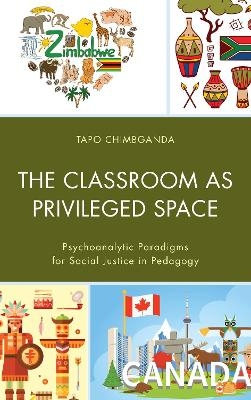
The Classroom as Privileged Space
Psychoanalytic Paradigms for Social Justice in Pedagogy
Seiten
2017
Lexington Books (Verlag)
978-1-4985-1195-7 (ISBN)
Lexington Books (Verlag)
978-1-4985-1195-7 (ISBN)
This book examines the psychic and emotional effects of the dehumanization of children based on discrimination and difference in classrooms. Using psychoanalysis, it highlights the emotional structures that develop in learners through the repeated trauma of racism and homophobia. Recommended for scholars in education, psychoanalysis, and sociology.
The Classroom as Privileged Space: Psychoanalytic Paradigms for Social Justice in Pedagogy examines the psychic and emotional effects of the dehumanization of children based on social discrimination and difference within schooling. Used as a tool to critique the current state of social justice within education, psychoanalysis allows for a focus on the individual within the social context of schooling. It highlights the emotional structures that can develop in children and learners through the oft repeated trauma of racism and homophobia. This book draws from the articulated experiences of three writers and urges the reader to approach the work of the writers and this book as a witness and as one who is enabled to respond through acquiring knowledge and acting on it. Drawing from scholars in psychoanalysis, sociology, and education, Tapo Chimbganda posits that perhaps the “safe space” education has been touting is not what is necessary to cultivate diversity, equity, and inclusion in classrooms. Rather, privilege, re-imagined through psychoanalytic technique, can make possible the elements of social justice that have long frustrated, silenced, and escaped the classroom.
The Classroom as Privileged Space: Psychoanalytic Paradigms for Social Justice in Pedagogy examines the psychic and emotional effects of the dehumanization of children based on social discrimination and difference within schooling. Used as a tool to critique the current state of social justice within education, psychoanalysis allows for a focus on the individual within the social context of schooling. It highlights the emotional structures that can develop in children and learners through the oft repeated trauma of racism and homophobia. This book draws from the articulated experiences of three writers and urges the reader to approach the work of the writers and this book as a witness and as one who is enabled to respond through acquiring knowledge and acting on it. Drawing from scholars in psychoanalysis, sociology, and education, Tapo Chimbganda posits that perhaps the “safe space” education has been touting is not what is necessary to cultivate diversity, equity, and inclusion in classrooms. Rather, privilege, re-imagined through psychoanalytic technique, can make possible the elements of social justice that have long frustrated, silenced, and escaped the classroom.
Tapo Chimbganda is clinical counsellor at the Bramalea Community Health Centre in Canada.
Contents
Introduction
Chapter One: Psychoanalytic Paradigms for Pedagogy
Chapter Two: Why Memoirs?
Chapter Three: Bev Sellars: They Called Me Number One
Chapter Four: Glen Retief: The Jack Bank”
Chapter Five: Mark Mathabane: Kaffir Boy
Chapter Six: Privileged Space: A Psychoanalytic Paradigm for Pedagogy
Conclusion
Bibliography
About the Author
| Erscheinungsdatum | 31.01.2018 |
|---|---|
| Reihe/Serie | Race and Education in the Twenty-First Century |
| Sprache | englisch |
| Maße | 157 x 240 mm |
| Gewicht | 490 g |
| Themenwelt | Geisteswissenschaften ► Psychologie ► Pädagogische Psychologie |
| Sozialwissenschaften ► Pädagogik ► Allgemeines / Lexika | |
| Sozialwissenschaften ► Pädagogik ► Bildungstheorie | |
| ISBN-10 | 1-4985-1195-3 / 1498511953 |
| ISBN-13 | 978-1-4985-1195-7 / 9781498511957 |
| Zustand | Neuware |
| Informationen gemäß Produktsicherheitsverordnung (GPSR) | |
| Haben Sie eine Frage zum Produkt? |
Mehr entdecken
aus dem Bereich

aus dem Bereich
Grundlagen, Diagnostik und Förderung
Buch | Softcover (2023)
Kohlhammer (Verlag)
CHF 39,95


