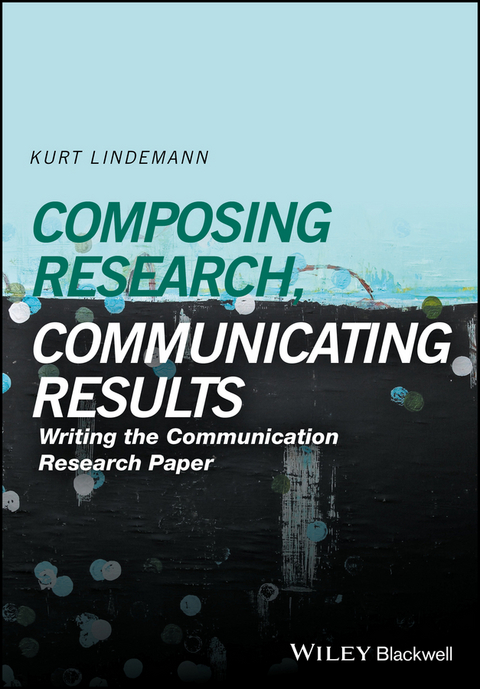
Composing Research, Communicating Results (eBook)
John Wiley & Sons (Verlag)
978-1-118-94093-8 (ISBN)
- The first work of its kind to take students from brainstorming to outlining to sentence and paragraph construction to paper presentation, drawing on student-written examples
- Easy-to-understand explanations of passive voice, point of view, commonly accepted citation styles, and more, with current and relatable student-written examples
- Covers common writing assignments in communication and related courses, including the literature review, application paper, and empirical research paper
- Four pedagogical features enhance comprehension and support learning: 'Write Away' quick exercises, integratable 'Building Blocks' assignments, 'Engaging Ethics' tips, and 'Student Spotlight' examples
Kurt Lindemann is Associate Professor and Director of Graduate Studies in the School of Communication at San Diego State University (SDSU). He also serves as the Director of the Center for the Study of Media and Performance, an interdisciplinary center at SDSU focused on the critical inquiry of live art and screen culture. Dr. Lindemann has taught courses in English composition, communication theory and methods, and more, and has published numerous scholarly and magazine articles, fiction, and poetry.
Composing Research, Communicating Results: Writing the Communication Research Paper provides communication students with the knowledge and necessary tools to compose a variety of course-required papers that are scholarly, accessible, and well-written. The first work of its kind to take students from brainstorming to outlining to sentence and paragraph construction to paper presentation, drawing on student-written examples Easy-to-understand explanations of passive voice, point of view, commonly accepted citation styles, and more, with current and relatable student-written examples Covers common writing assignments in communication and related courses, including the literature review, application paper, and empirical research paper Four pedagogical features enhance comprehension and support learning: Write Away quick exercises, integratable Building Blocks assignments, Engaging Ethics tips, and Student Spotlight examples
Kurt Lindemann is Associate Professor and Director of Graduate Studies in the School of Communication at San Diego State University (SDSU). He also serves as the Director of the Center for the Study of Media and Performance, an interdisciplinary center at SDSU focused on the critical inquiry of live art and screen culture. Dr. Lindemann has taught courses in English composition, communication theory and methods, and more, and has published numerous scholarly and magazine articles, fiction, and poetry.
Title Page 5
Copyright Page 6
Contents 9
Preface 11
Acknowledgments 15
Chapter 1 So You Have to Write a Research Paper … 17
Chapter Learning Outcomes 17
Chapter Features 18
What This Book Is Not … 18
What This Book Is … 19
Features of This Book 19
The Purpose of This Chapter 19
Writing Papers: Chore or Challenge? 20
Challenge: How do I find time to write? 20
Challenge: Is this supposed to be fact or opinion? 22
Challenge: How do I find research on my topic? 23
Challenge: Problems and potential of using published articles as models 23
Debunking Myths about Research Papers 25
The “Tao” of Writing 27
Topic 27
Audience 27
Occasion 27
Types of Papers 28
Reviews of literature 28
Analysis, application, and reaction papers 29
Empirical research papers 29
Thinking Beyond the Paper – Writing for a Professional Career 30
Handbooks and manuals 30
Policy manuals, vision statements, and mission statements 30
E-mails 32
Reports and memos 33
Blogs and website copy 34
Chapter Summary 34
References 35
Further Reading 36
Chapter 2 Brainstorm and Research: Formulating and Answering Questions 37
Chapter Learning Outcomes 37
Chapter Features 38
The Purpose of This Chapter 38
Brainstorming Topics: What Are You Interested In? 38
Idea mapping 39
Freewriting and journaling 42
Other brainstorming techniques 43
Now That You’ve Got Your Topic: Thinking about Your Audience 44
What do they already know? 45
What do they need to know? 46
Asking Questions: What Do You Want Know? 47
Theoretical questions 47
Practical questions 48
Types of research questions 48
Finding Research: Who Knows about This Topic and What Do They Know? 50
Using keyword searches 50
Communication and social science databases 52
Using the Web: Reminders 53
Outlining 54
Chapter Summary 55
References 56
Further Reading 57
Chapter 3 Making Arguments, Providing Support 59
Chapter Learning Outcomes 60
Chapter Features 60
The Purpose of This Chapter 60
Every Paper Is an Argument 60
You have something important to say! 62
Fact or opinion? Both! 62
Every argument needs support 63
The Toulmin Method 64
Making claims 64
Providing backing and evidence for the claim 67
Warrants: Often unstated, always important 74
Common Citation Styles 79
APA 79
MLA 82
Chicago 84
Chapter Summary 86
References 87
Further Reading 88
Chapter 4 Style and Format: How to Say What You Want to Say 89
Chapter Learning Outcomes 89
Chapter Features 90
The Purpose of This Chapter 90
Your Voice, Your Audience 90
To “I” or not to “I”: Should you use the first person in your paper? 91
Second person, second choice: I’m talking to “You” 96
Convention and confusion: When to use the third person in your paper 99
Actively avoiding the passive voice 102
Thesis Sentences 105
Does the Paper “Flow”? What Does That Even Mean? 106
The TESLA Method: Transmitting Ideas Smoothly and Effortlessly 107
Paragraphs 110
Transitions 111
Figures of Speech and Other Stylistic Choices 111
Grammar Reminders 113
Chapter Summary 115
References 115
Chapter 5 Writing the Literature Review: Arguing for Audiences 117
Chapter Learning Outcomes 117
Chapter Features 117
Who Are You Writing For? 118
Academic audiences 119
General readers 119
Taken-for-granted knowledge and new knowledge 120
Engaging a community of scholars 122
Why Do Your Readers Need to Know This? 123
Practical need: Applied understanding 124
Theoretical need: “Filling in the gaps” 125
Organizing the Literature Review 126
Diamond shape: Specific to broad to specific 126
Reverse triangle: Broad to specific 129
Citing Published Work: What Do I Say? 131
Chapter Summary 132
References 132
Chapter 6 Application and Reaction Papers 133
Chapter Learning Outcomes 133
Chapter Features 133
Purpose 134
Audience 134
Thinking Critically 135
Thinking Argumentatively 137
Providing support 138
Linking to scholarly literature 139
Making conclusions 141
Chapter Summary 141
References 142
Further Reading 142
Chapter 7 Writing Empirical Research Papers 143
Chapter Learning Outcomes 143
Chapter Features 143
Introduction, Justification, and Rationale 144
Revisiting the Literature Review 146
Quantitative approaches 146
Qualitative approaches 148
Methods: Argument and Explanation 149
Writing the quantitative methods section 150
Writing the qualitative methods section 151
Reporting Analysis and Findings 152
Writing the quantitative results and discussion section 152
Writing the qualitative analysis section 153
Conclusions: What Do We Know Now That We Didn’t Before? 154
Structure of the Paper: Similarities and Differences 156
Chapter Summary 158
References 159
Further Reading 159
Chapter 8 What Next? Presenting and Publishing Papers 161
Chapter Learning Outcomes 161
Chapter Features 162
Presenting Your Paper: Dos and Don’ts 162
Content 163
Style 164
Visual aids 165
Conferences and conventions 167
Publishing 173
Where should you publish? 173
Chapter Summary 174
References 175
Further Reading 175
Index 177
EULA 183
| Erscheint lt. Verlag | 24.4.2017 |
|---|---|
| Sprache | englisch |
| Themenwelt | Literatur ► Essays / Feuilleton |
| Geisteswissenschaften ► Sprach- / Literaturwissenschaft ► Literaturwissenschaft | |
| Geisteswissenschaften ► Sprach- / Literaturwissenschaft ► Sprachwissenschaft | |
| Sozialwissenschaften ► Kommunikation / Medien ► Kommunikationswissenschaft | |
| Sozialwissenschaften ► Politik / Verwaltung | |
| Sozialwissenschaften ► Soziologie ► Empirische Sozialforschung | |
| Schlagworte | application paper • Berichterstattung • Berichterstattung, Schreiben u. Redaktion • Communication & Media Studies • Communication Research • Communication Research Methods • communication thesis • Communication writing • empirical research paper • Kommunikationswissenschaften • Kommunikation u. Medienforschung • literature review • Methoden der Kommunikationswissenschaft • Reporting, Writing & Editing • Research Paper • research writing |
| ISBN-10 | 1-118-94093-8 / 1118940938 |
| ISBN-13 | 978-1-118-94093-8 / 9781118940938 |
| Informationen gemäß Produktsicherheitsverordnung (GPSR) | |
| Haben Sie eine Frage zum Produkt? |
 PDF (Adobe DRM)
Kopierschutz: Adobe-DRM
Adobe-DRM ist ein Kopierschutz, der das eBook vor Mißbrauch schützen soll. Dabei wird das eBook bereits beim Download auf Ihre persönliche Adobe-ID autorisiert. Lesen können Sie das eBook dann nur auf den Geräten, welche ebenfalls auf Ihre Adobe-ID registriert sind.
Details zum Adobe-DRM
Dateiformat: PDF (Portable Document Format)
Mit einem festen Seitenlayout eignet sich die PDF besonders für Fachbücher mit Spalten, Tabellen und Abbildungen. Eine PDF kann auf fast allen Geräten angezeigt werden, ist aber für kleine Displays (Smartphone, eReader) nur eingeschränkt geeignet.
Systemvoraussetzungen:
PC/Mac: Mit einem PC oder Mac können Sie dieses eBook lesen. Sie benötigen eine
eReader: Dieses eBook kann mit (fast) allen eBook-Readern gelesen werden. Mit dem amazon-Kindle ist es aber nicht kompatibel.
Smartphone/Tablet: Egal ob Apple oder Android, dieses eBook können Sie lesen. Sie benötigen eine
Geräteliste und zusätzliche Hinweise
Buying eBooks from abroad
For tax law reasons we can sell eBooks just within Germany and Switzerland. Regrettably we cannot fulfill eBook-orders from other countries.
aus dem Bereich