


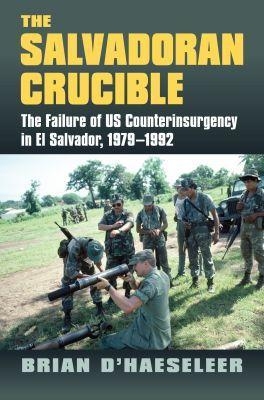
The Salvadoran Crucible
The Failure of U.S. Counterinsurgency in El Salvador, 1979-1992
Seiten
2017
University Press of Kansas (Verlag)
978-0-7006-2512-3 (ISBN)
University Press of Kansas (Verlag)
978-0-7006-2512-3 (ISBN)
In 1979, with El Salvador growing ever more unstable, the US undertook a counterinsurgency intervention that would become Washington's largest nation-building effort since Vietnam. Brian D'Haeseleer argues in The Salvadoran Crucible, that the US counterinsurgency in El Salvador produced no more than a stalemate, and in the process inflicted tremendous suffering on Salvadorans.
In 1979, with El Salvador growing ever more unstable and ripe for revolution, the United States undertook a counterinsurgency intervention that over the following decade would become Washington’s largest nation-building effort since Vietnam. In 2003, policymakers looked to this “successful” undertaking as a model for US intervention in Iraq. In fact, Brian D’Haeseleer argues in The Salvadoran Crucible, the US counterinsurgency in El Salvador produced no more than a stalemate, and in the process inflicted tremendous suffering on Salvadorans for a limited amount of foreign policy gains. D’Haeseleer’s book is a deeply informed, dispassionate account of how the Salvadoran venture took shape, what it actually accomplished, and what lessons it holds.
A historical analysis of the origins of US counterinsurgency policy provides context for understanding how precedents informed US intervention in El Salvador. What follows is a detailed, in-depth view of how the counterinsurgency unfolded—the nature, logic, and effectiveness of the policies, initiatives, and operations promoted by American strategists. D’Haeseleer’s account disputes the “success” narrative by showing that El Salvador’s achievements, mainly the spread of democracy, occurred as a result not of the American intervention but of the insurgents’ war against the state. Most significantly, The Salvadoran Crucible contends that the reforms enacted during the war failed to address the underlying causes of the conflict, which today continue to reverberate in El Salvador. The book thus suggests a reassessment of the history of American counterinsurgency, and a course-correction for the future.
In 1979, with El Salvador growing ever more unstable and ripe for revolution, the United States undertook a counterinsurgency intervention that over the following decade would become Washington’s largest nation-building effort since Vietnam. In 2003, policymakers looked to this “successful” undertaking as a model for US intervention in Iraq. In fact, Brian D’Haeseleer argues in The Salvadoran Crucible, the US counterinsurgency in El Salvador produced no more than a stalemate, and in the process inflicted tremendous suffering on Salvadorans for a limited amount of foreign policy gains. D’Haeseleer’s book is a deeply informed, dispassionate account of how the Salvadoran venture took shape, what it actually accomplished, and what lessons it holds.
A historical analysis of the origins of US counterinsurgency policy provides context for understanding how precedents informed US intervention in El Salvador. What follows is a detailed, in-depth view of how the counterinsurgency unfolded—the nature, logic, and effectiveness of the policies, initiatives, and operations promoted by American strategists. D’Haeseleer’s account disputes the “success” narrative by showing that El Salvador’s achievements, mainly the spread of democracy, occurred as a result not of the American intervention but of the insurgents’ war against the state. Most significantly, The Salvadoran Crucible contends that the reforms enacted during the war failed to address the underlying causes of the conflict, which today continue to reverberate in El Salvador. The book thus suggests a reassessment of the history of American counterinsurgency, and a course-correction for the future.
Brian D’Haeseleer is visiting assistant professor of history at Lyon College in Batesville, Arkansas.
| Erscheinungsdatum | 29.01.2018 |
|---|---|
| Verlagsort | Kansas |
| Sprache | englisch |
| Maße | 160 x 236 mm |
| Gewicht | 555 g |
| Themenwelt | Geisteswissenschaften ► Geschichte ► Regional- / Ländergeschichte |
| Geschichte ► Teilgebiete der Geschichte ► Militärgeschichte | |
| ISBN-10 | 0-7006-2512-7 / 0700625127 |
| ISBN-13 | 978-0-7006-2512-3 / 9780700625123 |
| Zustand | Neuware |
| Informationen gemäß Produktsicherheitsverordnung (GPSR) | |
| Haben Sie eine Frage zum Produkt? |
Mehr entdecken
aus dem Bereich



aus dem Bereich
von der Wiederbewaffnung bis zur Zeitenwende
Buch | Softcover (2025)
C.H.Beck (Verlag)
CHF 16,80
Deutschlands großer Volksaufstand
Buch | Softcover (2024)
Propyläen Verlag
CHF 30,80


