


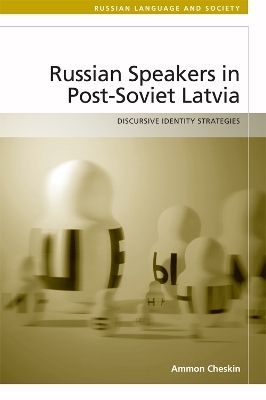
Russian-Speakers in Post-Soviet Latvia
Discursive Identity Strategies
Seiten
2017
Edinburgh University Press (Verlag)
9781474428507 (ISBN)
Edinburgh University Press (Verlag)
9781474428507 (ISBN)
The political shocks of the 2014 Ukrainian crisis have been felt in many former Soviet countries, not least Latvia, where over 35 per cent of the population are native Russian speakers. At a time when analysts and commentators are unsure about Russia’s future plans to intervene on behalf of their ‘compatriots’, this study provides a detailed political and cultural analysis of Russian-speaking identity in Latvia.
By using Russian-speakers in Latvia as a specific case study, this volume also offers a fresh methodological approach to the study of discourses and discursive strategies. It outlines a coherent methodology to study the evolution of discourses over time, rather than a single de-contextualised and static time period.
Drawing on media analysis, elite interviews, focus groups and survey data, this volume situates the identity strategies of Russian speakers within the transformations of the post-Soviet era. By assessing political, cultural and economic links with their home state (Latvia) and their potential kin-state (Russia), it offers important insights into the complex identity positions of Latvia’s Russian speakers, and how these positions have evolved in Latvia since the late Soviet period.
At a historical moment when many will question the loyalty of Russian speakers to their various ‘host states’, this book provides a timely, scholarly account of ethnic politics in Latvia. It also offers a methodological framework that allows for the mapping of trends in discursive strategies, exploring how they evolve through time.
By using Russian-speakers in Latvia as a specific case study, this volume also offers a fresh methodological approach to the study of discourses and discursive strategies. It outlines a coherent methodology to study the evolution of discourses over time, rather than a single de-contextualised and static time period.
Drawing on media analysis, elite interviews, focus groups and survey data, this volume situates the identity strategies of Russian speakers within the transformations of the post-Soviet era. By assessing political, cultural and economic links with their home state (Latvia) and their potential kin-state (Russia), it offers important insights into the complex identity positions of Latvia’s Russian speakers, and how these positions have evolved in Latvia since the late Soviet period.
At a historical moment when many will question the loyalty of Russian speakers to their various ‘host states’, this book provides a timely, scholarly account of ethnic politics in Latvia. It also offers a methodological framework that allows for the mapping of trends in discursive strategies, exploring how they evolve through time.
Ammon Cheskin is Lecturer in Nationalism and Identity in the Department of Central and East European Studies, the University of Glasgow
AbbreviationsAcknowledgementsPreface1: Introduction2: Discourse, memory, and identity3: Latvian state and nation building4: Russian-language media and identity formation5: Examining Russian-speaking identity from below6: The ‘democratisation of history’ and generational change7: The primacy of politics? Political discourse and identity formation8: The Russian Federation and Russian-speaking identity in LatviaConclusionsAppendicesGlossaryBibliography
| Erscheinungsdatum | 29.07.2017 |
|---|---|
| Reihe/Serie | Russian Language and Society |
| Verlagsort | Edinburgh |
| Sprache | englisch |
| Maße | 156 x 234 mm |
| Themenwelt | Geisteswissenschaften ► Sprach- / Literaturwissenschaft ► Sprachwissenschaft |
| ISBN-13 | 9781474428507 / 9781474428507 |
| Zustand | Neuware |
| Informationen gemäß Produktsicherheitsverordnung (GPSR) | |
| Haben Sie eine Frage zum Produkt? |
Mehr entdecken
aus dem Bereich


aus dem Bereich
Eine Wiederentdeckung
Buch | Softcover (2025)
Piper (Verlag)
CHF 19,55


