


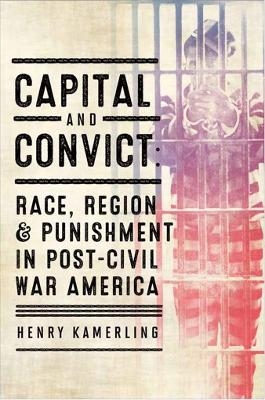
Capital and Convict
Race, Region, and Punishment in Post-Civil War America
Seiten
2017
University of Virginia Press (Verlag)
978-0-8139-4055-7 (ISBN)
University of Virginia Press (Verlag)
978-0-8139-4055-7 (ISBN)
- Titel z.Zt. nicht lieferbar
- Versandkostenfrei
- Auch auf Rechnung
- Artikel merken
Offers a comparative study of Illinois's and South Carolina's formal state penal systems in the fifty years after the Civil War. Henry Kamerling argues that although punishment was racially inflected both during Reconstruction and after, shared, non-racial factors defined both states' penal systems throughout this period.
Both in the popular imagination and in academic discourse, North and South are presented as fundamentally divergent penal systems in the aftermath of the Civil War, a difference mapped onto larger perceived cultural disparities between the two regions. The South’s post Civil War embrace of chain gangs and convict leasing occupies such a prominent position in the nation’s imagination that it has come to represent one of the region’s hallmark differences from the North. The regions are different, the argument goes, because they punish differently.
Capital and Convict challenges this assumption by offering a comparative study of Illinois’s and South Carolina’s formal state penal systems in the fifty years after the Civil War. Henry Kamerling argues that although punishment was racially inflected both during Reconstruction and after, shared, nonracial factors defined both states' penal systems throughout this period. The similarities in the lived experiences of inmates in both states suggest that the popular focus on the racial characteristics of southern punishment has shielded us from an examination of important underlying factors that prove just as central—if not more so—in shaping the realities of crime and punishment throughout the United States.
Both in the popular imagination and in academic discourse, North and South are presented as fundamentally divergent penal systems in the aftermath of the Civil War, a difference mapped onto larger perceived cultural disparities between the two regions. The South’s post Civil War embrace of chain gangs and convict leasing occupies such a prominent position in the nation’s imagination that it has come to represent one of the region’s hallmark differences from the North. The regions are different, the argument goes, because they punish differently.
Capital and Convict challenges this assumption by offering a comparative study of Illinois’s and South Carolina’s formal state penal systems in the fifty years after the Civil War. Henry Kamerling argues that although punishment was racially inflected both during Reconstruction and after, shared, nonracial factors defined both states' penal systems throughout this period. The similarities in the lived experiences of inmates in both states suggest that the popular focus on the racial characteristics of southern punishment has shielded us from an examination of important underlying factors that prove just as central—if not more so—in shaping the realities of crime and punishment throughout the United States.
Henry Kamerling is a professor of History at Seattle University.
| Erscheinungsdatum | 17.11.2017 |
|---|---|
| Reihe/Serie | The American South Series |
| Zusatzinfo | 4 black & white illustrations, 3 graphs, 2 tables |
| Verlagsort | Charlottesville |
| Sprache | englisch |
| Maße | 162 x 236 mm |
| Gewicht | 595 g |
| Themenwelt | Geschichte ► Allgemeine Geschichte ► Neuzeit (bis 1918) |
| Geisteswissenschaften ► Geschichte ► Regional- / Ländergeschichte | |
| Geschichte ► Teilgebiete der Geschichte ► Militärgeschichte | |
| ISBN-10 | 0-8139-4055-9 / 0813940559 |
| ISBN-13 | 978-0-8139-4055-7 / 9780813940557 |
| Zustand | Neuware |
| Informationen gemäß Produktsicherheitsverordnung (GPSR) | |
| Haben Sie eine Frage zum Produkt? |
Mehr entdecken
aus dem Bereich


aus dem Bereich
Geschichte einer wilden Handlung
Buch | Hardcover (2024)
C.H.Beck (Verlag)
CHF 47,60


