


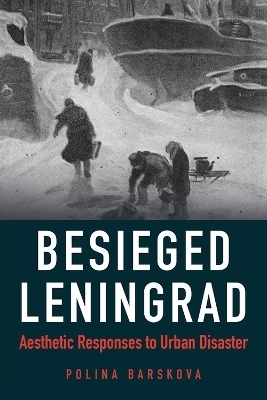
Besieged Leningrad
Aesthetic Responses to Urban Disaster
Seiten
2017
Northern Illinois University Press (Verlag)
978-0-87580-772-0 (ISBN)
Northern Illinois University Press (Verlag)
978-0-87580-772-0 (ISBN)
During the 872 days of the Siege of Leningrad (September 1941 to January 1944), the city's inhabitants were surrounded by the military forces of Nazi Germany. They suffered famine, cold, and darkness, and a million people lost their lives, making the siege one of the most destructive in history. Confinement in the besieged city was a traumatic...
During the 872 days of the Siege of Leningrad (September 1941 to January 1944), the city's inhabitants were surrounded by the military forces of Nazi Germany. They suffered famine, cold, and darkness, and a million people lost their lives, making the siege one of the most destructive in history. Confinement in the besieged city was a traumatic experience. Unlike the victims of the Auschwitz concentration camp, for example, who were brought from afar and robbed of their cultural roots, the victims of the Siege of Leningrad were trapped in the city as it underwent a slow, horrific transformation. They lost everything except their physical location, which was layered with historical, cultural, and personal memory. In Besieged Leningrad, Polina Barskova examines how the city's inhabitants adjusted to their new urban reality, focusing on the emergence of new spatial perceptions that fostered the production of diverse textual and visual representations. The myriad texts that emerged during the siege were varied and exciting, engendered by sometimes sharply conflicting ideological urges and aesthetic sensibilities. In this first study of the cultural and literary representations of spatiality in besieged Leningrad, Barskova examines a wide range of authors with competing views of their difficult relationship with the city, filling a gap in Western knowledge of the culture of the siege. It will appeal to Russian studies specialists as well as those interested in war testimonies and the representation of trauma.
During the 872 days of the Siege of Leningrad (September 1941 to January 1944), the city's inhabitants were surrounded by the military forces of Nazi Germany. They suffered famine, cold, and darkness, and a million people lost their lives, making the siege one of the most destructive in history. Confinement in the besieged city was a traumatic experience. Unlike the victims of the Auschwitz concentration camp, for example, who were brought from afar and robbed of their cultural roots, the victims of the Siege of Leningrad were trapped in the city as it underwent a slow, horrific transformation. They lost everything except their physical location, which was layered with historical, cultural, and personal memory. In Besieged Leningrad, Polina Barskova examines how the city's inhabitants adjusted to their new urban reality, focusing on the emergence of new spatial perceptions that fostered the production of diverse textual and visual representations. The myriad texts that emerged during the siege were varied and exciting, engendered by sometimes sharply conflicting ideological urges and aesthetic sensibilities. In this first study of the cultural and literary representations of spatiality in besieged Leningrad, Barskova examines a wide range of authors with competing views of their difficult relationship with the city, filling a gap in Western knowledge of the culture of the siege. It will appeal to Russian studies specialists as well as those interested in war testimonies and the representation of trauma.
Polina Barskova was born in Leningrad. She received a BA from Saint Petersburg State University and an MA and PhD from the University of California, Berkeley. She is associate professor of Russian literature at Hampshire College, and has published eight books of poetry in Russian and three in English translation. She is also the author of Living Pictures, which received the 2015 Andrey Bely Prize, and the editor of Written in the Dark.
| Erscheinungsdatum | 06.02.2018 |
|---|---|
| Reihe/Serie | NIU Series in Slavic, East European, and Eurasian Studies |
| Sprache | englisch |
| Maße | 152 x 229 mm |
| Gewicht | 454 g |
| Themenwelt | Geschichte ► Allgemeine Geschichte ► 1918 bis 1945 |
| Geisteswissenschaften ► Geschichte ► Regional- / Ländergeschichte | |
| Geschichte ► Teilgebiete der Geschichte ► Kulturgeschichte | |
| Geschichte ► Teilgebiete der Geschichte ► Militärgeschichte | |
| ISBN-10 | 0-87580-772-0 / 0875807720 |
| ISBN-13 | 978-0-87580-772-0 / 9780875807720 |
| Zustand | Neuware |
| Informationen gemäß Produktsicherheitsverordnung (GPSR) | |
| Haben Sie eine Frage zum Produkt? |
Mehr entdecken
aus dem Bereich

aus dem Bereich
Deutschland 1933 bis 1945
Buch | Hardcover (2025)
S. Fischer (Verlag)
CHF 47,60
ein Psychologe erlebt das Konzentrationslager
Buch | Hardcover (2024)
Kösel (Verlag)
CHF 30,80


