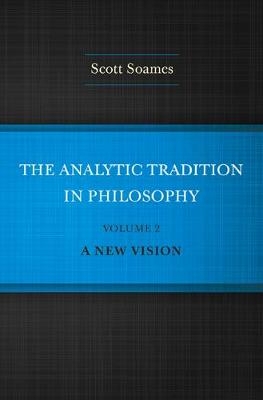
The Analytic Tradition in Philosophy, Volume 2
Princeton University Press (Verlag)
978-0-691-16003-0 (ISBN)
An in-depth history of the linguistic turn in analytic philosophy, from a leading philosopher of language This is the second of five volumes of a definitive history of analytic philosophy from the invention of modern logic in 1879 to the end of the twentieth century. Scott Soames, a leading philosopher of language and historian of analytic philosophy, provides the fullest and most detailed account of the analytic tradition yet published, one that is unmatched in its chronological range, topics covered, and depth of treatment. Focusing on the major milestones and distinguishing them from detours, Soames gives a seminal account of where the analytic tradition has been and where it appears to be heading. Volume 2 provides an intensive account of the new vision in analytical philosophy initiated by Ludwig Wittgenstein's Tractatus Logico-Philosophicus, its assimilation by the Vienna Circle of Moritz Schlick and Rudolf Carnap, and the subsequent flowering of logical empiricism.
With this "linguistic turn," philosophical analysis became philosophy itself, and the discipline's stated aim was transformed from advancing philosophical theories to formalizing, systematizing, and unifying science. In addition to exploring the successes and failures of philosophers who pursued this vision, the book describes how the philosophically minded logicians Kurt Godel, Alfred Tarski, Alonzo Church, and Alan Turing discovered the scope and limits of logic and developed the mathematical theory of computation that ushered in the digital era. The book's account of this pivotal period closes with a searching examination of the struggle to preserve ethical normativity in a scientific age.
Scott Soames is Distinguished Professor of Philosophy at the University of Southern California and a member of the American Academy of Arts and Sciences. His many books include Rethinking Language, Mind, and Meaning; Analytic Philosophy in America; Philosophy of Language; the two-volume Philosophical Essays; and the two-volume Philosophical Analysis in the Twentieth Century (all Princeton).
Preface ix
I The Tractatus: Language, Mind, And World
1 The Abbreviated Metaphysics of the Tractatus 3
2 The Single Great Problem of the Tractatus: Propositions 24
3 The Logic of the Tractatus 55
4 The Tractarian Test of Intelligibility and Its Consequences 88
II A New Conception Of Philosophy: Language, Logic, And Science
5 The Roots of Logical Empiricism 107
6 Carnap's Aufbau 129
7 The Heyday of Logical Empiricism 160
8 Advances in Logic: Goedel, Tarski, Church, and Turing 199
9 Tarski's Definition of Truth and Carnap's Embrace of "Semantics" 236
10 Analyticity, Necessity, and A Priori Knowledge 288
11 The Rise and Fall of the Empiricist Criterion of Meaning 311
III Is Ethics Possible?
12 Ethics as Science 337
13 Replacing Ethics with Metaethics: Emotivism and Its Critics 353
14 Normative Ethics and Cognitivist Metaethics in the Age
of Emotivism: H. A. Prichard and W. D. Ross 375
References 409
Index 419
| Erscheinungsdatum | 09.01.2018 |
|---|---|
| Verlagsort | New Jersey |
| Sprache | englisch |
| Maße | 152 x 235 mm |
| Gewicht | 482 g |
| Themenwelt | Geisteswissenschaften ► Philosophie ► Geschichte der Philosophie |
| Geisteswissenschaften ► Philosophie ► Philosophie der Neuzeit | |
| ISBN-10 | 0-691-16003-1 / 0691160031 |
| ISBN-13 | 978-0-691-16003-0 / 9780691160030 |
| Zustand | Neuware |
| Informationen gemäß Produktsicherheitsverordnung (GPSR) | |
| Haben Sie eine Frage zum Produkt? |
aus dem Bereich