


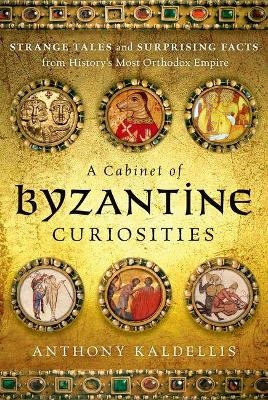
A Cabinet of Byzantine Curiosities
Strange Tales and Surprising Facts from History's Most Orthodox Empire
Seiten
2017
Oxford University Press Inc (Verlag)
978-0-19-062594-8 (ISBN)
Oxford University Press Inc (Verlag)
978-0-19-062594-8 (ISBN)
Byzantium has long been regarded by many as one big curiosity -- decadent, degenerate, superstitious, theocratic, effeminate. With its tales and trivia - ranging across religion, bureaucracy, food, theatre, medicine, xenophobia, warfare - this book will confirm some of these prejudices, but also open eyes to the life of this extraordinarily interesting civilization.
Weird, decadent, degenerate, racially mixed, superstitious, theocratic, effeminate, and even hyper-literate, Byzantium has long been regarded by many as one big curiosity. According to Voltaire, it represented "a worthless collection of miracles, a disgrace for the human mind" for Hegel it was "a disgusting picture of imbecility."
A Cabinet of Byzantine Curiosities will reinforce these old prejudices, while also stimulating a deeper interest among readers in one of history's most interesting civilizations. Many of the zanier tales and trivia that are collected here revolve around the political and religious life of Byzantium. Thus, stories of saints, relics, and their miracles--from the hilarious to the revolting--abound. Byzantine bureaucracy (whence the adjective "Byzantine"), court scandals, and elaborate penal code are world famous. And what would Byzantium be without its eunuchs, whose ambiguous gender produced odd and risible outcomes in different contexts? The book also contains sections on daily life that are equally eye-opening, including food (from aphrodisiacs to fermented fish sauce), games such as polo and acrobatics, and obnoxious views of foreigners and others (e.g. Germans, Catholics, Arabs, dwarves). But lest we overlook Byzantium's more honorable contributions to civilization, also included are some of the marvels of Byzantine science and technology, from the military (flamethrowers and hand grenades) to the theatrical ("elevator" thrones, roaring mechanical lions) and medical (catheters and cures, some bizarre). This vast assortment of historical anomaly and absurdity sheds vital light on one of history's most obscure and orthodox empires.
Weird, decadent, degenerate, racially mixed, superstitious, theocratic, effeminate, and even hyper-literate, Byzantium has long been regarded by many as one big curiosity. According to Voltaire, it represented "a worthless collection of miracles, a disgrace for the human mind" for Hegel it was "a disgusting picture of imbecility."
A Cabinet of Byzantine Curiosities will reinforce these old prejudices, while also stimulating a deeper interest among readers in one of history's most interesting civilizations. Many of the zanier tales and trivia that are collected here revolve around the political and religious life of Byzantium. Thus, stories of saints, relics, and their miracles--from the hilarious to the revolting--abound. Byzantine bureaucracy (whence the adjective "Byzantine"), court scandals, and elaborate penal code are world famous. And what would Byzantium be without its eunuchs, whose ambiguous gender produced odd and risible outcomes in different contexts? The book also contains sections on daily life that are equally eye-opening, including food (from aphrodisiacs to fermented fish sauce), games such as polo and acrobatics, and obnoxious views of foreigners and others (e.g. Germans, Catholics, Arabs, dwarves). But lest we overlook Byzantium's more honorable contributions to civilization, also included are some of the marvels of Byzantine science and technology, from the military (flamethrowers and hand grenades) to the theatrical ("elevator" thrones, roaring mechanical lions) and medical (catheters and cures, some bizarre). This vast assortment of historical anomaly and absurdity sheds vital light on one of history's most obscure and orthodox empires.
Anthony Kaldellis is Professor of Greek and Latin at The Ohio State University. Author of The Christian Parthenon: Classicism and Pilgrimage in Byzantine Athens (CUP 2009) and Hellenism in Byzantium: The Transformations of Greek Identity and the Reception of the Classical Tradition (CUP, 2007), among numerous others (including two in progress with OUP).
Animals
Byzantine emperors
Disasters
Erotic epigrams
Eunuchs
Food and dining
Foreigners, minorities, and others
Heretics, theology, and scandal
Latins, Franks, and Germans
Marriage, family, and divorce
Medical practice
Punishments
Rogues
Science and technology
Southerners, easterners, and northerners
Unorthodox sex
War
| Erscheinungsdatum | 11.11.2017 |
|---|---|
| Verlagsort | New York |
| Sprache | englisch |
| Maße | 137 x 211 mm |
| Gewicht | 386 g |
| Themenwelt | Geschichte ► Allgemeine Geschichte ► Mittelalter |
| ISBN-10 | 0-19-062594-5 / 0190625945 |
| ISBN-13 | 978-0-19-062594-8 / 9780190625948 |
| Zustand | Neuware |
| Informationen gemäß Produktsicherheitsverordnung (GPSR) | |
| Haben Sie eine Frage zum Produkt? |
Mehr entdecken
aus dem Bereich



aus dem Bereich
Geschichte einer Augsburger Familie (1367-1650)
Buch | Softcover (2024)
Kohlhammer (Verlag)
CHF 47,60


