


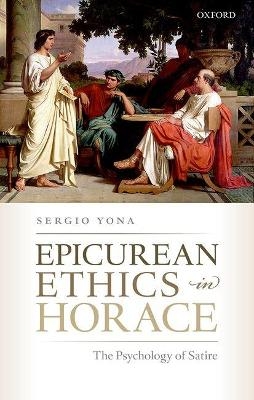
Epicurean Ethics in Horace
The Psychology of Satire
Seiten
2018
Oxford University Press (Verlag)
978-0-19-878655-9 (ISBN)
Oxford University Press (Verlag)
978-0-19-878655-9 (ISBN)
Horace's Satires owe debts of influence to a wide range of genres and authors, including, as this study demonstrates, the moral tradition of Epicureanism. Focusing on the philosopher Philodemus of Gadara, it argues that the central concerns of his work lie at the heart of the poet's criticisms of Roman society and its shortcomings.
Over the centuries leading up to their composition many genres and authors have emerged as influences on Horace's Satires, which in turn has led to a wide variety of scholarly interpretations. This study aims to expand the existing dialogue by exploring further the intersection of ancient satire and ethics, focusing on the moral tradition of Epicureanism through the lens of one source in particular: Philodemus of Gadara.
Philodemus was an Epicurean philosopher who wrote for a Roman audience and was one of Horace's contemporaries and neighbours in Italy. His works, which were preserved by the eruption of Vesuvius in AD 79 but have nevertheless not been widely read on account of their fragmentary nature, feature a range of ethical treatises on subjects including patronage, friendship, flattery, frankness, poverty, and wealth. Epicurean Ethics in Horace: The Psychology of Satire offers a serious consideration of the role of Philodemus' Epicurean teachings in Horace's Satires and argues that the central concerns of the philosopher's work not only lie at the heart of the poet's criticisms of Roman society and its shortcomings, but also lend to the collection a certain coherence and overall unity in its underlying convictions. The result is a ground-breaking study of the deep and pervasive influence of Epicurean ethical philosophy on Horace's Satires, which also reveals something of the poet behind the literary mask or persona by demonstrating the philosophical consistency of his position throughout the two books.
Over the centuries leading up to their composition many genres and authors have emerged as influences on Horace's Satires, which in turn has led to a wide variety of scholarly interpretations. This study aims to expand the existing dialogue by exploring further the intersection of ancient satire and ethics, focusing on the moral tradition of Epicureanism through the lens of one source in particular: Philodemus of Gadara.
Philodemus was an Epicurean philosopher who wrote for a Roman audience and was one of Horace's contemporaries and neighbours in Italy. His works, which were preserved by the eruption of Vesuvius in AD 79 but have nevertheless not been widely read on account of their fragmentary nature, feature a range of ethical treatises on subjects including patronage, friendship, flattery, frankness, poverty, and wealth. Epicurean Ethics in Horace: The Psychology of Satire offers a serious consideration of the role of Philodemus' Epicurean teachings in Horace's Satires and argues that the central concerns of the philosopher's work not only lie at the heart of the poet's criticisms of Roman society and its shortcomings, but also lend to the collection a certain coherence and overall unity in its underlying convictions. The result is a ground-breaking study of the deep and pervasive influence of Epicurean ethical philosophy on Horace's Satires, which also reveals something of the poet behind the literary mask or persona by demonstrating the philosophical consistency of his position throughout the two books.
Sergio Yona is Assistant Professor of Classical Studies at the University of Missouri and received his PhD in Classical Philology from the University of Illinois at Urbana-Champaign. His current research interests include the reception of Greek philosophy in Rome, Augustan and Early Christian poetry, and textual criticism, and he has published articles on Plato, Vergil, and Epicureanism in Horace. He lives with his wife and six children in Columbia, MO.
ENDMATTER
| Erscheinungsdatum | 17.04.2018 |
|---|---|
| Verlagsort | Oxford |
| Sprache | englisch |
| Maße | 148 x 222 mm |
| Gewicht | 576 g |
| Themenwelt | Literatur ► Klassiker / Moderne Klassiker |
| Geisteswissenschaften ► Sprach- / Literaturwissenschaft ► Anglistik / Amerikanistik | |
| Geisteswissenschaften ► Sprach- / Literaturwissenschaft ► Literaturwissenschaft | |
| ISBN-10 | 0-19-878655-7 / 0198786557 |
| ISBN-13 | 978-0-19-878655-9 / 9780198786559 |
| Zustand | Neuware |
| Informationen gemäß Produktsicherheitsverordnung (GPSR) | |
| Haben Sie eine Frage zum Produkt? |
Mehr entdecken
aus dem Bereich


aus dem Bereich
Poetik eines sozialen Urteils
Buch | Hardcover (2023)
De Gruyter (Verlag)
CHF 83,90


