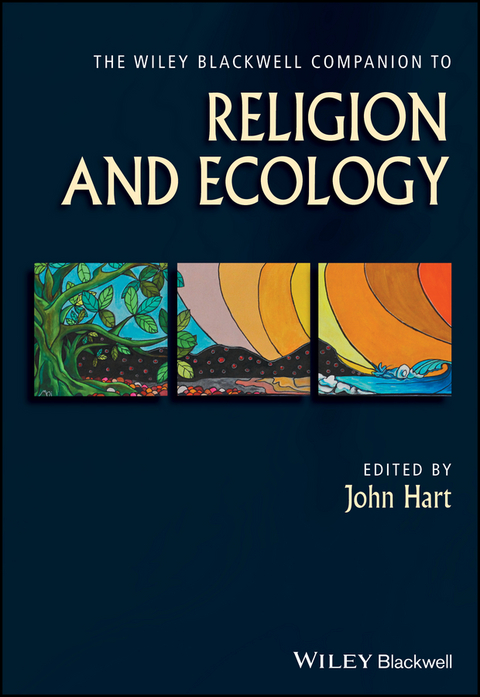
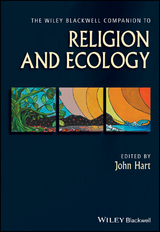
In the face of the current environmental crisis-which clearly has moral and spiritual dimensions-members of all the world's faiths have come to recognize the critical importance of religion's relationship to ecology. The Wiley Blackwell Companion to Religion and Ecology offers a comprehensive overview of the history and the latest developments in religious engagement with environmental issues throughout the world. Newly commissioned essays from noted scholars of diverse faiths and scientific traditions present the most cutting-edge thinking on religion's relationship to the environment. Initial readings explore the ways traditional concepts of nature in Christianity, Judaism, Islam, Buddhism, and other religious traditions have been shaped by the environmental crisis. Readings then address the changing nature of theology and religious thought in response to the challenges of protecting the environment. Various conceptual issues and themes that transcend individual traditions-climate change, bio-ethics, social justice, ecofeminism, and more-are then analyzed before a final section examines some of the immediate challenges we face in caring for the Earth while looking to the future of religious environmentalism. Timely and thought-provoking, Companion to Religion and Ecology offers illuminating insights into the role of religion in the ongoing struggle to secure the future well-being of our natural world.
With a foreword by Ecumenical Patriarch Bartholomew I, and an Afterword by John Cobb
John Hart is Professor of Christian Ethics, Boston University. His books include Cosmic Commons: Spirit, Science, and Space (2013), Sacramental Commons: Christian Ecological Ethics (2006), and The Spirit of the Earth (1984). He has lectured globally on socioecological ethics and religion-ecology in eight countries on five continents.
In the face of the current environmental crisis which clearly has moral and spiritual dimensions members of all the world s faiths have come to recognize the critical importance of religion s relationship to ecology. The Wiley Blackwell Companion to Religion and Ecology offers a comprehensive overview of the history and the latest developments in religious engagement with environmental issues throughout the world. Newly commissioned essays from noted scholars of diverse faiths and scientific traditions present the most cutting-edge thinking on religion s relationship to the environment. Initial readings explore the ways traditional concepts of nature in Christianity, Judaism, Islam, Buddhism, and other religious traditions have been shaped by the environmental crisis. Readings then address the changing nature of theology and religious thought in response to the challenges of protecting the environment. Various conceptual issues and themes that transcend individual traditions climate change, bio-ethics, social justice, ecofeminism, and more are then analyzed before a final section examines some of the immediate challenges we face in caring for the Earth while looking to the future of religious environmentalism. Timely and thought-provoking, Companion to Religion and Ecology offers illuminating insights into the role of religion in the ongoing struggle to secure the future well-being of our natural world.With a foreword by Ecumenical Patriarch Bartholomew I, and an Afterword by John Cobb
John Hart is Professor of Christian Ethics, Boston University. His books include Cosmic Commons: Spirit, Science, and Space (2013), Sacramental Commons: Christian Ecological Ethics (2006), and The Spirit of the Earth (1984). He has lectured globally on socioecological ethics and religion-ecology in eight countries on five continents.
List of Contributors
Nawal H. Ammar is a professor of criminology and Dean of the Faculty of Social Science and Humanities, University of Ontario Institute of Technology. Previously, Nawal was a professor at Kent State University, Ohio. Her research areas include environmental justice in Islam, violence against immigrant women, and Muslims in the criminal justice system. Nawal’s recent publications include an edited volume, Muslims in US Prisons (2015).
Francisco J. Ayala is a university professor and Donald Bren Professor of Biological Sciences at the University of California, Irvine. He has published over 1,000 articles and is author or editor of 50 books. He is a member of the US National Academy of Sciences and the American Philosophical Society. In 2001 he received the US National Medal of Science and in 2010 the Templeton Prize. The New York Times named him “Renaissance Man of Evolutionary Biology.”
Whitney A. Bauman is an associate professor of religious studies at Florida International University, Miami. He is the author of Religion and Ecology: Developing a Planetary Ethic (2014) and Theology, Creation and Environmental Ethics (2009), and editor of Grounding Religion: A Field Guide to the Study of Religion and Ecology (with Kevin J. O’Brien and Richard Bohannon, 2011) and Science and Religion: One Planet Many Possibilities (2014). He was a Fulbright Fellow in Indonesia (2014: “Religion and Globalization”) and a Humboldt Fellow in Germany (2015—16: “The Religious Underpinnings of Ernst Haeckel’s Understanding of Nature”).
Christopher Key Chapple, Doshi Professor of Indic and Comparative Theology and Director of the MA in Yoga Studies at Loyola Marymount University, Los Angeles, has published more than 20 books, including Yoga and Ecology (2008), Jainism and Ecology (2000), and Nonviolence to Animals, Earth, and Self in Asian Traditions (1993). He serves on several advisory boards, including the Forum on Religion and Ecology (Yale University) and the Jain Studies Centre (London), and edits the journal Worldviews.
John Chryssavgis, Archdeacon of the Ecumenical Patriarchate, is special theological advisor to the Office of Ecumenical and Inter‐Faith Affairs of the Greek Orthodox Archdiocese of America, coordinates the Social and Moral Issues Commission of the Orthodox Churches in America, and serves as ecological advisor to Ecumenical Patriarch Bartholomew I. His books include Light Through Darkness: the Orthodox Tradition (2004) and Beyond the Shattered Image: Insights into an Orthodox Christian Ecological Worldview (1999); he is editor of On Earth as in Heaven (2011) on Patriarch Bartholomew’s ecological vision and activities and, with Pope Francis, of Bartholomew: Apostle and Visionary (2016).
John B. Cobb, Jr. was born in Japan of Methodist missionary parents from Georgia. He earned a PhD from the Divinity School of the University of Chicago. Most of his teaching career was at Claremont School of Theology, California where, with David Griffin, he founded the Center for Process Studies. Among his books are Christ in a Pluralistic Age (with Charles Birch, 1999), The Liberation of Life (1982), and For the Common Good (with Herman Daly, 1994).
Heather Eaton is Full Professor of Conflict Studies, Saint Paul University, Ottawa. Her doctoral studies at the University of Toronto integrated ecology, feminism, theology, and religious pluralism. Heather’s publications include The Intellectual Journey of Thomas Berry (2014), Ecological Awareness: Exploring Religion, Ethics and Aesthetics (with Sigurd Bergmann, 2011), Introducing Ecofeminist Theologies (2005), Ecofeminism and Globalization (with Lois Ann Lorentzen, 2003), and numerous articles. Her most recent work covers religious imagination, evolution, Earth dynamics; peace and conflict studies on gender, ecology, and religion.
Dianne D. Glave is on the staff of the Western Pennsylvania United Methodist Conference Center as coordinator of diversity development. She completed her MDiv degree at the Candler School of Theology, Emory University, Druid Hills, Atlanta. She has served at two churches in Pittsburgh. Dianne’s doctorate in history emphasized African‐American and environmental history, and experience as a professor informs her current position. Her publications include Rooted in the Earth: Reclaiming the African American Environmental Heritage (2010).
Tom B. K. Goldtooth, Diné Nation, is executive director of the Indigenous Environmental Network (IEN). He has been a social activist for almost 40 years promoting, in his speeches, writing, and nonviolent protest, justice for indigenous peoples and the wellbeing of Mother Earth and all life. He is a member of the International Indigenous Peoples’ Forum on Climate Change and the Steering Committee of Climate Justice Alliance. He was awarded the Gandhi Peace Award in 2015, and in 2010 was selected as the Sierra Club and NAACP “Green Hero of Color.”
Roger S. Gottlieb is a professor of philosophy at Worcester Polytechnic Institute, Massachusetts, and the author or editor of 18 books and over 125 articles on environmentalism, political philosophy, spirituality, the Holocaust, and disability. Among his recent works are the Nautilus Book Award winners Spirituality: What it Is and Why it Matters (2012), Engaging Voices: Tales of Morality and Meaning in an Age of Global Warming (2011), and Political and Spiritual: Essays on Religion, Environment, Disability and Justice (2014).
Allison Gray is a doctoral student at the University of Windsor, Ontario pursuing a range of interests in the areas of social justice, criminology, and food studies. She is currently working on projects involving the experiences of contemporary food activists in a consumerist culture, exploring the connections between population demographics and the use of Canada's Food Guide, and the governance of children's brown‐bag school lunches in Ontario.
Tallessyn Zawn Grenfell‐Lee was awarded a doctorate from Boston University School of Theology; her MS in biology from Harvard University, and BS in biology from the Massachusetts Inistitute of Technology. She contributed a chapter on Creation empathy and Christian mission to Ecology and Mission (2015), and has published articles in the Journal of Faith and Science Exchange and James Nash: A Tribute: Environmental Ethics, Ecumenical Engagement, Public Theology (2010); and in the scientific journals PNAS, Molecular and Cellular Biology, and Neuron.
John Grim teaches religion and ecology at Yale University. With Mary Evelyn Tucker he directs the Yale Forum on Religion and Ecology, which arose from a series of ten conferences they organized at Harvard University and ten edited volumes. John specializes in Native American religions. He is the author of The Shaman (1988) and editor of Indigenous Traditions and Ecology (2001). With Mary Evelyn he edited Worldviews and Ecology (1994), Ecology and Religion (2014), and Thomas Berry’s essays, The Christian Future and the Fate of Earth (1994). John is president of the American Teilhard Association, with Mary Evelyn as vice president.
Melanie L. Harris is an associate professor of religion and ethics at Texas Christian University, Fort Worth. She teaches environmental ethics, womanist ethics, African‐American religion, and Africana studies. She is the author of Gifts of Virtue, Alice Walker and Womanist Ethics (2013). She is editor of Faith, Feminism and Scholarship. (with K. Ott, 2011). Melanie serves on the board of KERA‐TV; her academic leadership positions include member advocate, American Academy of Religion; and board member, Society of Christian Ethics.
John Hart is Professor of Christian Ethics, Boston University School of Theology. His books include Cosmic Commons: Spirit, Science, and Space (2013), Sacramental Commons: Christian Ecological Ethics (2006), What Are They Saying About … Environmental Theology? (2004), Ethics and Technology: Innovation and Transformation in Community Contexts (1997), and The Spirit of the Earth—A Theology of the Land (1984). He has written more than 100 articles, essays, and book chapters, and presented invited lectures on socioecological ethics on five continents, in eight countries, and 35 US states.
John F. Haught is Distinguished Research Professor, Theology Department, Georgetown University, Washington, DC, where he was formerly a professor and Chair. His area of specialization is systematic theology, with a particular interest in issues pertaining to science, cosmology, evolution, and ecology and religion. He has authored 20 books, most on topics in science and religion, including Science and Faith: A New Introduction (2013) and Making Sense of Evolution: Darwin, God, and the Drama of Life (2010), as well as numerous articles and reviews. He lectures internationally on issues related to science, ecology, and religion.
Kapya John Kaoma is a visiting researcher at Boston University’s Center for Global Christianity and Mission, and Adjunct Professor, St. John’s Anglican University College, Zambia. He holds degrees from Evangelical University College, Zambia; Trinity College, England; the Episcopal Divinity School; and...
| Erscheint lt. Verlag | 24.3.2017 |
|---|---|
| Reihe/Serie | Blackwell Companions to Religion |
| Blackwell Companions to Religion | Wiley Blackwell Companions to Religion |
| Sprache | englisch |
| Themenwelt | Geisteswissenschaften ► Religion / Theologie ► Weitere Religionen |
| Schlagworte | Comparative & World Religions • comparative religious ethics • environmental justice • Global Ecology • Global Ethics • global warming • Ökologie • Religion • Religion & Theology • Religion and Ecology • religion and environment • Religion u. Theologie • Religious Ethics • Social Justice • socioecological ethics • Sociology of Religion • Vergleichende Religionswissenschaft |
| ISBN-13 | 9781118465530 / 9781118465530 |
| Informationen gemäß Produktsicherheitsverordnung (GPSR) | |
| Haben Sie eine Frage zum Produkt? |
 EPUB (Adobe DRM)
Kopierschutz: Adobe-DRM
Adobe-DRM ist ein Kopierschutz, der das eBook vor Mißbrauch schützen soll. Dabei wird das eBook bereits beim Download auf Ihre persönliche Adobe-ID autorisiert. Lesen können Sie das eBook dann nur auf den Geräten, welche ebenfalls auf Ihre Adobe-ID registriert sind.
Details zum Adobe-DRM
Dateiformat: EPUB (Electronic Publication)
EPUB ist ein offener Standard für eBooks und eignet sich besonders zur Darstellung von Belletristik und Sachbüchern. Der Fließtext wird dynamisch an die Display- und Schriftgröße angepasst. Auch für mobile Lesegeräte ist EPUB daher gut geeignet.
Systemvoraussetzungen:
PC/Mac: Mit einem PC oder Mac können Sie dieses eBook lesen. Sie benötigen eine
eReader: Dieses eBook kann mit (fast) allen eBook-Readern gelesen werden. Mit dem amazon-Kindle ist es aber nicht kompatibel.
Smartphone/Tablet: Egal ob Apple oder Android, dieses eBook können Sie lesen. Sie benötigen eine
Geräteliste und zusätzliche Hinweise
Buying eBooks from abroad
For tax law reasons we can sell eBooks just within Germany and Switzerland. Regrettably we cannot fulfill eBook-orders from other countries.
aus dem Bereich