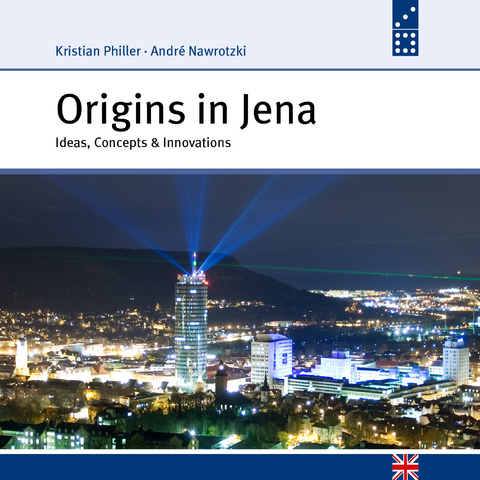
Origins in Jena
DominoPlan (Verlag)
978-3-9817215-7-7 (ISBN)
- Titel ist leider vergriffen;
keine Neuauflage - Artikel merken
That is why the path from patent to a marketable product is a short one in Jena. Whoever likes to think ahead should visit us. We always welcome good ideas.
The German national colors Black-Red-Gold
First photo of an extrasolar planet
Basic elements of a constitutional nation
The prism binocular
Hiking day
Basics of the “rechargeable battery”
Optical coatings
The Zeiss Planetarium
Ultraviolet rays
Aesthetic thoughts
Origins of “ecology”
Ultra-short waves
The Electroencephalography
The cell theory
The Revolution of logic
Goethe‘s theory of color
Origins of the Periodic Table
The first Internet trading system
Fireproof glass
The table lighter
The “Phenomenology of the Mind”
The “Loreley”
Carotene and caffeine
An prototype of color photography
The only theater building of Bauhaus
Forensic evidence
The human intermaxillary bone
How Jena became Jena
Ultra-short waves – Modern radio broadcasts for the first time in Jena. The physicist Abraham Esau came to Jena in 1925 to conduct research in high-frequency physics. The local university was, at that time, one of the first addresses for wireless communication. Since England already had a monopoly on undersea cables, Esau worked intensively during the First World War on the construction of a broadcasting network between Germany and its colonies. He soon became “the Pope of high frequencies”. In Jena Esau wanted to add very high frequency (VHF) waves to the already common middle, short and long waves of the broadcasting spectrum. This required stronger transmitters with special glass cylinders. It was convenient to have the Schott glass factory in town. The first VHF transmission in the world was made between Jena and Kahla in 1925. Not even Esau realized the full implications of VHF waves: “At that time it was not obvious to anyone that one day that this wavelength would prove to be so superior for broadcasting.” This technique enabled the first mobile broadcasting system in history to go on air between the community hall and the post office in 1931. It still took some time before background static disappeared from radio, to be replaced by crystal clear stereo sound. The new broadcasting technique was rst made accessible to the military, and was especially important for communication between military bases and pilots of high speed jet fighters. Discovery of the simple – The cell theory from Jena Matthias Jacob Schleiden, professor at the university in Jena and one of the three German cofounders of cell theory, published the statement that plant tissues are composed of cells, in his Contributions to Phytogenesis in 1838. Analogous to atomic theory in physics, cell theory is among the most important advances in biology. The realization that plants and animals are composed of the same type of basic functional units was a breakthrough in the biological understanding of life. Schleiden was among the first to demonstrate that millions of microscopic cells could build a macroscopic organism. Before Schleiden, Lorenz Oken had carefully examined the development of chicken embryos. Oken proposed that the organic body consisted of nothing more than many microscopic bubbles. This was a precedent for the cell theory developed by Schleiden and his colleague Theodor Schwann, and later completed by Rudolf Virchow. With the 1848 collection of his popular lectures, Plants and their Life, Schleiden awakened interest in botany. Interestingly, another Jena scientist, Carl Gegenbauer, demonstrated in 1861 that the big, yellow yolk of an unfertilized chicken egg is just a single cell. These scientists referred to a passage in Goethe’s Metamorphosis of Plants: “None resembleth another, yet all their forms have a likeness/ Therefore, a mystical law is by the chorus proclaim’d / Yes, a sacred enigma!” We will always continue in Jena to dive deeper into the mysteries of nature, no matter how small or how puzzling.
| Erscheinungsdatum | 27.03.2017 |
|---|---|
| Zusatzinfo | Fotografien, Portraits, Zeichnungen |
| Verlagsort | Jena |
| Sprache | englisch |
| Maße | 148 x 148 mm |
| Gewicht | 110 g |
| Einbandart | geklebt |
| Themenwelt | Geisteswissenschaften ► Geschichte ► Regional- / Ländergeschichte |
| Geschichte ► Teilgebiete der Geschichte ► Technikgeschichte | |
| Schlagworte | Concepts • Erfinder • Erfindung • Erfindungen • Geschichte • Goethe • Ideas • Innovationen • Innovations • Invention • Inventor • Jena • Planetarium • Schiller • Science • Stadtgeschichte • Technik • Technology • Thüringen • Thuringia • Treffliches • Wissenschaft |
| ISBN-10 | 3-9817215-7-8 / 3981721578 |
| ISBN-13 | 978-3-9817215-7-7 / 9783981721577 |
| Zustand | Neuware |
| Informationen gemäß Produktsicherheitsverordnung (GPSR) | |
| Haben Sie eine Frage zum Produkt? |
aus dem Bereich