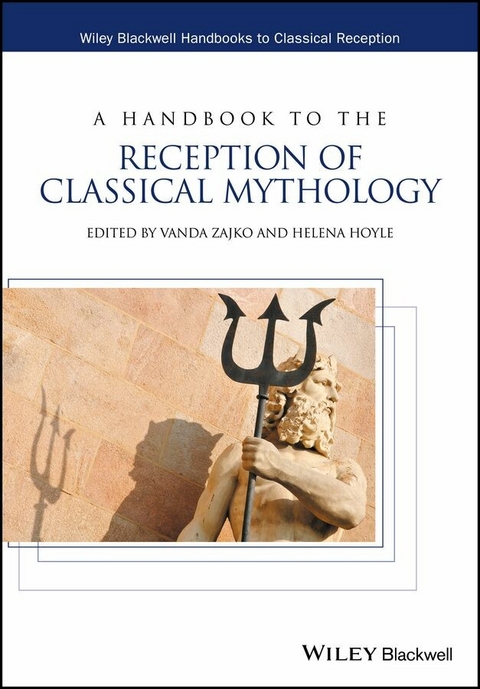
A Handbook to the Reception of Classical Mythology (eBook)
496 Seiten
John Wiley & Sons (Verlag)
978-1-119-07210-2 (ISBN)
* Reveals the importance of mythography to the survival, dissemination, and popularization of classical myth from the ancient world to the present day
* Features chronologically organized essays that address different sets of myths that were important in each historical era, along with their thematic relevance
* Features chronologically organized essays that address different sets of myths that were important in each historical era, along with their thematic relevance
* Offers a series of carefully selected in-depth readings, including both popular and less well-known examples
Vanda Zajko is Reader in Classics at the University of Bristol, UK. She is co-editor with Miriam Leonard of Laughing with Medusa: Classical Myth and Feminist Thought (2006); with Alexandra Lianeri of Translation and the Classic: Identity as Change in the History of Culture (2008); and with Ellen O'Gorman of Classical Myth and Psychoanalysis: Ancient and Modern Stories of the Self (2013).
Notes on Contributors ix
Introduction 1
Vanda Zajko
Part I Mythography 13
1 Greek Mythography 15
Robert L. Fowler
2 Roman Mythography 29
Gregory Hays
3 Myth and the Medieval Church 43
James G. Clark
4 The Renaissance Mythographers 59
John Mulryan
5 Bulfinch and Graves: Modern Mythography as Literary Reception 75
John Talbot
6 Myth Collections for Children 87
Sheila Murnaghan and Deborah H. Roberts
7 Contemporary Mythography: In the Time of Ancient Gods, Warlords, and Kings 105
Ika Willis
Part II Approaches and Themes 121
8 Circean Enchantments and the Transformations of Allegory 123
Greta Hawes
9 The Comparative Approach 139
Sarah Iles Johnston
10 Revisionism 153
Lillian Doherty
11 Alchemical Interpretations of Classical Myths 165
Didier Kahn
12 Nationalism and Cosmopolitanism: On the Gods of Greece, Italy, and India 179
Phiroze Vasunia
13 The Golden Age 193
Andreas T. Zanker
14 Matriarchy and Utopia 213
Peter Davies
Part III Myth, Creativity, and the Mind 229
15 The Half?]Blood Hero: Percy Jackson and Mythmaking in the Twenty-First Century 231
Joanna Paul
16 Myth as Case Study 243
Heather Tolliday
17 Mythical Narrative and Self?]Development 257
Meg Harris Williams
18 Finding Asylum for Virginia Woolf 's Classical Visions 271
Emily Pillinger
Part IV Iconic Figures and Texts 285
19 Orpheus and Eurydice 287
Genevieve Liveley
20 Narcissus and Echo 299
Rosemary Barrow
21 Prometheus, Pygmalion, and Helen: Science Fiction and Mythology 311
Tony Keen
22 Dionysus in Rome 323
Fiachra Mac Góráin
23 Cupid and Psyche 337
Julia Haig Gaisser
24 Constructing a Mythic City in the Book of the City of Ladies: A New Space for Women in Late Medieval Culture 353
Kathryn McKinley
25 Francis Bacon's Wisdom of the Ancients: Between Two Worlds 367
John Channing Briggs
26 Pieter Bruegel the Elder's Landscape with the Fall of Icarus 379
Jeanne Nuechterlein
27 Ancient and Modern Re?]sounding: Monteverdi's Il ritorno d'Ulisse in patria 391
George Burrows
28 Shelley Prometheus Unbound 407
Michael O'Neill
29 George Bernard Shaw: Pygmalion 419
Helen Slaney
30 Camus and the Myth of Sisyphus 433
Kurt Lampe
31 Creative Strategies: Lars von Trier's Medea 447
Mette Hjort
32 Regarding the Pain of Others with Marsyas: On Tortures Ancient and Modern 463
Lisa Saltzman
Index 475
| Erscheint lt. Verlag | 16.3.2017 |
|---|---|
| Reihe/Serie | HCRZ - Wiley-Blackwell Handbooks to Classical Reception | HCRZ - Wiley-Blackwell Handbooks to Classical Reception |
| Sprache | englisch |
| Themenwelt | Geschichte ► Allgemeine Geschichte ► Altertum / Antike |
| Geschichte ► Teilgebiete der Geschichte ► Religionsgeschichte | |
| Geisteswissenschaften ► Religion / Theologie ► Weitere Religionen | |
| Geisteswissenschaften ► Sprach- / Literaturwissenschaft ► Anglistik / Amerikanistik | |
| Geisteswissenschaften ► Sprach- / Literaturwissenschaft ► Literaturwissenschaft | |
| Schlagworte | Classical Studies • Humanistische Studien • Mythologie • Reception of the Ancient World • Rezeption der Antike |
| ISBN-10 | 1-119-07210-7 / 1119072107 |
| ISBN-13 | 978-1-119-07210-2 / 9781119072102 |
| Informationen gemäß Produktsicherheitsverordnung (GPSR) | |
| Haben Sie eine Frage zum Produkt? |
 PDF (Adobe DRM)
Kopierschutz: Adobe-DRM
Adobe-DRM ist ein Kopierschutz, der das eBook vor Mißbrauch schützen soll. Dabei wird das eBook bereits beim Download auf Ihre persönliche Adobe-ID autorisiert. Lesen können Sie das eBook dann nur auf den Geräten, welche ebenfalls auf Ihre Adobe-ID registriert sind.
Details zum Adobe-DRM
Dateiformat: PDF (Portable Document Format)
Mit einem festen Seitenlayout eignet sich die PDF besonders für Fachbücher mit Spalten, Tabellen und Abbildungen. Eine PDF kann auf fast allen Geräten angezeigt werden, ist aber für kleine Displays (Smartphone, eReader) nur eingeschränkt geeignet.
Systemvoraussetzungen:
PC/Mac: Mit einem PC oder Mac können Sie dieses eBook lesen. Sie benötigen eine
eReader: Dieses eBook kann mit (fast) allen eBook-Readern gelesen werden. Mit dem amazon-Kindle ist es aber nicht kompatibel.
Smartphone/Tablet: Egal ob Apple oder Android, dieses eBook können Sie lesen. Sie benötigen eine
Geräteliste und zusätzliche Hinweise
Buying eBooks from abroad
For tax law reasons we can sell eBooks just within Germany and Switzerland. Regrettably we cannot fulfill eBook-orders from other countries.
aus dem Bereich