


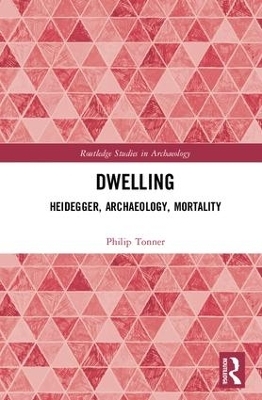
Dwelling
Heidegger, Archaeology, Mortality
Seiten
2017
Routledge (Verlag)
978-1-138-70542-5 (ISBN)
Routledge (Verlag)
978-1-138-70542-5 (ISBN)
Dwelling: Heidegger, Archaeology, Mortality negotiates the discourses of phenomenology, archaeology and palaeoanthropology in order to extend the ‘dwelling perspective’, an approach in the social sciences particularly associated with Tim Ingold and a number of other thinkers, including Chris Tilley, Julian Thomas, Chris Gosden and Clive Gamble, that developed out of an engagement with the thought of Martin Heidegger.
This unique book deals with Heidegger’s philosophy as it has been explored in archaeology and anthropology, seeking to expand its cross-disciplinary engagement into accounts of early humans and death awareness. Tonner reads Heidegger’s thought of dwelling in connection to recent developments in the archaeology of mortuary practice amongst our ancestors. Agreeing with Heidegger that an awareness of death marks out a distinctive way of ‘being-in-the-world’, Tonner rejects any relict anthropocentrism in Heidegger’s thought and seeks to break down simple divisions between humans and pre-humans.
This book is ideal for readers wishing to cross disciplinary boundaries and to challenge anthropocentric thinking in accounts of human evolution. It would be ideal for professional researchers in the fields covered by the book as well as for graduate students and advanced undergraduates.
This unique book deals with Heidegger’s philosophy as it has been explored in archaeology and anthropology, seeking to expand its cross-disciplinary engagement into accounts of early humans and death awareness. Tonner reads Heidegger’s thought of dwelling in connection to recent developments in the archaeology of mortuary practice amongst our ancestors. Agreeing with Heidegger that an awareness of death marks out a distinctive way of ‘being-in-the-world’, Tonner rejects any relict anthropocentrism in Heidegger’s thought and seeks to break down simple divisions between humans and pre-humans.
This book is ideal for readers wishing to cross disciplinary boundaries and to challenge anthropocentric thinking in accounts of human evolution. It would be ideal for professional researchers in the fields covered by the book as well as for graduate students and advanced undergraduates.
Philip Tonner is Head of Philosophy and Religion at Hutchesons’ Grammar School in Glasgow. His work explores the relationships between philosophy, archaeology, museology and education. He is the author of Heidegger, Metaphysics and the Univocity of Being (Continuum 2010) and Phenomenology Between Aesthetics and Idealism (Noesis Press 2015).
Chapter 1 Introduction, Chapter 2 Heidegger and the dwelling perspective, Chapter 3 Origins, Chapter 4 Dwelling and Mortality, Chapter 5 Modernity, dwelling and phenomenological archaeology, Chapter 6 Conclusion
| Erscheinungsdatum | 28.08.2017 |
|---|---|
| Reihe/Serie | Routledge Studies in Archaeology |
| Zusatzinfo | 12 Tables, black and white |
| Verlagsort | London |
| Sprache | englisch |
| Maße | 156 x 234 mm |
| Gewicht | 408 g |
| Themenwelt | Geisteswissenschaften ► Archäologie |
| Geisteswissenschaften ► Philosophie ► Philosophie der Neuzeit | |
| ISBN-10 | 1-138-70542-X / 113870542X |
| ISBN-13 | 978-1-138-70542-5 / 9781138705425 |
| Zustand | Neuware |
| Informationen gemäß Produktsicherheitsverordnung (GPSR) | |
| Haben Sie eine Frage zum Produkt? |
Mehr entdecken
aus dem Bereich

aus dem Bereich
ein Dialog mit Simone Weil
Buch | Softcover (2025)
Matthes & Seitz Berlin (Verlag)
CHF 19,55


