


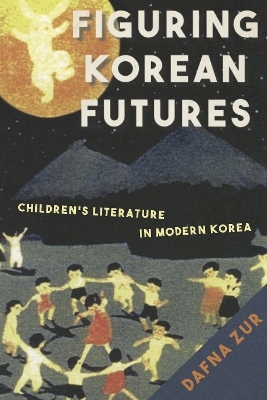
Figuring Korean Futures
Children's Literature in Modern Korea
Seiten
2017
|
New edition
Stanford University Press (Verlag)
9781503601680 (ISBN)
Stanford University Press (Verlag)
9781503601680 (ISBN)
This book is the story of the emergence and development of writing for children in modern Korea. Starting in the 1920s, a narrator-adult voice began to speak directly to a child-reader. This child audience was perceived as unique because of a new concept: the child-heart, the perception that the child's body and mind were transparent and knowable, and that they rested on the threshold of culture. This privileged location enabled writers and illustrators, educators and psychologists, intellectual elite and laypersons to envision the child as a powerful antidote to the present and as an uplifting metaphor of colonial Korea's future.
Reading children's periodicals against the political, educational, and psychological discourses of their time, Dafna Zur argues that the figure of the child was particularly favorable to the project of modernity and nation-building, as well as to the colonial and postcolonial projects of socialization and nationalization. She demonstrates the ways in which Korean children's literature builds on a trajectory that begins with the child as an organic part of nature, and ends, in the post-colonial era, with the child as the primary agent of control of nature. Figuring Korean Futures reveals the complex ways in which the figure of the child became a driving force of nostalgia that stood in for future aspirations for the individual, family, class, and nation.
Reading children's periodicals against the political, educational, and psychological discourses of their time, Dafna Zur argues that the figure of the child was particularly favorable to the project of modernity and nation-building, as well as to the colonial and postcolonial projects of socialization and nationalization. She demonstrates the ways in which Korean children's literature builds on a trajectory that begins with the child as an organic part of nature, and ends, in the post-colonial era, with the child as the primary agent of control of nature. Figuring Korean Futures reveals the complex ways in which the figure of the child became a driving force of nostalgia that stood in for future aspirations for the individual, family, class, and nation.
Dafna Zur is Assistant Professor of East Asian Languages and Cultures at Stanford University.
Introduction: The Child and Modern Korea
1. The Youth Magazine in Early Colonial Korea
2. Figuring the Child-Heart
3. Writing the Language of the Child-Heart
4. The Proletarian Child Fights Back
5. Playing War in Late Colonial Korea
6. Liberating the Child-Heart
Epilogue: The Turn to Science in Postwar North and South Korea
| Erscheinungsdatum | 08.10.2017 |
|---|---|
| Verlagsort | Palo Alto |
| Sprache | englisch |
| Maße | 152 x 229 mm |
| Themenwelt | Geisteswissenschaften ► Sprach- / Literaturwissenschaft ► Anglistik / Amerikanistik |
| Geisteswissenschaften ► Sprach- / Literaturwissenschaft ► Literaturwissenschaft | |
| ISBN-13 | 9781503601680 / 9781503601680 |
| Zustand | Neuware |
| Informationen gemäß Produktsicherheitsverordnung (GPSR) | |
| Haben Sie eine Frage zum Produkt? |
Mehr entdecken
aus dem Bereich



aus dem Bereich
Paul Celans Poetik der Mehrsprachigkeit
Buch | Hardcover (2025)
De Gruyter (Verlag)
CHF 153,90


