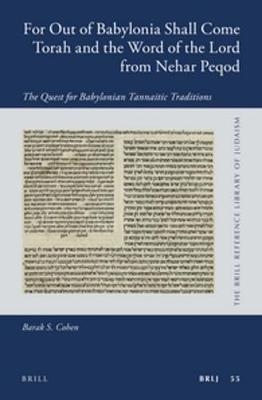
For Out of Babylonia Shall Come Torah and the Word of the Lord from Nehar Peqod
Brill (Verlag)
9789004347014 (ISBN)
Was this corpus one of the main contributors to the forced interpretations and resolutions found so frequently in the Bavli?
Barak S. Cohen, Ph.D. (2004) in Talmud and Rabbinics, is a senior lecturer at the Department of Talmud, Faculty of Jewish Studies, Bar-Ilan University. He has published extensively on the intellectual history, chronology and historiography of the Babylonian Amoraim. His previous book, The Legal Methodology of Late Nehardean Sages in Sasanian Babylonia, was published in 2011.
Acknowledgements
1 Introduction: A Reassesment of the Existence of Babylonian Tannaitic Traditions
“Babylonian Mishnah,” “Babylonian Baraitot,” and “Amoraic Baraitot”
The Significance of the Study of Early Babylonian Traditions
The Halakhic Corpora Discussed in This Study
History of Scholarship
Introductory Terms
Baraitot Which Interpret, Expand, or Add to the Mishnah
A Brief and Anonymous Formulation, without Attribution to Tannaim
The Absence of a Parallel in Palestinian Tannaitic Literature
The Relationship between Baraitot and Amoraic Memrot
Late Insertions of Halakhot and Interpretations into Earlier Baraitot
The Names of Sages and Their Geographical Location
Findings and Conclusions
The Origin and Nature of Halakha in Babylonia during the Second-Third Centuries
The Historical Reliability of Attributions
The Literary Contribution of Babylonian Sages from the Pre-talmudic Period
2 In Quest of Babylonian Halakha in Tannaitic Compositions
Babylonian Rabbinic Traditions in the Proto-talmudic Era: A History of Scholarship
Summary and Conclusions
Appendix: A Survey of the Main Evidence Presented by Scholars as Proof for the Existence of “Babylonian Halakhot” from the Mishnaic Period
Circumstancial Evidence
Sources in the Babylonian Talmud
b. Sukkah 20a
b. Pesaḥ. 109a
b. Git. 14b = b. Ketub. 94b
b. B. Bat. 7b
b. Beṣah 34b
b. Šabb. 6b = Šabb. 96b
b. Ḥul. 63b
b. Beṣah 6a
b. Nid. 14a
b. Šabb. 35b
b. Git. 65b
Sources in the Palestinian Talmud
y. Ḥal. 4:4 (60a)
y. Ta’an. 1:1 (63d) = b. Ta’an. 10a
y. Sanh. 8:4 (26b) = y. Soṭah 4:12 (19c) = Sifre Deut. 118 (ed. Finkelstein, p. 251)
y. Sanh. 1:3 (19a) = y. Ned. 6:8 (40a) = b. Ber. 63a-b
y. Šabb. 5:4 (7c) = y. Beṣah 2:8 (61c)
y. Qidd. 3:5 (64a) = b. Git. 14a
Midrashic Sources
Genesis Rabbah 33:3 (ed. Theodor-Albeck, p. 306)
Midrash Psalms 104:22 (ed. Buber, p. 446)
The Gaonic Evidence: R Sherira Gaon
R. Sherira Gaon, Epistle of R. Sherira Gaon, p 40
3 The Legal Traditions of Avuha-De-Shmuel
Introduction
Early Babylonian Halakhic Traditions?
His Halakhic Rulings
His Commentary on and Emendation of Tannaitic Sources
Avuha De-Shmuel’s Customs
Summary and Conclusions
4 The Legal Traditions of R. Shila
Introduction
The Problem of His Identification
Passages in Which R. Shila’s Identity is Certain
Doubtful Appearances of R. Shila in the Talmuds
Summary and Conclusions
Appendix: Traditions Ascribed to R. Shila in the Talmuds and Their Parallels in Palestinian Tannaitic Literature
Appearances Included in This Study
Certain Appearances
Doubtful Appearances
Appearances Not Included in This Study
Doubtful Appearances in Mss
The Tanna, R. Shila
A Late Aggadic Story
“Of the House of R. Shila (“ד]בי[ת] רב שילא]”)
5 Levi’s Baraitot: Tannei Levi, Tanna D’bei Levi
Introduction
Previous Scholarship
Baraitot Which Interpret, Expand, or Add to the Mishnah
Analysis of Sugyot
Laws Related to Topics Not Covered by the Mishnah
Baraitot That Differ from the Mishnah or Dispute It
Summary and Conclusions
Appendix: A List of All Levi’s Baraitot and Their Parallels in Rabbinic Literature
Babylonian Talmud
Palestinian Talmud
6 Shmuel’s Baraitot: Tanna D’Bei Shmuel, Tannei Shmuel
Introduction
Previous Scholarship
Analysis of Sugyot
Summary and Conclusions
Appendix: Shmuel’s Attitude towards the Tanna D’Bei Shmuel Baraitot
7 “They Teach There” (“תניי תמן”): “Babylonian Baraitot” in the Palestinian Talmud
Introduction
Re-evaluating Previous Research: Early Babylonian Halakhic Traditions?
Analysis of Sugyot
Summary and Conclusions
Appendix: The Halakhot Transmitted in the “They Teach There” (“תניי תמן”) Baraitot in the Palestinian Talmud and Their Parallels in Tannaitic Literature
8 The Tannei Tanna Kameh Baraitot
Introduction
Interpretations and Expansions of the Mishnah
Baraitot Containing Amoraic Additions
Baraitot That Were Rejected or Emended
Summary and Conclusions
Appendix A: A Detailed List of Halakhot Found in ttk Baraitot and Their Parallels in Tannaitic Literature
Babylonian Talmud
Palestinian Talmud
Appendix B: ttk Baraitot in the Babylonian Talmud Without an Amoraic Response
9 Shmuel: A Model of Halakhic Consistency
Introduction
The State of Scholarship: An Evaluation
A New Appraisal of Shmuel’s Halakhic Methodology Shmuel Rules According to the More Lenient Opinion
Adopting the Opinion of “Babylonian Tannaim”
Summary and Conclusions
Appendix A: Halakhic Rulings in the Two Talmuds Issued by Shmuel Using the Term “Halakha” or “Hilkheta” (“הלכה”/“הלכתא”) and the Names of the Amoraim Who Transmitted Them
Babylonian Talmud
Palestinian Talmud
Appendix B: Decisions Made by Shmuel Which Accord with the More Lenient Tanna
Babylonian Talmud
Palestinian Talmud
Uncertain Cases
Bibliography
Index
| Erscheinungsdatum | 08.06.2017 |
|---|---|
| Reihe/Serie | The Brill Reference Library of Judaism ; 55 |
| Verlagsort | Leiden |
| Sprache | englisch |
| Maße | 155 x 235 mm |
| Gewicht | 619 g |
| Themenwelt | Geisteswissenschaften ► Religion / Theologie ► Judentum |
| Geisteswissenschaften ► Sprach- / Literaturwissenschaft ► Anglistik / Amerikanistik | |
| Geisteswissenschaften ► Sprach- / Literaturwissenschaft ► Literaturwissenschaft | |
| ISBN-13 | 9789004347014 / 9789004347014 |
| Zustand | Neuware |
| Informationen gemäß Produktsicherheitsverordnung (GPSR) | |
| Haben Sie eine Frage zum Produkt? |
aus dem Bereich