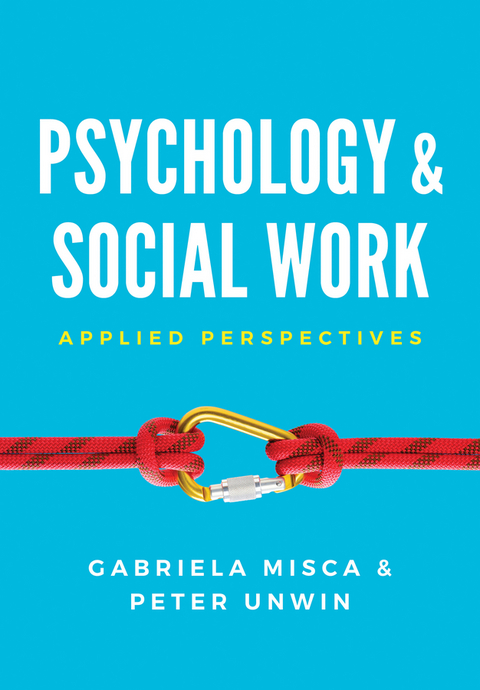
Successful social work practice is underpinned by knowledge, theories and research findings from a range of related disciplines, key among which is psychology. This timely book offers a grounded and engaging guide to psychology's vital role at the heart of contemporary social work practice.
The book skilfully addresses some of the central theoretical developments in psychology from an applied perspective, and explains how these make essential contributions to the methods and theory base of social work in ways that foster critical evaluation and promote best practice.
Written by two authors with extensive backgrounds in psychology and social work respectively-as well as a deep understanding of the intersections of the two-this book delivers a unique synthesis of perspectives and approaches, focusing on their application to the lives of individuals and families. Each chapter contains reflective points and case studies based on contemporary practice realities which are related to the Professional Capabilities Framework for Social Workers and also to the Health and Care Professions Council's Standards of Proficiency.
Times have never been more challenging for social work and this book will be an invaluable source of professional support within the ever-more complex psychological worlds where social work takes place.
Gabriela Misca is Senior Lecturer in Psychology at the University of Worcester and Associate Fellow of the British Psychological Society
Peter Unwin is Senior Lecturer in Social Work at the University of Worcester and Council Member of the British Association of Social Workers
Successful social work practice is underpinned by knowledge, theories and research findings from a range of related disciplines, key among which is psychology. This timely book offers a grounded and engaging guide to psychology's vital role at the heart of contemporary social work practice.The book skilfully addresses some of the central theoretical developments in psychology from an applied perspective, and explains how these make essential contributions to the methods and theory base of social work in ways that foster critical evaluation and promote best practice.Written by two authors with extensive backgrounds in psychology and social work respectively as well as a deep understanding of the intersections of the two this book delivers a unique synthesis of perspectives and approaches, focusing on their application to the lives of individuals and families. Each chapter contains reflective points and case studies based on contemporary practice realities which are related to the Professional Capabilities Framework for Social Workers and also to the Health and Care Professions Council's Standards of Proficiency. Times have never been more challenging for social work and this book will be an invaluable source of professional support within the ever-more complex psychological worlds where social work takes place.
Gabriela Misca is Senior Lecturer in Psychology at the University of Worcester and Associate Fellow of the British Psychological Society Peter Unwin is Senior Lecturer in Social Work at the University of Worcester and Council Member of the British Association of Social Workers
1. Introduction: The place of psychological knowledge and research in social work training and practice
2. Signposts from Developmental Psychology on Human Development over the Life Course
3. Perspectives from Clinical and Counselling Psychology on Mental Health and Illness
4. Perspectives from Social and Community Psychology: Understanding values, attitudes, diversity and community change
5. Health Psychology: Understanding health, illness, stress and addiction
6. Organizational Psychology: Understanding the individual and the organization in the social work structure
7. Forensic Psychology: Understanding criminal behaviour and working with victims of crime
8. Conclusion
References
Index
"This text provides a very well structured and written introduction to the application of psychology to social work. Its use of detailed examples brings the theory to life and ensures that the reader will come away with an understanding of the many uses of psychology in different social settings."
Michael Murray, Keele University
"A must for those wanting to know how to apply psychological insights to their social work practice. This textbook provides an engaging description of key psychological theories and perspectives critically applied to contemporary social work practice accompanied by reflective discussions and a long running case study."
Hugh McLaughlin, Manchester Metropolitan University
2
Signposts from Developmental Psychology on Human Development over the Life Course
The following are the key relevant capabilities and standards in this chapter for social workers.
Professional Capabilities Framework (BASW, 2015)
5 Knowledge
5.4 Recognise the short and long term impact of psychological, socio-economic, environmental and physiological factors on people’s lives, taking into account age and development, and how this informs practice
5.6 Acknowledge the centrality of relationships for people and the key concepts of attachment, separation, loss, change and resilience
Standards of Proficiency (HCPC, 2012)
13 Understand the key concepts of the knowledge base which are relevant to their profession
13.4 Human growth and development across the lifespan and the impact of key developmental stages and transitions
Introduction
Social work addresses issues with individuals at all stages in life, from infancy, through to childhood, adolescence, adulthood and old age. Developmental psychology is a branch of psychology which studies the systematic changes (psychological, cognitive, emotional) occurring over the life course. It is not in itself an applied field, but it is prolifically applied in many other fields, such as educational, forensic and health psychology. Of all the branches of psychology, developmental psychology is perhaps most familiar to social workers, students and professionals, as it contributes prominently to social work training under topics such as ‘human growth and development’ and/or ‘life-course development’.
Social work takes place with individuals and families in challenging and often extreme situations, but judgements and risk assessments need to be made against an understanding of ‘normative’ development. Children who have been neglected or abused will develop in different ways to children with a positive experience of nurture. Adults who have been sexually abused will need particular understanding with regard to their mental health and their parenting. Adults and children involved in domestic violence will need to be understood by social workers in reference to how past experiences might or might not affect future experiences, mental health relationships and ability for child care. Social work takes place in multicultural settings, and this chapter will also consider the influence of culture on development across the life course, taking note of the findings of recent inquiries regarding the importance of cultural understanding to child-centred decisions.
Psychology as a scientific and practical field became established much earlier than social work and, as such, provided many fundamental concepts and theories for developing tools and techniques for social work, some of which will be explored throughout his chapter. Having a basic knowledge and understanding of developmental theories and concepts is important for social workers, who need to assess and intervene in the lives of a range of different individuals and environments in their everyday practice. Many of the fundamental assumptions, concepts, principles, theories, methods and techniques used within social work are derived from developmental psychology.
What is developmental psychology and how is it relevant to social work?
According to the British Psychological Society (2015b), developmental psychology is the scientific study of cognitive, emotional, social, perceptual and biological age-related changes in both mind and behaviour. Original ideas about human development proposed that the formation of all our skills and abilities was completed in childhood; indeed many of the initial developmental psychology theories – such as Piaget’s theory of cognitive development and Bowlby’s attachment theory – were essentially concerned with childhood development. Nowadays, however, development is seen as a lifelong process, and, as lifespans increase and technology impacts on development and communication, it is accepted that the life course of any individual involves constant development and readjustment. Moreover, human development is multidimensional and incorporates psychological, biological, cognitive, social and cultural influences which overlap and interact interchangeably and shape individual development across the life course. Developmental psychology is informed by scientific methods of studying human behaviour and theories which aim to further our understanding of how development evolves, offering a growing body of knowledge of the general principles and models and of the differences and similarities in development across individuals. However, the study of human development is an endeavour that has been influenced by a multiplicity of disciplines, including psychology, biology, anthropology, sociology and history.
Reflective point
As you read this chapter, consider how knowledge of developmental psychology might help inform social work practice with the Brightwell family. The Brightwells certainly have a lot of issues, but their case is fairly typical of those open to statutory social workers and, if we are honest, there are elements of the Brightwell family in all of our families. Social workers should always be aware of this shared humanity and strike that difficult balance between empathy and authoritative practice – a balance that is more achievable from a sound and inquisitive knowledge base about developmental psychology.
Discussion: Exploring issues around the Brightwell family
Consider the situation of Susan Brightwell as an abused partner, single parent and carer for her mother. It is likely that her experiences impacted on her own life chances and potential for development. For example, caring responsibilities have made it unlikely that she would have been able to develop any educational or career aspirations and, given the pressing demands of close family, it is also likely that she neglects her own physical and mental health. Her self-esteem, after an unhappy relationship, is likely to be low, and Wayne’s abusive behaviour towards her will only serve to reinforce those feelings. There are several junctures in the Brightwell family’s life course when social workers might be involved, and the reflective social worker, equipped with an understanding of developmental psychology, will look further than the specific presenting problem and hopefully be able to make a difference to the family’s overall level of functioning.
Debates within developmental psychology
There are a number of long-standing debates within developmental psychology that are still being explored by continued research and theoretical developments. Some of the key elements of these debates are presented below, although it should be borne in mind that the families and individuals known to social workers have often experienced distorted, rather than normative, patterns of development likely to include issues such as the mental health of carers, the neglect of children, domestic violence and poor living conditions. Hence it should be expected that certain developmental milestones will be met within differing timescales.
Nature vs. nurture
The nature vs. nurture debate (Rutter, 2006) is one of the oldest debates in psychology and in essence refers to the relative contribution of nature and environment to human development. For example, the argument that development is rooted in nature can be traced back to philosophers such as Plato and Descartes, who supported the notion that babies are born with innate skills that are somehow programmed in the human mind. Nowadays, the nature argument encompasses advances in genetics and refers to the position that our genetic make-up and inheritance are the primary influence on development, while nurture refers to those primary influences being provided by our environment. This latter view evolved from early ideas in the seventeenth and eighteenth centuries of the child being a ‘blank slate’ at birth (John Locke, 1632–1704) and that environmental experiences are key in shaping the individual through their life course.
The contemporary view of the debate captures the complex interplay between nature and nurture. For example, the concept of temperament (Chess and Thomas, 1977) refers to individuals’ ways of responding to the emotional events and problems they may face; the child’s temperament appears to be affected in part by their genetic make-up but may be altered as a result of the environment in which they live (Rothbart et al., 2000).
Case studies: The nature vs. nurture debate
1) Consider the situation of Laura, a child brought up from birth in a home environment characterized by neglect and the drug abuse of both her parents. At age sixteen Laura decided that she was going to make something of her life and rejected what she saw as the ‘inherited self’ (low aspirations, low self-esteem, the beginnings of depression). She began attending school regularly, moved out of her parents’ home to live with an aunt and went on to complete a degree at university.
Discussion
Laura’s early life path has clearly been one shaped by nature. Consider how the nature vs. nurture perspectives might help explain her life path.
2) Consider the situations of Stella and Paul, both adopted at a few months of age from different birth families of mixed-race heritage. Adopted by a middle-class white couple in the 1970s,...
| Erscheint lt. Verlag | 27.2.2017 |
|---|---|
| Sprache | englisch |
| Themenwelt | Geisteswissenschaften ► Psychologie |
| Sozialwissenschaften ► Pädagogik ► Sozialpädagogik | |
| Sozialwissenschaften ► Politik / Verwaltung ► Staat / Verwaltung | |
| Sozialwissenschaften ► Soziologie | |
| Schlagworte | Bildungswesen • Education • Gesundheits- u. Sozialwesen • Health & Social Care • Lehrpläne / Psychologie • Psychologie • Psychology • Social Policy & Welfare • Social Work • social work, applied social work, health care, social care, social problems, welfare, social services, psychological theories, applied psychology, child development • Sozialarbeit • Sozialpolitik u. Wohlfahrt |
| ISBN-13 | 9780745696348 / 9780745696348 |
| Informationen gemäß Produktsicherheitsverordnung (GPSR) | |
| Haben Sie eine Frage zum Produkt? |
 EPUB (Adobe DRM)
Kopierschutz: Adobe-DRM
Adobe-DRM ist ein Kopierschutz, der das eBook vor Mißbrauch schützen soll. Dabei wird das eBook bereits beim Download auf Ihre persönliche Adobe-ID autorisiert. Lesen können Sie das eBook dann nur auf den Geräten, welche ebenfalls auf Ihre Adobe-ID registriert sind.
Details zum Adobe-DRM
Dateiformat: EPUB (Electronic Publication)
EPUB ist ein offener Standard für eBooks und eignet sich besonders zur Darstellung von Belletristik und Sachbüchern. Der Fließtext wird dynamisch an die Display- und Schriftgröße angepasst. Auch für mobile Lesegeräte ist EPUB daher gut geeignet.
Systemvoraussetzungen:
PC/Mac: Mit einem PC oder Mac können Sie dieses eBook lesen. Sie benötigen eine
eReader: Dieses eBook kann mit (fast) allen eBook-Readern gelesen werden. Mit dem amazon-Kindle ist es aber nicht kompatibel.
Smartphone/Tablet: Egal ob Apple oder Android, dieses eBook können Sie lesen. Sie benötigen eine
Geräteliste und zusätzliche Hinweise
Buying eBooks from abroad
For tax law reasons we can sell eBooks just within Germany and Switzerland. Regrettably we cannot fulfill eBook-orders from other countries.
aus dem Bereich