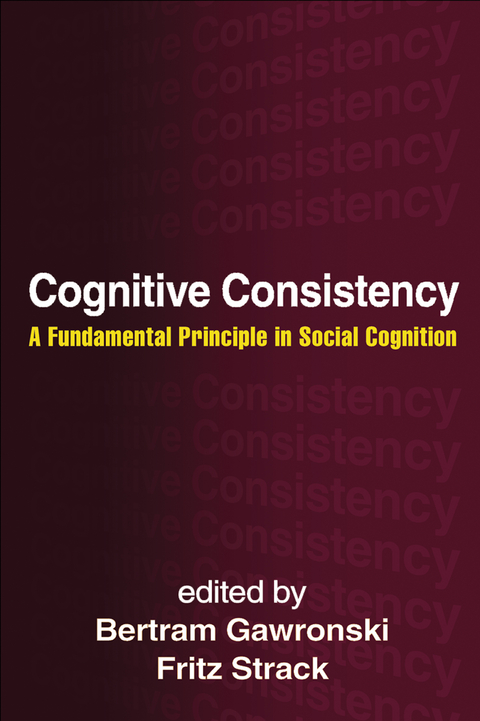
Cognitive Consistency (eBook)
494 Seiten
The Guilford Press (Verlag)
9781609189488 (ISBN)
Bertram Gawronski, PhD, is Professor of Psychology at the University of Texas at Austin. His research investigates the mental underpinnings and behavioral consequences of spontaneous and deliberate evaluations of objects, individuals, groups, and social issues. Dr. Gawronski's work has been recognized with honors including the Theoretical Innovation Prize from SPSP, the Career Trajectory Award from SESP, the Early Career Award from the International Social Cognition Network, the Early Researcher Award from the Ministry of Research and Innovation of Ontario, and the Charlotte-and-Karl-Bühler Award from the German Psychological Society. He is a fellow of APS, SESP, and SPSP.Fritz Strack, PhD, is Professor of Psychology at the University of Würzburg, Germany. His research focuses on reflective and impulsive processes underlying social behavior. Dr. Strack's work has been recognized with the Theoretical Innovation Prize from the Society for Personality and Social Psychology, the Thomas M. Ostrom Award from the Person Memory Interest Group for outstanding lifetime contributions to theory and research in the field of social cognition, and the Wilhelm Wundt Medal from the German Psychological Society for outstanding achievements in the field of psychology.
1. Cognitive Consistency as a Basic Principle of Social Information Processing, Bertram Gawronski and Fritz Strack I. Mental Representation2. Cognitive Conflict and Consciousness, Ezequiel Morsella, Pareezad Zarolia, and Adam Gazzaley 3. A Neuroscientific Perspective on Dissonance, Guided by the Action-Based Model, Eddie Harmon-Jones, Cindy Harmon-Jones, and David M. Amodio4. Parallel Constraint Satisfaction as a Mechanism for Cognitive Consistency, Stephen J. Read and Dan Simon II. Fluency and Fit 5. Fluency of Consistency: When Thoughts Fit Nicely and Flow Smoothly, Piotr Winkielman, David E. Huber, Liam Kavanagh, and Norbert Schwarz6. Nonpropositional Consistency, Sascha Topolinski 7. Motivational Fit, E. Tory HigginsIII. Implicit Social Cognition8. Balanced Identity Theory:Review of Evidence for Implicit Consistency in Social Cognition, Dario Cvencek, Anthony G. Greenwald, and Andrew N. Meltzoff 9. Implicit Ambivalence, Richard E. Petty, Pablo Briñol, and India Johnson10. Discrepancies between Implicit and Explicit Attitudes, Prejudices, and Self-Esteem: A Model of Simultaneous Accessibility, Christian H. Jordan, Christine Logel, Steven J. Spencer, and Mark P. Zanna IV. Thinking and Reasoning11. Mental Models and Consistency, Philip N. Johnson-Laird12. Cognitive Consistency as Means to an End: How Subjective Logic Affords Knowledge, Arie W. Kruglanski and Garriy ShteynbergV. Decision Making and Choice13. The Dynamics of Ambivalence: Evaluative Conflict in Attitudes and Decision Making, Frenk van Harreveld, Iris K. Schneider, Hannah Nohlen, and Joop van der Pligt 14. Self-Produced Decisional Conflict Due to Incorrect Metacognitions, Lottie Bullens, Jens Förster, Frenk van Harreveld, and Nira Liberman 15. Regret, Consistency, and Choice: An Opportunity × Mitigation Framework, Keith D. Markman and Denise R. Beike 16. Consistency as a Basis for Behavioral Interventions: Using Hypocrisy and Cognitive Dissonance to Motivate Behavior Change, Jeff StoneVI. Interpersonal Processes17. Balance Principles in Attitude Formation and Change: The Desire to Maintain Consistent Cognitions about People, Eva Walther and Rebecca Weil18. Cognitive Consistency in Prejudice-Related Belief Systems: Integrating Old-Fashioned, Modern, Aversive, and Implicit Forms of Prejudice, Bertram Gawronski, Paula M. Brochu, Rajees Sritharan, and Fritz Strack19. Stereotype Confirmation and Disconfirmation, Jeffrey W. Sherman, Thomas J. Allen, and Dario L. M. Sacchi20. Adhering to Consistency Principles in an Unjust World: Implications for Sense-Making, Victim Blaming, and Justice Judgments, Kees van den Bos and Marjolein Maas 21. Interpersonal Cognitive Consistency and the Sharing of Cognition in Groups, Ernest S. Park, R. Scott Tindale, and Verlin B. Hinsz
| Erscheint lt. Verlag | 27.1.2012 |
|---|---|
| Sprache | englisch |
| Maße | 160 x 160 mm |
| Themenwelt | Geisteswissenschaften ► Psychologie ► Allgemeine Psychologie |
| Geisteswissenschaften ► Psychologie ► Psychoanalyse / Tiefenpsychologie | |
| Geisteswissenschaften ► Psychologie ► Sozialpsychologie | |
| Geisteswissenschaften ► Psychologie ► Verhaltenstherapie | |
| Schlagworte | attitudes • cognitive consistency • cognitive dissonance • Information Processing • Personality • Prejudice • Social Cognition • Social Psychology • stereotypes • Stereotyping • "substance abuse, behavior change, psychotherapy, interventions, addictions, ambivalence, resistance, therapy, counseling field, counseling students, interviewing skills, meth addiction, life coaching, helping professionals, therapeutic relationship, helping professions, professional counselor, core concepts, social workers, transpersonal, rationales, person-centered, exam, cognitive-behavioral, court-ordered, modality, clinicians, evidence-based, revisions, trainers, therapists, counselors, seminar, exerci |
| ISBN-13 | 9781609189488 / 9781609189488 |
| Informationen gemäß Produktsicherheitsverordnung (GPSR) | |
| Haben Sie eine Frage zum Produkt? |
 EPUB (Adobe DRM)
Kopierschutz: Adobe-DRM
Adobe-DRM ist ein Kopierschutz, der das eBook vor Mißbrauch schützen soll. Dabei wird das eBook bereits beim Download auf Ihre persönliche Adobe-ID autorisiert. Lesen können Sie das eBook dann nur auf den Geräten, welche ebenfalls auf Ihre Adobe-ID registriert sind.
Details zum Adobe-DRM
Dateiformat: EPUB (Electronic Publication)
EPUB ist ein offener Standard für eBooks und eignet sich besonders zur Darstellung von Belletristik und Sachbüchern. Der Fließtext wird dynamisch an die Display- und Schriftgröße angepasst. Auch für mobile Lesegeräte ist EPUB daher gut geeignet.
Systemvoraussetzungen:
PC/Mac: Mit einem PC oder Mac können Sie dieses eBook lesen. Sie benötigen eine
eReader: Dieses eBook kann mit (fast) allen eBook-Readern gelesen werden. Mit dem amazon-Kindle ist es aber nicht kompatibel.
Smartphone/Tablet: Egal ob Apple oder Android, dieses eBook können Sie lesen. Sie benötigen eine
Geräteliste und zusätzliche Hinweise
Buying eBooks from abroad
For tax law reasons we can sell eBooks just within Germany and Switzerland. Regrettably we cannot fulfill eBook-orders from other countries.
aus dem Bereich