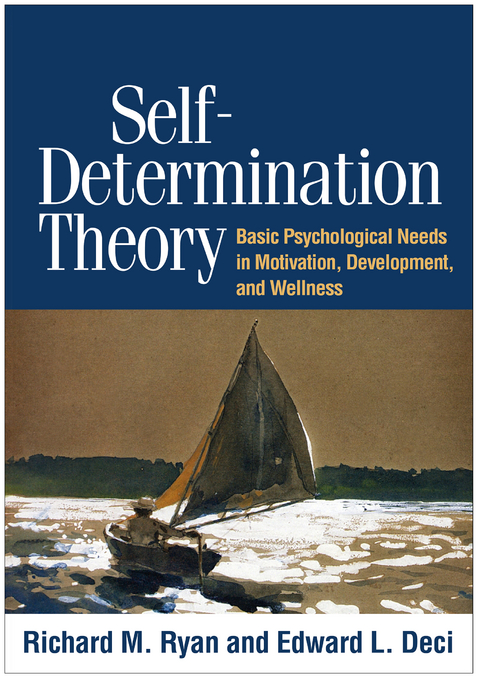
Self-Determination Theory (eBook)
756 Seiten
The Guilford Press (Verlag)
978-1-4625-2878-3 (ISBN)

Richard M. Ryan, PhD, is Research Professor at the Institute for Positive Psychology and Education at Australian Catholic University, and Professor of Clinical and Social Sciences in Psychology at the University of Rochester. Dr. Ryan is a Fellow of the American Psychological Association, the Association for Psychological Science, the American Educational Research Association, and the Society for Personality and Social Psychology. He received distinguished career awards from the International Society for Self and Identity and the International Network on Personal Meaning, as well as a Shavelson Distinguished Researcher Award, presented by the International Global SELF Research Centre, among other honors. An honorary member of the German Psychological Society and the recipient of an honorary doctorate from the University of Thessaly in Greece, he is also a recipient of a James McKeen Cattell Fund Fellowship and a Leverhulme Fellowship. Dr. Ryan has also been a visiting professor at the National Institute of Education in Singapore, the University of Bath in England, and the Max Planck Institute in Berlin, Germany. Edward L. Deci, PhD, is the Helen F. and Fred H. Gowen Professor in the Social Sciences at the University of Rochester, with secondary appointments at the University College of Southeast Norway and Australian Catholic University. Dr. Deci is a Fellow of the Association for Psychological Science, the American Psychological Association, and the Society for Personality and Social Psychology, among other associations. His numerous honors include a distinguished scholar award from the Society for Personality and Social Psychology, a lifetime achievement award from the International Society for Self and Identity, and a distinguished scientific contribution award from the Positive Psychology Network. He was named honorary president of the Canadian Psychological Association and is a recipient of a James McKeen Cattell Fund Fellowship.
I. Introduction 1. Self-Determination Theory: An Introduction and Overview II. Philosophical and Historical Considerations 2. Organismic Principles: Historical Perspectives on Development and Integration in Living Entities 3. Human Autonomy: Philosophical Perspectives and the Phenomenology of Self 4. Psychological Needs: Varied Concepts and a Preliminary Description of Self-Determination Theory’s Approach 5. A Brief History of Intrinsic Motivation III. The Six Mini-Theories of Self-Determination Theory 6. Cognitive Evaluation Theory, Part I: The Effects of Rewards, Feedback, and Other External Events on Intrinsic Motivation 7. Cognitive Evaluation Theory, Part II: Interpersonal and Intrapersonal Processes Affecting Intrinsic Motivation 8. Organismic Integration Theory: Internalization and the Differentiation of Extrinsic Motivation 9. Causality Orientations Theory: Individual Differences in, and Priming of, Motivational Orientations 10. Basic Psychological Needs Theory: Satisfaction and Frustration of Autonomy, Competence, and Relatedness in Relation to Psychological Wellness and Full Functioning 11. Goal Contents Theory: Aspirations, Life Goals, and Their Varied Consequences 12. Relationships Motivation Theory: The Self in Close Relationships IV. Motivation and Human Development in Families, Schools, and Societies 13. Parenting and the Facilitation of Autonomy and Well-Being in Development 14. Schools as Contexts for Learning and Social Development 15. Identity Development, Self-Esteem, and Authenticity 16. Development, Basic Psychological Needs, and Psychopathology V. The Application and Practice of Self-Determination Theory in Multiple Domains 17. Psychotherapy and Behavior Change: Creating Facilitating Environments 18. Health Care and Patient Need Satisfaction: Supporting Maintained Health Behavior Change 19. Sport, Physical Activity, and Physical Education 20. Motivation and Need Satisfaction in Video Games and Virtual Environments 21. Work and Organizations: Promoting Wellness and Productivity VI. Basic Psychological Needs in Pervasive Social Contexts 22. Pervasive Social Influences, Part I: Cultural Contexts 23. Pervasive Social Influences, Part II: Economic and Political Systems 24. On Basic Needs and Human Natures: Altruism, Aggression, and the Bright and Dark Sides of Human Motivation A Very Brief Epilogue References Author Index Subject Index
| Erscheint lt. Verlag | 20.1.2017 |
|---|---|
| Sprache | englisch |
| Maße | 180 x 180 mm |
| Themenwelt | Geisteswissenschaften ► Psychologie ► Psychoanalyse / Tiefenpsychologie |
| Geisteswissenschaften ► Psychologie ► Sozialpsychologie | |
| Schlagworte | adults • Autonomy • Behavioral Health • Behavior change • children • close relationships • competence • Educational Psychology • exercise • Extrinsic • Families • Family • goals • Health Care • Human nature • intrinsic • learning • Management • Motivation • organizational psychology • parenting • Parents • Personality • psychological needs • psychotherapy • relatedness • schools • sdt • Self-Determination Theory • social development • Social Psychology • Sports • Teaching • Wellness • Workplaces |
| ISBN-10 | 1-4625-2878-3 / 1462528783 |
| ISBN-13 | 978-1-4625-2878-3 / 9781462528783 |
| Informationen gemäß Produktsicherheitsverordnung (GPSR) | |
| Haben Sie eine Frage zum Produkt? |
 EPUB (Adobe DRM)
Kopierschutz: Adobe-DRM
Adobe-DRM ist ein Kopierschutz, der das eBook vor Mißbrauch schützen soll. Dabei wird das eBook bereits beim Download auf Ihre persönliche Adobe-ID autorisiert. Lesen können Sie das eBook dann nur auf den Geräten, welche ebenfalls auf Ihre Adobe-ID registriert sind.
Details zum Adobe-DRM
Dateiformat: EPUB (Electronic Publication)
EPUB ist ein offener Standard für eBooks und eignet sich besonders zur Darstellung von Belletristik und Sachbüchern. Der Fließtext wird dynamisch an die Display- und Schriftgröße angepasst. Auch für mobile Lesegeräte ist EPUB daher gut geeignet.
Systemvoraussetzungen:
PC/Mac: Mit einem PC oder Mac können Sie dieses eBook lesen. Sie benötigen eine
eReader: Dieses eBook kann mit (fast) allen eBook-Readern gelesen werden. Mit dem amazon-Kindle ist es aber nicht kompatibel.
Smartphone/Tablet: Egal ob Apple oder Android, dieses eBook können Sie lesen. Sie benötigen eine
Geräteliste und zusätzliche Hinweise
Buying eBooks from abroad
For tax law reasons we can sell eBooks just within Germany and Switzerland. Regrettably we cannot fulfill eBook-orders from other countries.
aus dem Bereich