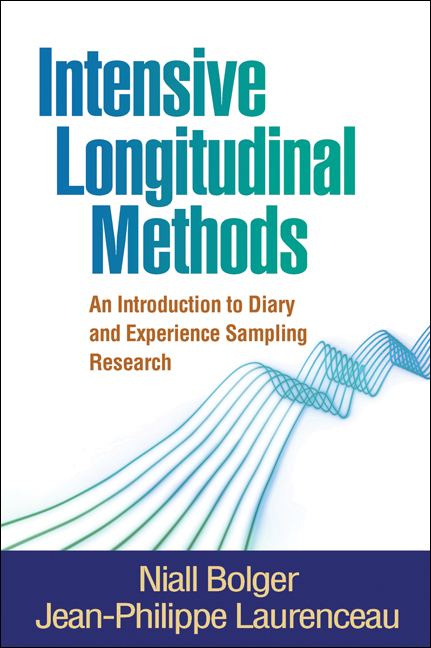
Intensive Longitudinal Methods (eBook)
256 Seiten
Guilford Publications (Verlag)
978-1-4625-0691-0 (ISBN)
Niall Bolger, PhD, is Professor and Chair of Psychology at Columbia University. He is a Charter Member and Fellow of the Association for Psychological Science and a Fellow of the Society of Experimental Social Psychology and the Society for Personality and Social Psychology. Dr. Bolger's main research interests include adjustment processes in close relationships using intensive longitudinal methods and laboratory-based studies of dyadic behavior, emotion and physiology, and personality processes as they are revealed in patterns of behavior, emotion, and physiology in daily life. He is also interested in statistical methods for analyzing longitudinal and multilevel data.Jean-Philippe Laurenceau, PhD, is Professor of Psychology at the University of Delaware. He is an appointed member of the Social, Personality, and Interpersonal Processes grant review panel of the National Institutes of Health. Dr. Laurenceau's research focuses on understanding the processes by which partners in marital and romantic relationships develop and maintain intimacy in the context of everyday life. His methodological interests include intensive longitudinal methods for studying close relationship processes and applications of modern methods for the analysis of change in individuals and dyads.
1. Introduction to Intensive Longitudinal Methods1.1 What Are Intensive Longitudinal Methods?1.2 Applications of Intensive Longitudinal Methods1.3 Why Use Intensive Longitudinal Methods?1.4 Goals for This Book and Intended Audience1.5 Organization of This Book1.6 Recommended Readings2. Types of Intensive Longitudinal Designs2.1 Chapter Overview2.2 Strengths of Intensive Longitudinal Designs2.3 Types of Research Questions2.4 Types of Designs and Prototypical Examples2.5 Limitations of Intensive Longitudinal Designs2.6 Which Intensive Longitudinal Design Is Best for You?2.7 Chapter Summary2.8 Recommended Readings3. Fundamentals of Intensive Longitudinal Data3.1 Chapter Overview3.2 An Example Dataset3.3 Between-Subjects and Within-Subjects Levels of Analysis3.4 Allowing for Between-Subjects Heterogeneity: Random Effects3.5 Taking Account of Time3.6 How Many Independent Units Are There in Intensive Longitudinal Datasets?3.7 Choosing an Appropriate Zero Point For X3.8 Chapter Summary3.9 Recommended Readings4. Modeling the Time Course of Continuous Outcomes4.1 Chapter Overview4.2 The Example Intervention Dataset4.3 An Application of Linear Growth Curve Analysis4.4 Example Write-Up of Intervention Study Data4.5 Chapter Summary4.6 Recommended Readings5. Modeling the Within-Subject Causal Process5.1 Chapter Overview5.2 Conceptualizing a Within-Subject Causal Process5.3 Example Daily Conflict and Intimacy Dataset5.4 Multilevel Causal Model Linking Daily Conflict and Intimacy5.5 Modeling a Process with Missing Repeated Measures Data5.6 When the Intervals between Measurements Are Unequal5.7 Example Write-Up of Daily Conflict Study Data5.8 Chapter Summary5.9 Recommended Readings6. Modeling Categorical Outcomes6.1 Chapter Overview6.2 Exploring the Example Dataset6.3 A Longitudinal Multilevel Model Linking Morning Anger to the Incidence of Daily Conflict in Couples6.4 Implementation in SAS PROC GLIMMIX6.5 Implementation in IBM SPSS GENLINMIXED6.6 Implementation in Mplus6.7 Chapter Summary6.8 Recommended Readings7. Psychometrics of Intensive Longitudinal Measures of Emotional States7.1 Chapter Overview7.2 Basic Ideas about Random Measurement Error7.3 Making Use of Generalizability Theory7.4 Making Use of Multilevel Confirmatory Factor Analysis7.5 Chapter Summary7.6 Recommended Readings8. Design and Analysis of Intensive Longitudinal Studies of Distinguishable Dyads8.1 Chapter Overview8.2 Motivation for Studying the Everyday Lives of Dyads8.3 Methodological and Design Issues in Intensive Longitudinal Studies of Distinguishable Dyads8.4 The Multilevel Model for Intensive Longitudinal Data from Distinguishable Dyads8.5 Example Write-Up of Dyadic Study Data8.6 Chapter Summary8.7 Recommended Readings9. Within-Subject Mediation Analysis9.1 Chapter Overview9.2 Single-Level Mediation to Multilevel Mediation9.3 Empirical Example9.4 Implementing Within-Subject Mediation in Statistical Software9.5 Interpretation of Results9.6 Chapter Summary9.7 Recommended Readings10. Statistical Power for Intensive Longitudinal Designs10.1 Chapter Overview10.2 Approaches to Power10.3 Power in Multilevel Models10.4 Power for the Marital Therapy and Intimacy Example10.5 Power for the Daily Conflicts and Intimacy Example10.6 Power Analysis for the Daily Conflict Categorical Outcomes Example10.7 Power for the Dyadic Process Example10.8 Power for the Within-Subject Multilevel Mediation Example10.9 Chapter Summary10.10 Recommended Readings
| Erscheint lt. Verlag | 22.1.2013 |
|---|---|
| Reihe/Serie | Methodology in the Social Sciences |
| Verlagsort | New York |
| Sprache | englisch |
| Maße | 160 x 160 mm |
| Themenwelt | Geisteswissenschaften ► Psychologie |
| Sozialwissenschaften ► Soziologie ► Empirische Sozialforschung | |
| ISBN-10 | 1-4625-0691-7 / 1462506917 |
| ISBN-13 | 978-1-4625-0691-0 / 9781462506910 |
| Informationen gemäß Produktsicherheitsverordnung (GPSR) | |
| Haben Sie eine Frage zum Produkt? |
 PDF (Adobe DRM)
Kopierschutz: Adobe-DRM
Adobe-DRM ist ein Kopierschutz, der das eBook vor Mißbrauch schützen soll. Dabei wird das eBook bereits beim Download auf Ihre persönliche Adobe-ID autorisiert. Lesen können Sie das eBook dann nur auf den Geräten, welche ebenfalls auf Ihre Adobe-ID registriert sind.
Details zum Adobe-DRM
Dateiformat: PDF (Portable Document Format)
Mit einem festen Seitenlayout eignet sich die PDF besonders für Fachbücher mit Spalten, Tabellen und Abbildungen. Eine PDF kann auf fast allen Geräten angezeigt werden, ist aber für kleine Displays (Smartphone, eReader) nur eingeschränkt geeignet.
Systemvoraussetzungen:
PC/Mac: Mit einem PC oder Mac können Sie dieses eBook lesen. Sie benötigen eine
eReader: Dieses eBook kann mit (fast) allen eBook-Readern gelesen werden. Mit dem amazon-Kindle ist es aber nicht kompatibel.
Smartphone/Tablet: Egal ob Apple oder Android, dieses eBook können Sie lesen. Sie benötigen eine
Geräteliste und zusätzliche Hinweise
Buying eBooks from abroad
For tax law reasons we can sell eBooks just within Germany and Switzerland. Regrettably we cannot fulfill eBook-orders from other countries.
aus dem Bereich