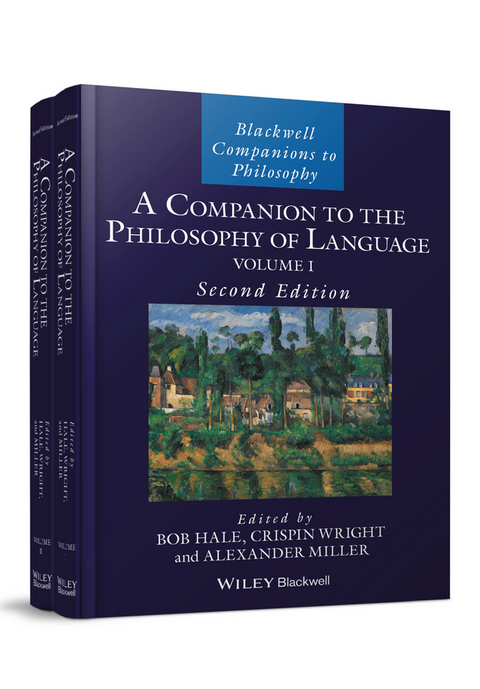
A Companion to the Philosophy of Language (eBook)
John Wiley & Sons (Verlag)
978-1-118-97208-3 (ISBN)
'Providing up-to-date, in-depth coverage of the central question, and written and edited by some of the foremost practitioners in the field, this timely new edition will no doubt be a go-to reference for anyone with a serious interest in the philosophy of language.'
Kathrin Glüer-Pagin, Stockholm University
Now published in two volumes, the second edition of the best-selling Companion to the Philosophy of Language provides a complete survey of contemporary philosophy of language. The Companion has been greatly extended and now includes a monumental 17 new essays - with topics chosen by the editors, who curated suggestions from current contributors - and almost all of the 25 original chapters have been updated to take account of recent developments in the field.
In addition to providing a synoptic view of the key issues, figures, concepts, and debates, each essay introduces new and original contributions to ongoing debates, as well as addressing a number of new areas of interest, including two-dimensional semantics, modality and epistemic modals, and semantic relationism. The extended 'state-of-the-art' chapter format allows the authors, all of whom are internationally eminent scholars in the field, to incorporate original research to a far greater degree than competitor volumes. Unrivaled in scope, this volume represents the best contemporary critical thinking relating to the philosophy of language.
Bob Hale is an Emeritus Professor at the University of Sheffield. He is a member of the editorial board of Philosophia Mathematica, and is author of Abstract Objects (Blackwell, 1987) and Necessary Beings (2013; revised 2nd edn, 2015); co-editor of Reading Putnam (with Peter Clark; Blackwell, 1994), The Blackwell Companion to Philosophy of Language (with Crispin Wright; Blackwell, 1997), and Modality: Metaphysics, Logic, and Epistemology (with Aviv Hoffmann, 2010); and co-author of The Reason's Proper Study (with Crispin Wright, 2001).
Crispin Wright is Professor of Philosophy at New York University and Professor of Philosophical Research at the University of Stirling. His books include Wittgenstein on the Foundations of Mathematics (1980), Frege's Conception of Numbers as Objects (1983), Truth and Objectivity (1992), Realism, Meaning and Truth (2nd edn, 1993), The Blackwell Companion to Philosophy of Language (with Bob Hale, Blackwell, 1997), The Reason's Proper Study (with Bob Hale, 2001), Rails to Infinity (2001), and Saving the Differences (2003).
Alexander Miller is Professor of Philosophy at the University of Otago, New Zealand. His publications include Contemporary Metaethics: An Introduction Revised and Expanded (2nd edn, 2013), Philosophy of Language Revised and Expanded (2nd edn, 2007), and Rule-Following and Meaning (with Crispin Wright, 2002).
Providing up-to-date, in-depth coverage of the central question, and written and edited by some of the foremost practitioners in the field, this timely new edition will no doubt be a go-to reference for anyone with a serious interest in the philosophy of language. Kathrin Gl er-Pagin, Stockholm University Now published in two volumes, the second edition of the best-selling Companion to the Philosophy of Language provides a complete survey of contemporary philosophy of language. The Companion has been greatly extended and now includes a monumental 17 new essays with topics chosen by the editors, who curated suggestions from current contributors and almost all of the 25 original chapters have been updated to take account of recent developments in the field. In addition to providing a synoptic view of the key issues, figures, concepts, and debates, each essay introduces new and original contributions to ongoing debates, as well as addressing a number of new areas of interest, including two-dimensional semantics, modality and epistemic modals, and semantic relationism. The extended state-of-the-art chapter format allows the authors, all of whom are internationally eminent scholars in the field, to incorporate original research to a far greater degree than competitor volumes. Unrivaled in scope, this volume represents the best contemporary critical thinking relating to the philosophy of language.
Bob Hale is an Emeritus Professor at the University of Sheffield. He is a member of the editorial board of Philosophia Mathematica, and is author of Abstract Objects (Blackwell, 1987) and Necessary Beings (2013; revised 2nd edn, 2015); co-editor of Reading Putnam (with Peter Clark; Blackwell, 1994), The Blackwell Companion to Philosophy of Language (with Crispin Wright; Blackwell, 1997), and Modality: Metaphysics, Logic, and Epistemology (with Aviv Hoffmann, 2010); and co-author of The Reason's Proper Study (with Crispin Wright, 2001). Crispin Wright is Professor of Philosophy at New York University and Professor of Philosophical Research at the University of Stirling. His books include Wittgenstein on the Foundations of Mathematics (1980), Frege's Conception of Numbers as Objects (1983), Truth and Objectivity (1992), Realism, Meaning and Truth (2nd edn, 1993), The Blackwell Companion to Philosophy of Language (with Bob Hale, Blackwell, 1997), The Reason's Proper Study (with Bob Hale, 2001), Rails to Infinity (2001), and Saving the Differences (2003). Alexander Miller is Professor of Philosophy at the University of Otago, New Zealand. His publications include Contemporary Metaethics: An Introduction Revised and Expanded (2nd edn, 2013), Philosophy of Language Revised and Expanded (2nd edn, 2007), and Rule-Following and Meaning (with Crispin Wright, 2002).
Volume I 3
Title Page 5
Copyright Page 6
Contents 7
List of Contributors 10
Preface to the Second Edition 17
Preface to the First Edition 18
Part I Meaning and Theories`of Meaning 21
Chapter 1 Metaphysics, Philosophy, and the Philosophy of Language 23
1 Two Positions 23
2 Dummett and Thought 24
3 Wittgenstein, Early and Late 27
4 Carnap and Quine 30
5 Ordinary Language Philosophy 34
6 The Turn Back 36
7 The Larger Picture 39
Notes 41
References 44
Chapter 2 Meaning and Truth-Conditions: From Frege’s Grand Design to Davidson’s 47
Notes 63
References 66
Chapter 3 Intention and Convention in the Theory of Meaning 69
1 Lewis on the Public-Language Relation 70
2 Intention-Based Semantics 76
3 An Almost-Gricean Semantics 82
4 What Endures? 87
Notes 90
References 91
Chapter 4 Meaning, Use, Verification 93
1 Meaning as Use 93
2 Verificationism 103
3 Rules and Norms 110
Notes 115
References 117
Postscript 119
Meaning Is Use 119
Use and Assertion 120
A First Response: Specialized Assertion Conditions 122
A Second Response: Adding to Assertion Conditions 123
Fitch’s Paradox or the Paradox of Knowability 123
Notes 124
References 125
Chapter 5 Semantics and Pragmatics 127
1 Pragmatics and Semantics 127
2 Austin on Locutionary, Illocutionary, and Perlocutionary Acts 129
3 Grice on Illocutionary Acts 131
4 Grice on Basic and Derivative Illocutionary Acts 133
5 The Orthodox View 137
6 Occasion-Sensitivity 141
7 Basic and Derivative Illocutionary Acts 143
8 Conclusion 144
Note 145
References 145
Chapter 6 Pragmatics 147
1 Semantic Properties 148
2 The Pragmatic View 149
3 Domestications 151
4 Implicature 154
5 Metaphysics 157
6 Perspective 159
7 Thoughts 161
8 Concluding Remarks 163
Notes 164
References 164
Further Reading 164
Postscript 165
In Retrospect 165
References 169
Further Reading 170
Chapter 7 On the Linguistic Status of Context Sensitivity 171
1 Introduction 171
2 Terms of Debate 172
3 Overt Context Sensitivity 176
4 Covert Context Sensitivity 178
5 Whither Context? 188
6 Concluding Remarks 189
Notes 189
References 191
Further Reading 193
Chapter 8 A Guide to Naturalizing Semantics 194
The Crude Causal Theory 197
Dretske’s Information-Theoretic Account 198
Optimal Conditions Accounts 199
Teleological Theories 200
Fodor’s Asymmetric Dependence Theory 202
Causal-Role Semantics 205
Conclusion 206
Postscript 210
Teleological Theories: Basic Distinctions 211
The Content Question: Input-Oriented Theories 211
The Content Question: Output-Oriented and Mixed Theories 212
The Status Question 214
Conclusion 215
Notes 215
References 216
Chapter 9 Inferentialism 217
1 Varieties of Inferentialism 218
2 Logical Inferentialism 224
3 Brandom’s Inferentialism 229
4 Objections and Replies 234
Notes 238
References 240
Further Reading 244
Chapter 10 Against Harmony 245
1 The Inversion Principle 246
2 An Argument for the Inversion Principle 249
3 Problems with the Argument 250
4 Arguments from the ‘Innocence’ of Logic 257
5 Tennant’s Argument for Harmony 260
6 Harmony and Inferential Role Semantics 264
Notes 265
References 268
Chapter 11 Meaning and Privacy 270
1 Introduction: The Two Questions and their Consequences 270
2 Private States and Public Language: The Possibility 272
3 Private States and Public Language: The Effects 278
4 The Possibility of a Private Language 279
Notes 285
References 285
Further Reading 286
Postscript 286
References 290
Chapter 12 Tacit Knowledge 292
1 Introduction 292
2 Tacit Knowledge and Propositional Attitudes 293
3 Tacit Knowledge and Dispositional States 298
4 Wright’s Attack on Evans 300
5 The Mirror Constraint and Understanding Novel Utterances 311
6 Wright’s Proposal 311
7 Tacit Knowledge and Rule-Following 313
Notes 315
References 317
Further Reading 318
Chapter 13 Radical Interpretation 319
1 A Bird’s-Eye View of Some Options 319
2 From “Truth and Meaning” to “Radical Interpretation” 322
3 The Basis for Radical Interpretation 326
4 Interpretation, Charity, Holism, and Norms 329
5 Indeterminacy of Meaning, Holism, and Molecularity 334
References 336
Postscript 337
Notes 342
References 343
Chapter 14 Propositional Attitudes 344
Propositional Attitudes and Philosophy of Language 344
Questions about Propositions 347
Semantics and Structure 348
(Neo-)Russellianism and Fregeanism 350
Attitudes, Utterances, and Sentences 353
Semantic versus Psychological Sententialism 355
Attitudes and Context 357
Alternatives to Relational Accounts 361
Appendix: De Dicto, De Re, and De Se 362
Notes 365
References 370
Further Reading 374
Chapter 15 Holism 377
1 What Is Meaning Holism? 377
2 Does the Duhem–Quine Thesis Provide a Ground for Meaning Holism? 380
3 Does Revisability Support Meaning Holism? 382
4 Do Interpretational and Compositional Considerations Support Meaning Holism? 385
5 Global Holism, Justification, and Semantic Value 389
6 Local Holisms and Their Source 391
Notes 393
References 393
Chapter 16 Metaphor 395
1 Figurative and Non-figurative: Metaphor, Idiom, and Ambiguity 396
2 Metaphorical Meaning 398
3 Davidson and the Case against Metaphorical Meaning 400
4 Paraphrase and Propositional Status 402
5 Metaphor and Communication 405
6 Pragmatics and Speaker’s Meaning 407
7 Metaphor, Rhetoric, and Relevance 410
References 412
Further Reading 413
Postscript 413
1 Metaphor, Meaning, and Language: Positive Developments 413
2 Distinctiveness and Dispensability: For and Against 417
References 419
Further Reading 420
Chapter 17 Conditionals 421
1 Introduction: Conditional Information 421
2 Preliminaries 422
3 Strict Conditionals 425
4 Variably Strict Conditionals 428
5 Counterfactual Dynamics 432
6 Indicative Conditionals and Collapse 437
7 Antecedents as Restrictors 440
8 Dynamics and Indicative Conditionals 444
9 Other Surveys 448
Notes 448
References 454
Chapter 18 Generics 457
1 Generics 457
2 Genericity 460
3 Separating the Semantics of Generics from Theories of Genericity 461
4 Connecting the Semantics of Generics with Theories of Genericity 470
5 Ascriptions of Dispositions, Habits, and Capacities 472
6 Some Theories of Genericity 472
7 Two Ways of Doing Away with Genericity 476
8 Closing 479
Notes 479
References 481
Chapter 19 Deflationist Theories of Truth, Meaning, and Content 483
I 483
A. Radical Inflationism 484
B. Radical Deflationism 485
II 504
Notes 507
References 510
Volume II 511
Title Page 513
Copyright Page 514
Contents 515
Part I Language, Truth, and Reality 519
Chapter 20 Realism and its Oppositions 521
1 Dummett’s General Account of R/AR Disputes 522
2 Arguments against Semantic Realism 525
3 The Adequacy of Dummett’s Characterization of R/AR Disputes 532
4 Error Theories, Projectivism, and Quasi?realism 536
5 Realism and Objective Truth 539
Notes 546
References 550
Further Reading 552
Postscript 553
Relativizing Truth 554
Realism and Grounds 557
The Variety of Conceptions of Realism 558
Notes 558
References 558
Chapter 21 Theories of Truth 560
1 Introduction: Problems with Correspondence 560
2 The Coherence Theory and the Pragmatic Theory 561
3 Coherence and Correspondence 562
4 Why Pragmatic and Coherence Theories are Attractive 564
5 Why the Coherence Theory Fails 566
6 Frege on Defining Truth 567
7 The Correspondence Theory 569
8 The Redundancy Theory 572
9 The Semantic Theory 575
Note 577
References 577
Further Reading 579
Postscript: Pluralism about Truth 579
Notes 582
References 583
Further Reading 583
Chapter 22 Truthmaker Semantics 584
I Theory 584
II Applications 597
Notes 603
References 603
Chapter 23 Analyticity 606
I 606
Belief, Apriority, and Indeterminacy 607
Analyticity: Metaphysical or Epistemological? 609
The Metaphysical Concept 610
The Epistemological Concept 612
II 613
“Two Dogmas” and the Rejection of Frege?Analyticity 613
Skeptical Theses about Analyticity 614
Non-factualism about Frege-Analyticity 616
The Error Thesis about Frege-Analyticity 617
III 619
The Analyticity of Logic 619
The Classical View and Implicit Definition 620
Implicit Definition and Non-Factualism 623
Implicit Definition and Conventionalism 624
Quine against Implicit Definition: Regress 625
Quine against Implicit Definition: Constitutive Truth 627
Implicit Definition, Justification, and Entitlement 629
Conclusion 631
Appendix: A Priori Knowledge of the Second Premise 631
Notes 635
References 638
Further Reading 639
Postscript: Further Thoughts about Analyticity: 20 Years Later 639
Introduction 639
Can Epistemic Analyticity Explain All A Priori Justification? 641
Is Uniformity a Requirement? 642
Can Epistemic Analyticity Explain Even Some Cases of A Priori Justification? 642
The Constitutive View 643
The Basis View 644
Conclusion 645
Notes 645
References 646
Chapter 24 Rule-Following, Objectivity, and Meaning 647
1 Wittgenstein on Meaning, Understanding, and Rules 647
2 Kripke on Rules 648
3 Is Semantic Irrealism Incoherent? 651
4 Wright on the Rule?Following Considerations 656
5 Concluding Remarks 667
Notes 668
References 669
Further Reading 670
Postscript: Factualism and New Problems for Rule-Following 671
1 Factualist Readings of Kripke’s Wittgenstein 671
2 Wright’s and Boghossian’s Problems from “Blind” Rule-Following 673
References 676
Chapter 25 The Normativity of Meaning 677
1 Introduction 677
2 Meaning and Normative Judgment 679
3 Meaning as a Source of Normativity 683
4 The Normative Determination of Meaning 686
5 The Normativity of Semantic Concepts 689
6 Conclusion 693
Notes 693
References 695
Chapter 26 Indeterminacy of Translation 698
1 What Does the Indeterminacy of Translation Involve? 699
2 Could One Live with the Indeterminacy of Translation? 701
3 Quine’s Arguments for the Indeterminacy Thesis 702
4 Evans’s Appraisal of the Argument from Below 704
5 Are Evans’s Objections Compelling? 708
6 The Argument from Above: Preliminary Clarifications 712
7 The Argument from Above: Appraisal 716
Notes 720
References 723
Further Reading 723
Postscript 724
1 The Argument from Below I: Simplicity in Semantic Theory 724
2 The Argument from Below II: Simplicity in Psychological Theory 725
3 The Argument from Above I: The Underdetermination Thesis 726
4 The Argument from Above II: Tightness and Indeterminacy 727
Notes 729
References 730
Further Reading 730
Chapter 27 Putnam’s Model-Theoretic Argument against Metaphysical Realism 731
I 732
II 733
III 734
IV 741
V 742
VI 744
VII 746
VIII 748
Appendix: Permutation Results 749
Notes 753
References 757
Further Reading 757
Postscript: Recent Work on Putnam’s Model-Theoretic Argument 758
1 Reconsidering the ‘Just More Theory’ Maneuver 758
2 Reference Magnetism 759
Notes 760
References 761
Chapter 28 Sorites 762
1 The Early History 762
2 Recent Approaches 769
Notes 782
References 784
Further Reading 785
Postscript 785
1 Supervaluationism, Degree Theory, and Epistemicism Revisited 785
2 Quandaries and Intuitionism 787
3 Dialetheism as a Unified Solution 788
4 Contextualism and Interest?Relativity 789
Notes 790
References 791
Further Reading 792
Chapter 29 Time and Tense 793
1 Introduction 793
2 Temporalism versus Eternalism 794
3 The Quantifier View versus the Operator View 805
4 From Philosophy of Language to Metaphysics 809
5 Conclusion 813
Notes 813
References 813
Further Reading 814
Chapter 30 Relativism 815
1 Varieties of Relativism 817
2 Index, Context, and Content 819
3 Retraction and Disagreement 821
4 Control and Syntax 828
Notes 830
References 830
Part II Reference, Identity, and Necessity 833
Chapter 31 Modality 835
1 Preliminary Considerations: Philosophical Issues 835
2 Quine’s Skepticism and Reactions to It 838
3 Modal Realism 1: Realism about Possible Worlds 840
4 Modal Realism 2: The Non?cognitivist Challenge 852
Notes 856
References 860
Postscript 862
The Source of Necessity and Possibility 862
Essence and Essentialist Theories of Modality 863
Modal Knowledge 864
Necessary and Contingent Existence, Actualism, and Possibilism 866
Notes 867
References 868
Chapter 32 Relativism about Epistemic Modals 871
1 Introduction 871
2 Contextualism 875
3 Contextualism about Epistemic Modals 876
4 Relativist Proposals 877
5 Relativists’ Arguments against Contextualism 881
Conclusion 889
References 890
Chapter 33 Internalism and Externalism 893
1 Introduction: Internal Duplicates and Supervenience 893
2 Origins of Semantic Externalism 895
3 Which Semantic Feature Is Externally Determined? 897
4 How Should the Supervenience Base Be Extended? 899
5 Why Should We Accept Externalism? 900
Notes 904
References 907
Chapter 34 Essentialism 909
1 Concepts 909
2 Essentialist Theses and Arguments for Them 911
3 Slippery Slopes and Primitive Thisnesses 915
4 The Grounds of Metaphysical Necessity 921
References 924
Further Reading 924
Postscript 924
The Essentiality of Origin and Individual Essences 925
The Essentiality of Kind Membership 927
Essential Properties and What a Thing Is 928
References 929
Further Reading 929
Chapter 35 Reference and Necessity 930
1 Questions and Theses 931
2 The Possible-Worlds Framework 933
3 What Are the Semantic Values of Names? 935
4 How Do Names Get Their Semantic Values? 937
5 Names and Essences 942
References 947
Chapter 36 Names and Rigid Designation 948
1 Rigidity 948
2 Rigid Designation and Quantified Modal Logic 951
3 The Descriptive Picture 955
4 Kripke’s Argument and the Rigidity Thesis 957
5 The ‘Actualized’ Description Theory 961
6 Names and Wide?Scope 963
7 Assertoric Content and Ingredient Sense 966
Conclusion 969
Notes 969
References 973
Chapter 37 Two-Dimensional Semantics 976
1 2D Semantics: Ideas, Interpretations, and Issues 976
2 The 2D Apparatus of Worlds-cum-Intensions 978
3 Essential Background: Orthodox Kripkeanism 981
4 Kaplan’s 2D Semantics for Indexicals 983
5 Robert Stalnaker, or 2D Pragmatics 986
6 Enter the 2D Fregeans: Jackson, Chalmers, and the Primacy of A-Intensions 988
7 Jackson, or Why Communication Requires a 2D Semantics 990
8 Chalmers’s Epistemic Two-Dimensionalism 992
9 An Upshot, or the State of the Debate 994
Notes 995
References 995
Chapter 38 The Semantics and Pragmatics of Indexicals 998
1 Introduction 998
2 Approaches 999
3 The Semantics of Indexicals 1001
4 Cognitive Significance and Pragmatics 1002
5 Two Distinctions 1005
6 Indexical and Undexical Uses 1007
7 Tokens and Technology 1009
8 Demonstratives 1011
9 Direct Reference 1012
10 A Problem about ‘I’ and ‘Now’ 1013
11 Conclusion 1015
Notes 1015
References 1016
Chapter 39 Objects and Criteria of Identity 1018
1 Introduction 1018
2 Sortals and Counting 1020
3 What Is an Object? 1021
4 Frege on Concepts and Objects 1023
5 Two Forms of Identity Criterion 1024
6 The Logical Status and Role of Identity Criteria 1026
7 One-Level versus Two-Level Identity Criteria 1027
8 On the Identity of Cardinal Numbers 1028
9 Cardinal Numbers and Counting 1029
10 Abstract and Concrete Objects 1031
11 The Paradoxes of Identity over Time 1032
Appendix: Informal Proof of (N2) 1034
References 1035
Postscript 1036
References 1039
Chapter 40 Relative Identity 1041
Introduction 1041
The Non-existence of Absolute Identity 1042
The Sortal Relativity of Identity 1043
The Derelativization Thesis 1043
The Counting Thesis 1045
The Irreducibility of Restricted Quantification 1045
The ‘Name for an A’/‘Name of an A’ Distinction 1046
Geach versus Quine: A Baroque Meinongian Ontology 1047
Cats, Rivers, and Heralds 1050
Substantival Terms and the Derelativization Thesis 1054
References 1059
Further Reading 1060
Chapter 41 De Jure Codesignation 1061
1 1061
2 1066
3 1068
4 1075
5 1081
6 1084
7 1086
Notes 1095
References 1101
Glossary 1108
Index 1145
EULA 1175
| Erscheint lt. Verlag | 15.2.2017 |
|---|---|
| Reihe/Serie | Blackwell Companions to Philosophy | Blackwell Companions to Philosophy |
| Sprache | englisch |
| Themenwelt | Geisteswissenschaften ► Philosophie ► Allgemeines / Lexika |
| Geisteswissenschaften ► Philosophie ► Geschichte der Philosophie | |
| Geisteswissenschaften ► Philosophie ► Philosophie der Neuzeit | |
| Schlagworte | analyticity • causal theories of semantics • central question • Companion to the Philosophy of Language • contemporary philosophy of language • Davidson's programme • Demonstratives • epistemic modals • essentialism • force and pragmatics • holisms • Identity • identity criteria • Indeterminacy of Translation • Inscrutability of Reference • intention and convention • leading philosophers • meaning and privacy of language • meaning and verification • Metaphor • modality • modality modals • names and rigid destination • object identity • philosophical research • Philosophie • Philosophy • Philosophy of Language • Propositional attitudes • Radical interpretation • Realism • reference and necessity • Rule Following • Semantic Relationism • sorites paradox • Sprachphilosophie • Tacit Knowledge • Theories of truth • Two-dimensional semantics • vagueness |
| ISBN-10 | 1-118-97208-2 / 1118972082 |
| ISBN-13 | 978-1-118-97208-3 / 9781118972083 |
| Informationen gemäß Produktsicherheitsverordnung (GPSR) | |
| Haben Sie eine Frage zum Produkt? |
 PDF (Adobe DRM)
Kopierschutz: Adobe-DRM
Adobe-DRM ist ein Kopierschutz, der das eBook vor Mißbrauch schützen soll. Dabei wird das eBook bereits beim Download auf Ihre persönliche Adobe-ID autorisiert. Lesen können Sie das eBook dann nur auf den Geräten, welche ebenfalls auf Ihre Adobe-ID registriert sind.
Details zum Adobe-DRM
Dateiformat: PDF (Portable Document Format)
Mit einem festen Seitenlayout eignet sich die PDF besonders für Fachbücher mit Spalten, Tabellen und Abbildungen. Eine PDF kann auf fast allen Geräten angezeigt werden, ist aber für kleine Displays (Smartphone, eReader) nur eingeschränkt geeignet.
Systemvoraussetzungen:
PC/Mac: Mit einem PC oder Mac können Sie dieses eBook lesen. Sie benötigen eine
eReader: Dieses eBook kann mit (fast) allen eBook-Readern gelesen werden. Mit dem amazon-Kindle ist es aber nicht kompatibel.
Smartphone/Tablet: Egal ob Apple oder Android, dieses eBook können Sie lesen. Sie benötigen eine
Geräteliste und zusätzliche Hinweise
Buying eBooks from abroad
For tax law reasons we can sell eBooks just within Germany and Switzerland. Regrettably we cannot fulfill eBook-orders from other countries.
aus dem Bereich