Reading the Eighteenth-Century Novel (eBook)
John Wiley & Sons (Verlag)
978-1-118-62111-0 (ISBN)
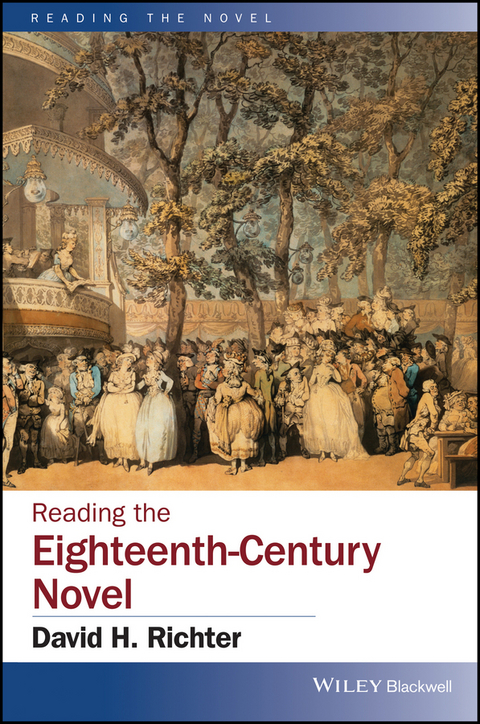
Reading the Eighteenth-Century Novel is a lively exploration of the evolution of the English novel from 1688-1815. A range of major works and authors are discussed along with important developments in the genre, and the impact of novels on society at the time.
The text begins with a discussion of the 'rise of the novel' in the long eighteenth century and various theories about the economic, social, and ideological changes that caused it. Subsequent chapters examine ten particular novels, from Oroonoko and Moll Flanders to Tom Jones and Emma, using each one to introduce and discuss different rhetorical theories of narrative. The way in which books developed and changed during this period, breaking new ground, and influencing later developments is also discussed, along with key themes such as the representation of gender, class, and nationality. The final chapter explores how this literary form became a force for social and ideological change by the end of the period. Written by a highly experienced scholar of English literature, this engaging textbook guides readers through the intricacies of a transformational period for the novel.
David H. Richter is Professor of English at Queens College and the Graduate Center, City University of New York, USA. His publications include Fable's End (1974), The Progress of Romance: Literary Historiography and the Gothic Novel (1996), Ideology and Form in Eighteenth-Century Literature (1999), The Critical Tradition (3rd edition, 2006), Falling into Theory (2nd edition, 2010), and The Blackwell Companion to Literary Theory (Wiley Blackwell, 2017).
Reading the Eighteenth-Century Novel is a lively exploration of the evolution of the English novel from 1688-1815. A range of major works and authors are discussed along with important developments in the genre, and the impact of novels on society at the time. The text begins with a discussion of the rise of the novel in the long eighteenth century and various theories about the economic, social, and ideological changes that caused it. Subsequent chapters examine ten particular novels, from Oroonoko and Moll Flanders to Tom Jones and Emma, using each one to introduce and discuss different rhetorical theories of narrative. The way in which books developed and changed during this period, breaking new ground, and influencing later developments is also discussed, along with key themes such as the representation of gender, class, and nationality. The final chapter explores how this literary form became a force for social and ideological change by the end of the period. Written by a highly experienced scholar of English literature, this engaging textbook guides readers through the intricacies of a transformational period for the novel.
David H. Richter is Professor of English at Queens College and the Graduate Center, City University of New York, USA. His publications include Fable's End (1974), The Progress of Romance: Literary Historiography and the Gothic Novel (1996), Ideology and Form in Eighteenth-Century Literature (1999), The Critical Tradition (3rd edition, 2006), Falling into Theory (2nd edition, 2010), and The Blackwell Companion to Literary Theory (Wiley Blackwell, 2017).
Acknowledgments viii
1 The World That Made the Novel 1
2 Oroonoko (1688) 34
3 Moll Flanders (1722) 51
4 Pamela, or Virtue Rewarded (1740) 66
5 The History of Tom Jones, A Foundling (1749) 81
6 The Life and Opinions of Tristram Shandy, Gent. (1759-1767) 100
7 Evelina: The History of a Young Lady's Entrance into the World (1778) 117
8 The Mysteries of Udolpho (1794) 131
9 Things As They Are, or The Adventures of Caleb Williams (1794) 151
10 Waverley, or 'Tis Sixty Years Since (1814) 171
11 Emma (1815) 189
12 The World the Novel Made 213
Selected Further Reading 226
Index 232
Chapter 2
Oroonoko (1688)
Oroonoko, or The Royal Slave: A True History
The plot of Oroonoko is quickly told. The hero is an African prince, grandson and heir of the aged King of Coramantien, handsome, noble, and brave as a lion in battle. He falls in love with Imoinda, and she with him; they are secretly betrothed. But Imoinda is sent the royal veil by Oroonoko’s grandfather and is forced to become one of his many wives. Through the intrigues of his friend Aboan, who romances Onahal, one of the king’s cast‐off concubines, Oroonoko gains access to the harem and he and Imoinda consummate their love. When this is discovered, Imoinda is sold into slavery, though all are told that she is dead. Oroonoko gets this news when he is inland in command of the army and with courage continues to fight, defeating his foe and taking the survivors as slaves; their leader Jamoan becomes Oroonoko’s prized companion. Returning to Coromantien, Oroonoko is decoyed aboard a European ship, whose captain flatters him and plies him with liquor, and on awakening Oroonoko discovers himself in chains, a slave on the Middle Passage between Africa and the Americas.
On arrival at the English colony of Surinam, Oroonoko is bought by Trefry, the agent of the Governor‐General Lord Willoughby, who does not put him to work in the fields. Oroonoko soon discovers that a beautiful and chaste female slave on the same plantation is none other than his Imoinda. Oroonoko then tries to negotiate his return with his wife to Africa, while the Deputy Governor, Byam, meditates how he can be properly dealt with. As time passes, Imoinda becomes pregnant, and Oroonoko becomes desperate to arrange for their freedom so that his son will not be born into slavery. The narrator of the tale is meanwhile assigned to befriend Oroonoko, to keep him busy and to spy on him. The outnumbered white settlers fear a revolt of the African slaves led by an experienced commander whom they recognize as their king. Realizing at length, that his negotiations with the settlers are leading nowhere, Oroonoko leads a revolt of the slaves against their English owners. The English are too cowardly to fight, but the slaves are persuaded to abandon Oroonoko and return for a promise of amnesty. Alone, Oroonoko is tricked by Trefry and Byam into surrendering, then savagely beaten, after which he vows revenge. He plans to kill Imoinda with her consent (so that she will not be dishonored after his death), then to kill Byam, and finally himself, but after killing Imoinda he is recaptured and, in the absence of his partisans like Trefry and the narrator, Byam has Oroonoko savagely executed by being dismembered while alive.
Oroonoko: The Initiation
Oroonoko is a good place to begin the study of eighteenth‐century fiction because it exemplifies so perfectly what fiction before the novel was like. The first thing the reader will notice is that it claims on the title page not to be fiction at all, but rather a “True History,” and the narrator’s insistence on the truth of the story takes up the first two paragraphs:
I do not pretend, in giving you the History of this Royal Slave, to entertain my Reader with the Adventures of a feign’d Hero, whose Life and Fortunes Fancy may manage at the Poet’s Pleasure, nor in relating the Truth, design to adorn it with any Accidents, but such as arriv’d in earnest to him. And it shall come simply into the World, recommended by its own proper Merits, and natural Intrigues, there being enough of Reality to support it, and to render it diverting, without the Addition of Invention.
I was my self an Eye‐Witness to a great part, of what you will find here set down, and what I cou’d not be Witness of, I receiv’d from the Mouth of the chief Actor in his History, the Hero himself, who gave us the whole Transactions of his Youth.
Aphra Behn made the very same truth‐claim, almost verbatim, in the initiation phase of another narrative she published the same year as Oroonoko, The Fair Jilt: “I do not pretend here to entertain you with a feign’d Story, or any thing piec’d together with Romantic Accidents, but every Circumstance, to a Tittle, is Truth. To a great part of the Main, I my self was an Eyewitness.” In fact all of The Fair Jilt is pure invention except for its climactic incident, a botched public execution in Antwerp that was reported in the London Gazette for May 1666. And Aphra Behn may in fact have been present at that time; she was then in the Low Countries employed as a spy in the service of King Charles II.
Similarly in Oroonoko, the title character is invented, along with his history in Africa, but five historical figures populate the part of his tale set in the English colony of Surinam. The actual Governor‐General of the English colonies in the Caribbean during the early 1660s, Francis Lord Willoughby of Parham, who is mentioned but never appears in person in the narrative, was stationed in Barbados, and there are ample records of the two English colonists who admire Oroonoko (John Trefry and George Marten), and of the two who betray and execute him (William Byam and James Banister).
Aphra Behn
And what of the sixth historical figure, the first‐person narrator “eye‐witness” Aphra Behn, who claims to have known Oroonoko, both within the novel itself and in her Epistle Dedicatory to Lord Maitland? Though the occasional scholar has been sceptical – because so much of the local color in Oroonoko could have been picked up from other travel literature – most are convinced that Behn had indeed been there.
The consensus is that she was christened “Eaffrey Johnson” in 1640 near Canterbury in Kent, and there is evidence that she crossed the Atlantic to Surinam in 1663, staying for some months. She may indeed have been living with her mother and sisters at St. John’s Hill, a plantation whose owner, Sir Robert Harley, was not in residence, and where we have a record in 1664 of “ladies” being present. But Behn was, as Mae West said, no lady, and in fact we have no firm idea of why she came to Surinam or what Aphra’s status may have been there. The wildly implausible explanation given in Oroonoko is that her father (Bartholomew Johnson, a mere barber) had been appointed by Lord Willoughby to be his lieutenant‐general over England’s Caribbean colonies but died on the voyage to the New World. (In real life it had been Lord Willoughby who died at sea, in 1666.) Aphra is probably the “Astrea” mentioned in William Byam’s March 1664 letter as leaving the colony for England via Barbados, followed by her “Celadon,” an aspiring but impecunious suitor, William Scot. (“Astraea” was later to be Behn’s pen name, taken from the heroine of the 1607 pastoral romance by Honoré D’Urfé.) Behn claims in Oroonoko to have presented the “King’s Theatre” (the Theatre Royal at Covent Garden) with exotic feathers brought from Surinam, feathers that costumed the heroine of The Indian‐Queen, a popular heroic drama by Sir Robert Howard and John Dryden. But she could not have returned in time for that play’s opening in January 1664, though these feathers may have graced the stage for a revival later in the decade.
Much of the rest of Behn’s life has similar lacunae that have to be filled in by scholarly speculation. Her early years, which coincided with the English Civil War and the Protectorate of Oliver Cromwell, are a complete blank, but we know she had been educated well beyond what would have been typical for her social class and her sex, perhaps by having been informally adopted by the aristocratic Culpeper family of Kent, for whom her mother was a wet‐nurse. This might account for the extreme royalist sympathies and Tory politics evident in all her writings. She returned from Surinam in 1664, and signed herself “Behn” from 1666. The name suggests marriage to someone of German or Dutch extraction, but we know nothing of husband or marriage except that it must have been short lived, as no husband is in evidence during her later career. In July of 1666 she was employed in the Netherlands as a spy by Charles II’s government, which was at war with the Dutch, but payment for her services must have been lax as she was threatened in 1668 with imprisonment for debt in Antwerp, and she sent frantic letters of appeal for relief to Charles’s court. She returned to London and began to write for the stage; in 1670, her first play, The Forc’d Marriage, was a success. Behn followed that up with eighteen other dramas, primarily romantic comedies; the most frequently revived was The Rover (1677). Behn’s dramatic works were called sexually indecent, even in her lifetime, but they were typical of the comedies of her time. What was unique was the sex of the author, who was, as Virginia Woolf pointed out, the first woman to live by her pen.
Truth‐Telling
After Behn’s opening truth‐claim for the story, she delays the launch again in order, she says, to tell us how African slaves are brought to Surinam, but she gets to that point by a highly circuitous path. The colonists, she tells us, live with the native Guyanans “in perfect Amity, without daring to command ‘em, but on the contrary, caress ‘em with all the brotherly and friendly...
| Erscheint lt. Verlag | 13.2.2017 |
|---|---|
| Reihe/Serie | Reading the Novel |
| Reading the Novel | Reading the Novel |
| Sprache | englisch |
| Themenwelt | Geisteswissenschaften ► Sprach- / Literaturwissenschaft ► Anglistik / Amerikanistik |
| Geisteswissenschaften ► Sprach- / Literaturwissenschaft ► Literaturgeschichte | |
| Geisteswissenschaften ► Sprach- / Literaturwissenschaft ► Literaturwissenschaft | |
| Schlagworte | 18th century • Eighteenth Century Literature • Emma • Henry Fielding • Jane Austen • Literary History • Literature • Literaturwissenschaft • Moll Flanders • mysteries of udolpho • Pamela • Romane • The novel • Tom Jones • Tristam Shandy |
| ISBN-10 | 1-118-62111-5 / 1118621115 |
| ISBN-13 | 978-1-118-62111-0 / 9781118621110 |
| Informationen gemäß Produktsicherheitsverordnung (GPSR) | |
| Haben Sie eine Frage zum Produkt? |
 EPUB (Adobe DRM)
Kopierschutz: Adobe-DRM
Adobe-DRM ist ein Kopierschutz, der das eBook vor Mißbrauch schützen soll. Dabei wird das eBook bereits beim Download auf Ihre persönliche Adobe-ID autorisiert. Lesen können Sie das eBook dann nur auf den Geräten, welche ebenfalls auf Ihre Adobe-ID registriert sind.
Details zum Adobe-DRM
Dateiformat: EPUB (Electronic Publication)
EPUB ist ein offener Standard für eBooks und eignet sich besonders zur Darstellung von Belletristik und Sachbüchern. Der Fließtext wird dynamisch an die Display- und Schriftgröße angepasst. Auch für mobile Lesegeräte ist EPUB daher gut geeignet.
Systemvoraussetzungen:
PC/Mac: Mit einem PC oder Mac können Sie dieses eBook lesen. Sie benötigen eine
eReader: Dieses eBook kann mit (fast) allen eBook-Readern gelesen werden. Mit dem amazon-Kindle ist es aber nicht kompatibel.
Smartphone/Tablet: Egal ob Apple oder Android, dieses eBook können Sie lesen. Sie benötigen eine
Geräteliste und zusätzliche Hinweise
Buying eBooks from abroad
For tax law reasons we can sell eBooks just within Germany and Switzerland. Regrettably we cannot fulfill eBook-orders from other countries.
aus dem Bereich