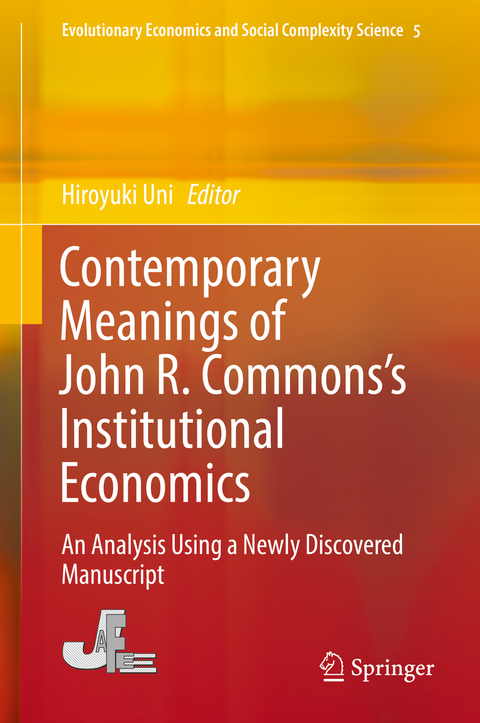
Contemporary Meanings of John R. Commons’s Institutional Economics (eBook)
XVIII, 231 Seiten
Springer Singapore (Verlag)
978-981-10-3202-8 (ISBN)
This book is the first to reinterpret John R. Commons's Institutional Economics with a newly discovered manuscript written in 1927 in order to find its contemporary meanings in economic theories. Commons aimed to establish institutional economics to understand capitalism in the USA of that time, when people's collective actions were gaining importance with the emergence of powerful labor unions, oligopolistic corporations, and national judicial systems. Setting three types of transactions as his central concepts for analysis, Commons described dynamics of capitalism as multiple and cumulative causal processes of transactions, through which the final goal should be achievements of a 'reasonable value'. He also believed that the reasonable value could be achieved by the evolution of institutions.
There is no doubt that Commons's ideas proposed in Institutional Economics such as transactions and collective actions greatly inspired later economists; however, few studies have contributed to comprehensive understanding of the origin of his masterpiece. To what extent and in what sense had Commons rejected or accepted previous classical economics or marginalism for constituting his original institutional economics? What are the meanings and limitations that reasonable value may have for contemporary political economy?
Institutional Economics as attempts to resolve deep economic problems at that time. Commons's efforts create important implications for us, those who are living in an era after the global financial crisis and confronting various challenges to political economy.
Hiroyuki Uni, Graduate School of Economics, Kyoto University
This book is the first to reinterpret John R. Commons's Institutional Economics with a newly discovered manuscript written in 1927 in order to find its contemporary meanings in economic theories. Commons aimed to establish institutional economics to understand capitalism in the USA of that time, when people's collective actions were gaining importance with the emergence of powerful labor unions, oligopolistic corporations, and national judicial systems. Setting three types of transactions as his central concepts for analysis, Commons described dynamics of capitalism as multiple and cumulative causal processes of transactions, through which the final goal should be achievements of a "e;reasonable value"e;. He also believed that the reasonable value could be achieved by the evolution of institutions.There is no doubt that Commons's ideas proposed in Institutional Economics such as transactions and collective actions greatly inspired later economists; however, few studies have contributed to comprehensive understanding of the origin of his masterpiece. To what extent and in what sense had Commons rejected or accepted previous classical economics or marginalism for constituting his original institutional economics? What are the meanings and limitations that reasonable value may have for contemporary political economy?Institutional Economics as attempts to resolve deep economic problems at that time. Commons's efforts create important implications for us, those who are living in an era after the global financial crisis and confronting various challenges to political economy.
Hiroyuki Uni, Graduate School of Economics, Kyoto University
Preface 6
Contents 15
Contributors 16
Part I Volitional Theory of Value with Multiple Causations 18
Scope of John R. Commons's Criticism of the Classical Theory of Value: Progress and Limitations in the 1927 Manuscript 19
1 Conclusions of Commons's Criticism of the Classical Theory of Value 20
2 Theoretical Progress in the 1927 Manuscript 22
2.1 Conceptualization of Proprietary Scarcity 22
2.2 Construction of a Theory of Value with Multiple Causations 26
2.3 Formulation of Three Types of Transactions 30
3 Theoretical Limitations in the 1927 Manuscript 35
3.1 Limitations in the Concept of Judicial Transactions 35
3.2 Coordination of Managerial and Bargaining Transactions 37
4 Concluding Remarks 40
References 42
From Carl Menger to John R. Commons: Human Volition and Value Theory in Institutional Economics 43
1 Introduction 44
2 Austrian Prelude to Institutional Economics: Value and Powers in Commons Before 1927 46
3 Menger's Grundsätze for the Scientific Volitional Theory of Value in the 1927 Draft 51
3.1 Menger as a Pioneer of the Volitional Theory of Value 52
3.2 Functional Analysis in Grundsätze as “Exact Orientation of Research” 54
3.3 Commons and Menger as Contemporaries: Two Directions Within the Economy and Conflicts of Interests in the Second Edition of Grundsätze 56
4 Reasonable Value as a Development of Grundsätze in Institutional Economics in 1934 59
5 Concluding Remarks 65
References 67
Part II Theories for Social Reform 69
The Effect of the Great Depression on the Institutional Economics of John R. Commons 70
1 Introduction 71
2 Comparison Between Institutional Economics (1934) and the 1927 Manuscript 73
2.1 Previous Studies on the 1927 Manuscript 73
2.2 The Concept of the Institution 74
3 Two Publications in 1931: “World Depressions” and “Institutional Economics” 75
3.1 “World Depressions” (1931) 75
3.1.1 Causes of World Depressions 75
3.1.2 Measures Against World Depressions 76
3.2 “Institutional Economics” (1931) 77
3.2.1 Concept of the Institution 77
3.2.2 Rationing Transaction 77
4 The Influence of the Great Depression on Commons 78
4.1 Administration of Incorporeal Property and Intangible Property 78
4.2 How to Control Two Kinds of Property 80
4.3 Teachings of Benjamin Strong 81
4.4 The Administrative Committee After the Great Depression 82
5 Discussion 83
6 Conclusion 86
References 86
Two Methods of Institutional Reform in the Institutional Economics of John R. Commons 88
1 Introduction 89
2 The Method of Institutional Reform Seen in The Legal Foundations of Capitalism (1924) and the 1927 Manuscript 91
3 The Method of Institutional Reform Described in Institutional Economics (1934a) 94
3.1 Sovereignty in the Joint Bargaining System 98
3.2 Reasons Private Going Concerns Participate in the System 99
3.3 Two Meanings of Reasonableness 100
4 The Importance of the Joint Bargaining System 101
4.1 Avoidance of Totalitarianism 101
4.2 The Passage of the Unemployment Prevention Law 104
5 The Articulation of the Two Methods of Institutional Reform 107
6 Concluding Remarks 110
References 112
John R. Commons and Gunnar Myrdal on Institutional Economics: Their Methods of Social Reform 114
1 Introduction 115
2 Commons's and Myrdal's Meeting in 1930 116
3 Commons and the Formative Process of Institutional Economics 118
3.1 Wisconsin in 1930 118
3.2 From the 1927 Manuscript to Institutional Economics 119
4 Methods of Social Reform 122
4.1 Commons's Method of Reasonable Value 122
4.2 Myrdal's Method of Explicit Value Premises 124
4.3 A Comparative Analysis 127
5 Conclusion 129
References 130
Part III Accomplished Dynamic Models 133
John R. Commons's Two Evolutionary Models of Capitalism: Industrial Stages and Economic Stages 134
1 Introduction 135
2 Three Stages of Industrial Development: Merchant Capitalism, Employer Capitalism, and Banker Capitalism 138
2.1 Industrial Stages and Economic Stages 138
2.2 The Stage of Merchant Capitalism 139
2.3 The Stage of Employer Capitalism 141
2.4 The Stage of Banker Capitalism 142
3 Three Stages of Economic Development: Eras of Scarcity, Abundance, and Stabilization 143
3.1 From Physical Control to Legal Control 143
3.2 Era of Scarcity: Principles of the Open Market 144
3.3 Era of Abundance: How to Restrain Competition 145
3.4 Era of Stabilization: How to Achieve Discrimination 146
4 Commons's Evolutionary Stage Theory of Capitalism 149
References 151
The Theoretical Connection Between John R. Commons and Regulation and Convention Theories 153
1 Introduction 154
2 Dewey's Pragmatism 155
3 Macrodynamics and Various Forms of Coordination 158
3.1 Commons: Value Theory Based on Multiple Causation 158
3.2 Regulation Theory: A Growth Regime Based on Cumulative Causation 163
4 Micro Theory of Human Interaction and Collective Action 165
4.1 Commons: Interrelation of Habitual Assumption and Collective Action 165
4.2 Convention Theory: Two-Layered Coordination Constituted by Regulative and Constitutive Rules 169
5 Concluding Remarks 172
References 174
Appendix 176
Excerpts from the 1927 Manuscript: Reasonable Value, A Theory of Volitional Economics by John R. Commons 176
Reasonable Value: A Theory of Volitional Economics 177
Chapter I Method 177
1. Metaphysics 177
2. Formula of Transactions 183
Chapter VIII: Scarcity and Efficiency 194
1. Use-Value, Scarcity-Value, and Value 194
(1) Value and Wealth 194
(II) Value and Price 204
III Fund and Flow 221
| Erscheint lt. Verlag | 3.2.2017 |
|---|---|
| Reihe/Serie | Evolutionary Economics and Social Complexity Science | Evolutionary Economics and Social Complexity Science |
| Zusatzinfo | XVIII, 231 p. 20 illus. |
| Verlagsort | Singapore |
| Sprache | englisch |
| Themenwelt | Geschichte ► Teilgebiete der Geschichte ► Wirtschaftsgeschichte |
| Wirtschaft ► Allgemeines / Lexika | |
| Wirtschaft ► Volkswirtschaftslehre | |
| Schlagworte | Collective Action • Institutional Economics • John Commons • Reasonable Value • Transaction |
| ISBN-10 | 981-10-3202-5 / 9811032025 |
| ISBN-13 | 978-981-10-3202-8 / 9789811032028 |
| Informationen gemäß Produktsicherheitsverordnung (GPSR) | |
| Haben Sie eine Frage zum Produkt? |
 PDF (Wasserzeichen)
DRM: Digitales Wasserzeichen
Dieses eBook enthält ein digitales Wasserzeichen und ist damit für Sie personalisiert. Bei einer missbräuchlichen Weitergabe des eBooks an Dritte ist eine Rückverfolgung an die Quelle möglich.
Dateiformat: PDF (Portable Document Format)
Mit einem festen Seitenlayout eignet sich die PDF besonders für Fachbücher mit Spalten, Tabellen und Abbildungen. Eine PDF kann auf fast allen Geräten angezeigt werden, ist aber für kleine Displays (Smartphone, eReader) nur eingeschränkt geeignet.
Systemvoraussetzungen:
PC/Mac: Mit einem PC oder Mac können Sie dieses eBook lesen. Sie benötigen dafür einen PDF-Viewer - z.B. den Adobe Reader oder Adobe Digital Editions.
eReader: Dieses eBook kann mit (fast) allen eBook-Readern gelesen werden. Mit dem amazon-Kindle ist es aber nicht kompatibel.
Smartphone/Tablet: Egal ob Apple oder Android, dieses eBook können Sie lesen. Sie benötigen dafür einen PDF-Viewer - z.B. die kostenlose Adobe Digital Editions-App.
Buying eBooks from abroad
For tax law reasons we can sell eBooks just within Germany and Switzerland. Regrettably we cannot fulfill eBook-orders from other countries.
aus dem Bereich