Literary Theory (eBook)
John Wiley & Sons (Verlag)
978-1-118-71838-4 (ISBN)
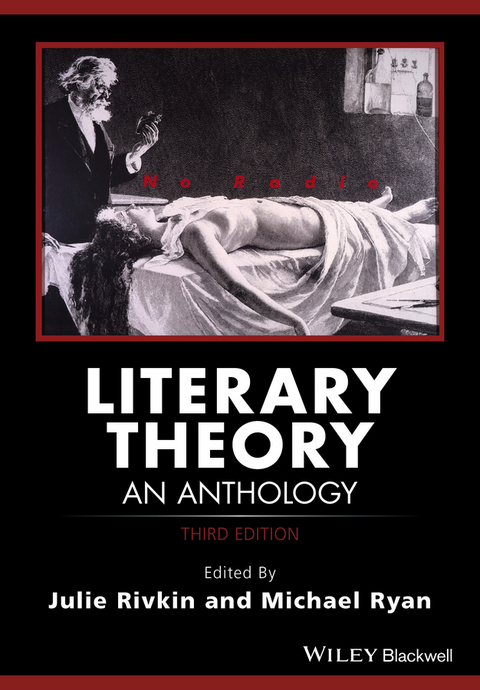
The new edition of this bestselling literary theory anthology has been thoroughly updated to include influential texts from innovative new areas, including disability studies, eco-criticism, and ethics.
- Covers all the major schools and methods that make up the dynamic field of literary theory, from Formalism to Postcolonialism
- Expanded to include work from Stuart Hall, Sara Ahmed, and Lauren Berlant.
- Pedagogically enhanced with detailed editorial introductions and a comprehensive glossary of terms
Julie Rivkin is Professor of English at Connecticut College, USA, where she teaches on American literature, contemporary women writers, and literary theory. She is the author of False Positions: The Representational Logics of Henry James's Fiction (1996). With Michael Ryan, she is the author of Literary Theory: A Practical Introduction(Wiley Blackwell, 3rd edition, 2016).
Michael Ryan is Professor of Film and Media Arts at Temple University, USA. He is the author of several books, two novels, and co-editor of the journal Politics and Culture. With Julie Rivkin, he is the author of Literary Theory: A Practical Introduction (Wiley Blackwell, 3rd edition, 2016).
Julie Rivkin is Professor of English at Connecticut College, USA, where she teaches on American literature, contemporary women writers, and literary theory. She is the author of False Positions: The Representational Logics of Henry James's Fiction (1996). With Michael Ryan, she is the author of Literary Theory: A Practical Introduction(Wiley Blackwell, 3rd edition, 2016). Michael Ryan is Professor of Film and Media Arts at Temple University, USA. He is the author of several books, two novels, and co-editor of the journal Politics and Culture. With Julie Rivkin, he is the author of Literary Theory: A Practical Introduction (Wiley Blackwell, 3rd edition, 2016).
A Short History of Theory
The first recorded human story, something that might be called “The Hunt,” appears on the walls of the caves at Lascaux, France. It was made either by children or for children, judging from the hand and feet impressions on the floor of the cave, and it represents not just a hunt but also a remarkable shift in human cognition that occurred, according to archeologist Richard Klein, around 42 ka. From this point forward, humans become more “human” in our modern sense. They invent new tools, everything from plows to currency, that expand the reach of human culture. They evidence an ability to picture abstract mental concepts and to imagine a spirit world. They slowly switch from a hunting existence to an agricultural existence. They stop living in small kin‐based bands and organize large settled communities. The early human tendency to commit rampant genocide against his cousins slowly diminishes, and humans live together in relative peace. The emergence of this new way of life can be accounted for by the change in human cognition that is expressed in “The Hunt.” The mimetic ability one sees in the paintings for the first time was essential to emergent sociality. A capacity for mental representations is linked to control over rapid‐fire, automatic negative emotions such as prejudice and fight‐or‐flight that aided survival on the savannah but were inimical to a settled social existence. That new mimetic cognitive ability was also crucial to imagining others’ lives empathetically so that communities of kin and non‐kin could be built. The capacity for story‐telling is thus connected in an essential way to the cognitive abilities that aided the emergence of modern human life. We did not so much begin to tell each other stories because we started living together in large communities; rather, we were able to build such communities because we were able to tell each other stories.
Story‐telling likely also played a more direct role in the emergence of modern human life. Stories allowed early humans to store and to transmit information that was crucial to the social learning upon which humans’ new culturally mediated civil existence depended. Stories are memory banks that record lessons from the past and are easily transmissible. Some ethnologists believe a greater capacity for short‐term memory was a key change in the human cognitive revolution around 42 ka. Early human stories were probably initially accounts of remembered events, simple documentaries. Those documentary accounts with time became fictional narratives as real characters were replaced by imaginary ones (some of whom would be taken from the surrounding nature, such as Crow or Turtle). Memory stories were also narratives that projected a future, the unknown part of the story yet to be told but anticipated in the mind. Such narrative graphing of life’s actions in terms of past, present, and future meant humans could also plan ahead and foresee events more so than before. Their lives were no longer limited to the satisfying of physical needs in an immediate and short‐term manner. “The Hunt” gave way to “The Trip to Whole Foods.”
Story‐telling would have aided the building of more complex social networks, the integration of diverse people into a uniform culture, the training of minds in a communally beneficial empathy, and the evolution of common norms. Early human stories often possessed a normative dimension. One purpose of telling them was to instruct the young in the life‐sustaining norms and practices of the community. Our earliest recorded verbal stories – Homer’s epics – teach norms of appropriate behavior towards others in one’s community such as hospitality and respect. And the tragedies of the fifth‐century Greek enlightenment caution against norm‐breaking behavior.
Literary theory came into being at a time when the normative function of story‐telling was felt quite strongly. One of the first theorists, Plato, argued that literature should educate the young in good behavior. He lived and taught in Athens 2600 years ago, and he founded the first institution of higher learning in the West, the Academy. That is important because one consequence of the evolution of human cognition is the creation of a need for nurturing environments or niches to sustain the new cognitive abilities. Those nurturing environments were possible in cities and took the form of institutions such as schools and practices such as writing. Psychologists now know that the mind’s advanced cognitive abilities as well as the mind’s ability to live in a civil, sociable way with others depend on training and modeling. External prompting is required to allow full cognitive powers to emerge and full emotional abilities to grow. That humans’ ability to think in certain ways happened at the same time that nurturing institutions such as schools came into being should therefore be no surprise. The advance in human cognitive powers allowed humans to use external instruments such as writing and book‐making to preserve past human cognitive achievements (as an external hard drive does today for a computer). Other tools and techniques could now also be used to train minds to replicate the achievements of the past so they would not be lost. Humans became capable of using what today we call cultural and social construction to maintain human civilization.
The new cognitive power of abstraction that began to emerge around 42 ka divided knowledge between sense impressions and the abstract ideas the new cognition made possible. Plato built his philosophy around this distinction. He felt the abstract ideas the mind could now imagine were more true than sense impressions. The world around one did not offer many examples of perfectly formed beautiful things, but in one’s mind one could imagine an ideal beauty. Plato mistakenly thought these abstract concepts – Beauty, Truth, Justice – were actual things in the world, a kind of spirit realm of pure forms or ideas. We now know that he was simply describing the new cognitive ability of the human brain, its new capacity to picture non‐sensory objects in the mind’s eye. All around Plato in his world, that new cognitive ability was helping his human companions to build a new civilization using new cultural tools such as currency, laws, and rhetoric. He felt, correctly, that the new cultural forms such as the enactment of fictional human events would serve an important function in the building of that new civilization. Empathy, an ability to live together in peace by imagining others’ lives and feeling them as similar to one’s own, was crucial to the new human capacity for sociality and civility, and literature and theater fostered it by obliging audiences to imagine others’ lives as if they were their own. Only a few hundred thousand years earlier, members of the Homo line had been hunting each other for food. Athens was clearly an improvement, but getting there required a new way of thinking whose normative function Plato correctly saw.
Plato:
If the prospective guardians of our community are to loathe casual quarrels with one another, we must take good care that battles between gods and giants and all the other various tales of gods and heroes coming to blows with their relatives and friends don’t occur in the stories they hear and the pictures they see. No, if we’re somehow to convince them that fellow citizens never fall out with one another, that this is wrong, then that is the kind of story they must hear, from childhood onwards, from the community’s elders of both sexes; and the poets they’ll hear when they’re older must be forced to tell equivalent stories in their poetry…. All things considered then, that is why a very great deal of importance should be placed upon ensuring that the first stories they hear are best adapted for their moral improvement.
If Plato’s belief in rational ideas such as Justice, Beauty, and Truth that existed in a purely ideal or rational realm apart from sensory experience reflects the emergence of a brain capable of abstraction, of separating mental concepts from sensory data, the ability to construct mental representations also made possible more refined observation of sensory objects by separating the adaptively evolved mind from the world around it. Prior to this point, the human brain, in order to help preserve life, needed to be vigilant and keenly focused on sense impressions for signs of danger. Living in the emerging civil communities allowed the brain to evolve further and to adapt to social life by developing new communicative and emotional skills that required less immersion in or fusion with the sensory world around it. With the diminishment of danger and the growth of sociality came a greater separation of mind from world through the development of a capacity for mental representation that allowed the world to be perceived and studied more like an object. Civil existence and science became possible at the same time.
Plato’s student Aristotle studied the structure of literature and its effects in this manner, treating literature as an object in the world that is as worthy of study as geology. He therefore described the structure of stories and noticed, for example, that the sequence of events in narrative is organized around moments of reversal and recognition. He differentiated between narrative perspectives and examined the traits that distinguish one genre like comedy from another like tragedy. He also analyzed the...
| Erscheint lt. Verlag | 23.1.2017 |
|---|---|
| Reihe/Serie | Blackwell Anthologies |
| Blackwell Anthologies | Blackwell Anthologies |
| Sprache | englisch |
| Themenwelt | Geisteswissenschaften ► Sprach- / Literaturwissenschaft ► Anglistik / Amerikanistik |
| Geisteswissenschaften ► Sprach- / Literaturwissenschaft ► Literaturwissenschaft | |
| Schlagworte | English literature, literary criticism, formalism, discourse studies, narrative , linguistics, structuralism, post-structuralism,Derrida, Barthes, Foucault, phenomenology, Husserl, psychoanalysis, Freud, gender studies, Lacan, Marxism, Marx, Adorno, , Dialectics, feminism, transnational studies, Walter Benjamin, Ethnic studies, Queer theory, Spivak, Butler, , Said, Agamben, Ahmed, Berlant, thing studies, evolution, cognition, eco-criticism, environment,, ethics, affect, neuroscience, digital humanities, an • Literary Theory • Literature • Literaturtheorie • Literaturwissenschaft |
| ISBN-10 | 1-118-71838-0 / 1118718380 |
| ISBN-13 | 978-1-118-71838-4 / 9781118718384 |
| Informationen gemäß Produktsicherheitsverordnung (GPSR) | |
| Haben Sie eine Frage zum Produkt? |
 EPUB (Adobe DRM)
Kopierschutz: Adobe-DRM
Adobe-DRM ist ein Kopierschutz, der das eBook vor Mißbrauch schützen soll. Dabei wird das eBook bereits beim Download auf Ihre persönliche Adobe-ID autorisiert. Lesen können Sie das eBook dann nur auf den Geräten, welche ebenfalls auf Ihre Adobe-ID registriert sind.
Details zum Adobe-DRM
Dateiformat: EPUB (Electronic Publication)
EPUB ist ein offener Standard für eBooks und eignet sich besonders zur Darstellung von Belletristik und Sachbüchern. Der Fließtext wird dynamisch an die Display- und Schriftgröße angepasst. Auch für mobile Lesegeräte ist EPUB daher gut geeignet.
Systemvoraussetzungen:
PC/Mac: Mit einem PC oder Mac können Sie dieses eBook lesen. Sie benötigen eine
eReader: Dieses eBook kann mit (fast) allen eBook-Readern gelesen werden. Mit dem amazon-Kindle ist es aber nicht kompatibel.
Smartphone/Tablet: Egal ob Apple oder Android, dieses eBook können Sie lesen. Sie benötigen eine
Geräteliste und zusätzliche Hinweise
Buying eBooks from abroad
For tax law reasons we can sell eBooks just within Germany and Switzerland. Regrettably we cannot fulfill eBook-orders from other countries.
aus dem Bereich