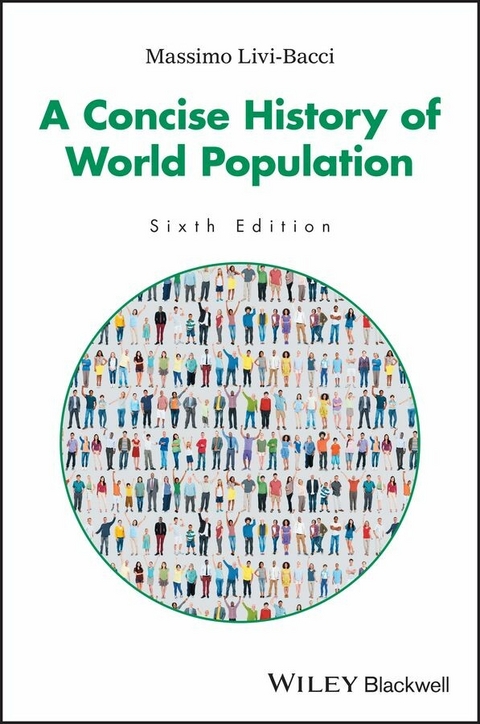
A Concise History of World Population (eBook)
John Wiley & Sons (Verlag)
9781119029298 (ISBN)
- A new edition of this classic history of demography text, which has been updated to strengthen the major subject areas of Africa, international migration and population and the environment
- Includes the latest statistical information, including the 2015 UN population projections revision and developments in China's population policy
- Information is presented in a clear and simple form, with academic material presented accessibly for the undergraduate audience whilst still maintaining the interest of higher level students and scholars
- The text covers issues that are crucial to the future of every species by encouraging humanity's search for ways to prevent future demographic catastrophes brought about by environmental or human agency
- Analyses the changing patterns of world population growth, including the effects of migration, war, disease, technology and culture
Massimo Livi-Bacci is Professor of Demography at the University of Florence. A former president of the International Union for the Scientific Study of Population, his extensive research interests include contemporary demography as well as the history of population. He has taught and held fellowships at universities all over the world, including Princeton University, the University of California at Berkeley, the Collège de France, and the Colegio de México. His many publications include Population and Nutrition (1991), The Population of Europe: A History (Blackwell, 1999), Conquest: The Destruction of the American Indios (2007), and A Short History of Migration (2012).
The latest edition of this classic text has been updated to reflect current trends and implications for future demographic developments. The areas of Africa, international migration and population and environment have been strengthened and statistical information has been updated throughout. A new edition of this classic history of demography text, which has been updated to strengthen the major subject areas of Africa, international migration and population and the environment Includes the latest statistical information, including the 2015 UN population projections revision and developments in China's population policy Information is presented in a clear and simple form, with academic material presented accessibly for the undergraduate audience whilst still maintaining the interest of higher level students and scholars The text covers issues that are crucial to the future of every species by encouraging humanity's search for ways to prevent future demographic catastrophes brought about by environmental or human agency Analyses the changing patterns of world population growth, including the effects of migration, war, disease, technology and culture
Massimo Livi-Bacci is Professor of Demography at the University of Florence. A former president of the International Union for the Scientific Study of Population, his extensive research interests include contemporary demography as well as the history of population. He has taught and held fellowships at universities all over the world, including Princeton University, the University of California at Berkeley, the Collège de France, and the Colegio de México. His many publications include Population and Nutrition (1991), The Population of Europe: A History (Blackwell, 1999), Conquest: The Destruction of the American Indios (2007), and A Short History of Migration (2012).
Title Page 5
Copyright Page 6
Contents 7
Preface 11
Acknowledgment 13
Chapter 1 The Space and Strategy of Demographic Growth 15
1.1 Humans and Animals 15
1.2 Divide and Multiply 19
1.3 Jacopo Bichi and Domenica Del Buono, Jean Guyon, and Mathurine Robin 21
1.4 Reproduction and Survival 23
1.4.1 The frequency of births 24
1.4.2 The fecund period used for reproduction 25
1.5 The Space of Growth 31
1.6 Environmental Constraints 33
1.7 A Few Figures 38
Notes 41
Further Reading 46
Chapter 2 Demographic Growth: Between Choice and Constraint 47
2.1 Constraint, Choice, Adaptation 47
2.2 From Hunters to Farmers: The Neolithic Demographic Transition 49
2.3 Black Death and Demographic Decline in Europe 56
2.4 The Tragedy of the American Indios: Old Microbes and New Populations 61
2.5 Africa, America, and the Slave Trade 67
2.6 The French Canadians: A Demographic Success Story 71
2.7 Ireland and Japan: Two Islands, Two Histories 75
2.8 On the Threshold of the Contemporary World: China and Europe 81
Notes 87
Further Reading 98
Chapter 3 Land, Labor, and Population 99
3.1 Diminishing Returns and Demographic Growth 99
3.2 Historical Confirmations 103
3.3 Demographic Pressure and Economic Development 108
3.4 More on Demographic Pressure and Development: Examples from the Stone Age to the Present Day 112
3.5 Space, Land, and Development 115
3.5.1 The occupation of uninhabited or sparsely populated regions 118
3.5.2 Transformation and land reclamation 118
3.5.3 External expansion 119
3.6 Population Size and Prosperity 122
3.7 Increasing or Decreasing Returns? 126
Notes 127
Further Reading 131
Chapter 4 Toward Order and Efficiency: The Recent Demography of Europe and the Developed World 133
4.1 From Waste to Economy 133
4.2 From Disorder to Order: The Lengthening of Life 138
4.3 From High to Low Fertility 145
4.4 European Emigration: A Unique Phenomenon 151
4.5 A Summing Up: The Results of the Transition 157
4.6 Theoretical Considerations on the Relationship between Demographic and Economic Growth 160
4.6.1 Purely demographic factors 162
4.6.2 Factors of Scale and Dimensional Factors in General 162
4.6.3 The Stock of Knowledge and Technological Progress 163
4.7 More on the Relationship between Demographic and Economic Growth: Empirical Observations 164
Notes 171
Further Reading 178
Chapter 5 The Populations of Poor Countries 181
5.1 An Extraordinary Phase 181
5.2 The Conditions of Survival 186
5.3 A Brief Geography of Fertility 193
5.4 The Conditions and Prospects for Fertility Decline and Demographic Policy 198
5.5 India and China 205
5.6 Fertilia and Sterilia 215
5.7 Explaining a Paradox 219
Notes 226
Further Reading 236
Chapter 6 The Future 239
6.1 Population and Self?Regulation 239
6.2 The Numbers of the Future 241
6.3 The North–South Divide and International Migration 247
6.3.1 Demographic Inequalities 252
6.3.2 Economic Inequalities 252
6.3.3 Migration Policies 253
6.3.4 Geography and Migratory Systems 255
6.3.5 Climate Change and Environment 255
6.4 On Sustainability of Extended Survival 256
6.4.1 Biological Sustainability 257
6.4.2 The AIDS Epidemic: Sustainable for the Rich, Unsustainable for the Poor 258
6.4.3 Political Sustainability 262
6.4.4 Economic Sustainability 263
6.5 The Moving Limits 265
6.6 Non-Renewable Resources and the Parable of Pauperia and Tycoonia 269
6.7 Food for All? 273
6.8 Space and Environment in a Smaller Planet 279
6.9 Calculations and Values 284
Notes 288
Major Scientific Journals for Further Reading 295
Index 297
EULA 315
| Erscheint lt. Verlag | 10.1.2017 |
|---|---|
| Sprache | englisch |
| Themenwelt | Geisteswissenschaften ► Geschichte ► Allgemeine Geschichte |
| Geschichte ► Teilgebiete der Geschichte ► Kulturgeschichte | |
| Sozialwissenschaften ► Politik / Verwaltung | |
| Sozialwissenschaften ► Soziologie ► Empirische Sozialforschung | |
| Schlagworte | African population • Anthropological demography • Anthropology • Bevölkerungsentwicklung • Bevölkerungsentwicklung • demographic catastrophes • demographic growth • Demographic History • demography of Europe • Development Studies • Entwicklungsforschung • Geographie • Geographie der Bevölkerungsentwicklung u. Migration • Geographie der Bevölkerungsentwicklung u. Migration • Geography • Geography of Population & Migration • Geschichte • Geschichte der Bevölkerungsentwicklung • Geschichte der Bevölkerungsentwicklung • global human migration • Global population • History • International migration • Migration Studies • Population & Development • population and environment • Population Growth • UN population projections • Weltbevölkerung • Weltbevölkerung • World Population • world’s population growth |
| ISBN-13 | 9781119029298 / 9781119029298 |
| Informationen gemäß Produktsicherheitsverordnung (GPSR) | |
| Haben Sie eine Frage zum Produkt? |
 PDF (Adobe DRM)
Kopierschutz: Adobe-DRM
Adobe-DRM ist ein Kopierschutz, der das eBook vor Mißbrauch schützen soll. Dabei wird das eBook bereits beim Download auf Ihre persönliche Adobe-ID autorisiert. Lesen können Sie das eBook dann nur auf den Geräten, welche ebenfalls auf Ihre Adobe-ID registriert sind.
Details zum Adobe-DRM
Dateiformat: PDF (Portable Document Format)
Mit einem festen Seitenlayout eignet sich die PDF besonders für Fachbücher mit Spalten, Tabellen und Abbildungen. Eine PDF kann auf fast allen Geräten angezeigt werden, ist aber für kleine Displays (Smartphone, eReader) nur eingeschränkt geeignet.
Systemvoraussetzungen:
PC/Mac: Mit einem PC oder Mac können Sie dieses eBook lesen. Sie benötigen eine
eReader: Dieses eBook kann mit (fast) allen eBook-Readern gelesen werden. Mit dem amazon-Kindle ist es aber nicht kompatibel.
Smartphone/Tablet: Egal ob Apple oder Android, dieses eBook können Sie lesen. Sie benötigen eine
Geräteliste und zusätzliche Hinweise
Buying eBooks from abroad
For tax law reasons we can sell eBooks just within Germany and Switzerland. Regrettably we cannot fulfill eBook-orders from other countries.
aus dem Bereich