


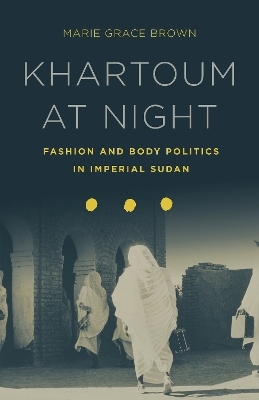
Khartoum at Night
Fashion and Body Politics in Imperial Sudan
Seiten
2017
|
New edition
Stanford University Press (Verlag)
978-1-5036-0264-9 (ISBN)
Stanford University Press (Verlag)
978-1-5036-0264-9 (ISBN)
In the first half of the twentieth century, a pioneering generation of young women exited their homes and entered public space, marking a new era for women's civic participation in northern Sudan. A provocative new public presence, women's civic engagement was at its core a bodily experience. Amid the socio-political upheavals of imperial rule, female students, medical workers, and activists used a careful choreography of body movements and fashion to adapt to imperial mores, claim opportunities for political agency, and shape a new standard of modern, mobile womanhood.
Khartoum at Night is the first English-language history of these women's lives, examining how their experiences of the British Empire from 1900–1956 were expressed on and through their bodies. Central to this story is the tobe: a popular, modest form of dress that wrapped around a woman's head and body. Marie Grace Brown shows how northern Sudanese women manipulated the tucks, folds, and social messages of the tobe to deftly negotiate the competing pulls of modernization and cultural authenticity that defined much of the imperial experience. Her analysis weaves together the threads of women's education and activism, medical midwifery, urban life, consumption, and new behaviors of dress and beauty to reconstruct the worlds of politics and pleasure in which early-twentieth-century Sudanese women lived.
Khartoum at Night is the first English-language history of these women's lives, examining how their experiences of the British Empire from 1900–1956 were expressed on and through their bodies. Central to this story is the tobe: a popular, modest form of dress that wrapped around a woman's head and body. Marie Grace Brown shows how northern Sudanese women manipulated the tucks, folds, and social messages of the tobe to deftly negotiate the competing pulls of modernization and cultural authenticity that defined much of the imperial experience. Her analysis weaves together the threads of women's education and activism, medical midwifery, urban life, consumption, and new behaviors of dress and beauty to reconstruct the worlds of politics and pleasure in which early-twentieth-century Sudanese women lived.
Marie Grace Brown is Assistant Professor of History at the University of Kansas.
Introduction
1. The Post Office Pen: The Imperial Mission
2. "Forty White Tobes": Enclosures and the Campaign for Pure Bodies
3. The Schoolmistresses' Ribs: Dress, Discipline, and Progress
4. The Woman's Voice: Claiming City Streets
5. Khartoum at Night: Global Politics and Personal Pleasures
Conclusion
| Erscheinungsdatum | 14.07.2017 |
|---|---|
| Zusatzinfo | 10 halftones, 1 map |
| Verlagsort | Palo Alto |
| Sprache | englisch |
| Maße | 140 x 216 mm |
| Themenwelt | Geschichte ► Allgemeine Geschichte ► Neuzeit (bis 1918) |
| Geisteswissenschaften ► Geschichte ► Regional- / Ländergeschichte | |
| ISBN-10 | 1-5036-0264-8 / 1503602648 |
| ISBN-13 | 978-1-5036-0264-9 / 9781503602649 |
| Zustand | Neuware |
| Informationen gemäß Produktsicherheitsverordnung (GPSR) | |
| Haben Sie eine Frage zum Produkt? |
Mehr entdecken
aus dem Bereich

aus dem Bereich
Geschichte einer wilden Handlung
Buch | Hardcover (2024)
C.H.Beck (Verlag)
CHF 47,60


