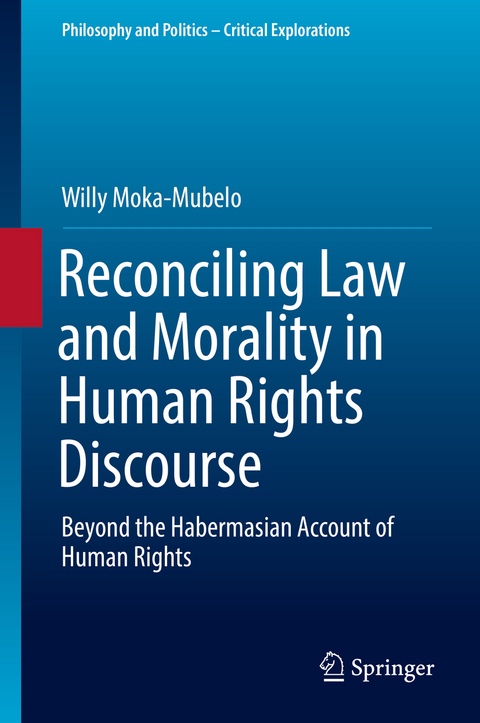
Reconciling Law and Morality in Human Rights Discourse (eBook)
205 Seiten
Springer-Verlag
978-3-319-49496-8 (ISBN)
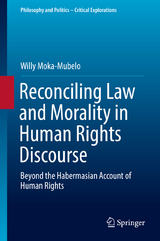
In this book I argue for an approach that conceives human rights as both moral and legal rights. The merit of such an approach is its capacity to understand human rights more in terms of the kind of world free and reasonable beings would like to live in rather than simply in terms of what each individual is legally entitled to. While I acknowledge that every human being has the moral entitlement to be granted living conditions that are conducive to a dignified life, I maintain, at the same time, that the moral and legal aspects of human rights are complementary and should be given equal weight. The legal aspect compensates for the limitations of moral human rights the observance of which depends on the conscience of the individual, and the moral aspect tempers the mechanical and inhumane application of the law.
Unlike the traditional or orthodox approach, which conceives human rights as rights that individuals have by virtue of their humanity, and the political or practical approach, which understands human rights as legal rights that are meant to limit the sovereignty of the state, the moral-legal approach reconciles law and morality in human rights discourse and underlines the importance of a legal framework that compensates for the deficiencies in the implementation of moral human rights. It not only challenges the exclusively negative approach to fundamental liberties but also emphasizes the necessity of an enforcement mechanism that helps those who are not morally motivated to refrain from violating the rights of others. Without the legal mechanism of enforcement, the understanding of human rights would be reduced to simply framing moral claims against injustices.
From the moral-legal approach, the protection of human rights is understood as a common and shared responsibility. Such a responsibility goes beyond the boundaries of nation-states and requires the establishment of a cosmopolitan human rights regime based on the conviction that all human beings are members of a community of fate and that they share common values which transcend the limits of their individual states. In a cosmopolitan human rights regime, people are protected as persons and not as citizens of a particular state.
Willy Moka-Mubelo, S.J. is a Jesuit from the Democratic Republic of Congo. He earns a Licentiate in Sacred Theology (STL) and a Master of Theology (ThM) from the Jesuit School of Theology of Santa Clara University in California/USA and a Ph.D. in philosophy from Boston College in Massachusetts/USA. His area of interest is social and political philosophy. He is the author of Justice and Social Reconciliation in the Democratic Republic of Congo: The Church’s Contribution to the Building of a New Society and Le Dilemme éthico-politique dans l’état moderne: Une lecture de la philosophie politique d’Éric Weil.
| Erscheint lt. Verlag | 13.12.2016 |
|---|---|
| Reihe/Serie | Philosophy and Politics - Critical Explorations | Philosophy and Politics - Critical Explorations |
| Zusatzinfo | XI, 205 p. |
| Verlagsort | Cham |
| Sprache | englisch |
| Themenwelt | Geisteswissenschaften ► Philosophie ► Allgemeines / Lexika |
| Recht / Steuern ► Allgemeines / Lexika | |
| Recht / Steuern ► EU / Internationales Recht | |
| Recht / Steuern ► Privatrecht / Bürgerliches Recht | |
| Sozialwissenschaften ► Politik / Verwaltung | |
| Schlagworte | Charles Larmore • Civic Republicanism • Classical Liberalism • Human dignity • Human Rights • Jürgen Habermas • Klaus Günther • Mutua on Human Rights • Private and public autonomy • Rainer Forst • Responsibility to Protect • Thomas Pogge |
| ISBN-10 | 3-319-49496-1 / 3319494961 |
| ISBN-13 | 978-3-319-49496-8 / 9783319494968 |
| Informationen gemäß Produktsicherheitsverordnung (GPSR) | |
| Haben Sie eine Frage zum Produkt? |
 PDF (Wasserzeichen)
DRM: Digitales Wasserzeichen
Dieses eBook enthält ein digitales Wasserzeichen und ist damit für Sie personalisiert. Bei einer missbräuchlichen Weitergabe des eBooks an Dritte ist eine Rückverfolgung an die Quelle möglich.
Dateiformat: PDF (Portable Document Format)
Mit einem festen Seitenlayout eignet sich die PDF besonders für Fachbücher mit Spalten, Tabellen und Abbildungen. Eine PDF kann auf fast allen Geräten angezeigt werden, ist aber für kleine Displays (Smartphone, eReader) nur eingeschränkt geeignet.
Systemvoraussetzungen:
PC/Mac: Mit einem PC oder Mac können Sie dieses eBook lesen. Sie benötigen dafür einen PDF-Viewer - z.B. den Adobe Reader oder Adobe Digital Editions.
eReader: Dieses eBook kann mit (fast) allen eBook-Readern gelesen werden. Mit dem amazon-Kindle ist es aber nicht kompatibel.
Smartphone/Tablet: Egal ob Apple oder Android, dieses eBook können Sie lesen. Sie benötigen dafür einen PDF-Viewer - z.B. die kostenlose Adobe Digital Editions-App.
Buying eBooks from abroad
For tax law reasons we can sell eBooks just within Germany and Switzerland. Regrettably we cannot fulfill eBook-orders from other countries.
aus dem Bereich