


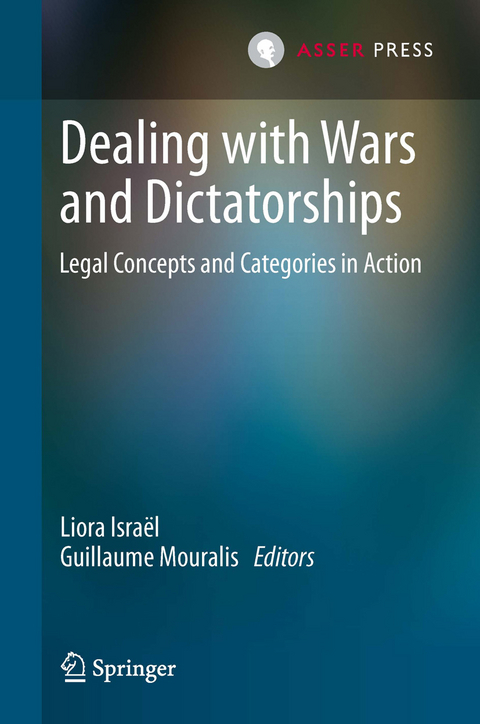
Dealing with Wars and Dictatorships (eBook)
XI, 269 Seiten
T.M.C. Asser Press (Verlag)
978-90-6704-930-6 (ISBN)
Liora Israël is a sociologist at the École des Hautes Études en Sciences Sociales and assistant director of the Centre Maurice Halbwachs, Paris. Guillaume Mouralis is an historian and sociologist at the Centre National de la Recherche Scientifique and a member of the Institut des Sciences Sociales du Politique, Université Paris Ouest Nanterre.
Democratic 'transitions' in Latin America, Eastern Europe, and South Africa, often studied under the conceptual rubric of 'transitional justice', have involved the formation of public policies toward the past that are multifaceted and often ambitious. Recent scholarship rarely questions the concepts and categories transposed from one country to another. This is true both in the language of political life and in the social sciences examining past-oriented public policy, especially policy toward 'ethnic cleansing' and the line between the language of political practice, legal analysis, and scholarly discourse has been quite porous. This book examines how these phenomena have been described and understood by focusing recent processes, such as the advent of international criminal justice, in relation to previous postwar and recent purges. By crossing disciplinary approaches and periods, the authors pay attention to three main aspects: the legal or political concepts used (and/or the ones mobilized in the academic work); the circulation of categories, know-how, and arguments; the different levels that can shed light on transitions.
Liora Israël is a sociologist at the École des Hautes Études en Sciences Sociales and assistant director of the Centre Maurice Halbwachs, Paris. Guillaume Mouralis is an historian and sociologist at the Centre National de la Recherche Scientifique and a member of the Institut des Sciences Sociales du Politique, Université Paris Ouest Nanterre.
General Introduction.- “Épuration”: History of a Word.- Humanity Seized by International Criminal Justice.- Dealing with Collaboration in Belgium after the Second World War: From Activism to Collaboration and Incivism.- Transitional Justice as Universal Narrative.- The Invention of “Transitional Justice” in the 1990s.- “Transitional Justice” and National “Mastering of the Past”: Criminal Justice and Liberalization Processes in West Germany after 1945.- Poor Little Belgium? Belgian Trials of German War Criminals, 1944-1951.- From Revolution to Restoration. Transnational Implications of the Greek Purge of Wartime Collaborators.- The Defense in the Dock: Professional Purges of French Lawyers after the Second World War.- Law and the Soviet Purge: Domestic Renewal and International Convergences.- Circulation of Models of épuration after the Second World War: from France to Italy.- Reassessing the Boundaries of Transitional Justice: An Inquiry of Political Transitions, Armed Conflicts and Human Rights Violations.- The Emergence of Transitional Justice as a Professional International Practice.- The Uncertain Place of Purge within Transitional Justice, and the Limitations of International Law in the World’s Response to Mass Atrocity.
| Erscheint lt. Verlag | 2.12.2013 |
|---|---|
| Zusatzinfo | XI, 269 p. 3 illus. |
| Verlagsort | The Hague |
| Sprache | englisch |
| Themenwelt | Geisteswissenschaften ► Geschichte |
| Recht / Steuern ► EU / Internationales Recht | |
| Recht / Steuern ► Öffentliches Recht ► Völkerrecht | |
| Sozialwissenschaften ► Politik / Verwaltung ► Politische Theorie | |
| Sozialwissenschaften ► Soziologie | |
| Schlagworte | Épuration • Human Rights Violations • International Criminal Justice • Purges, ethnic cleansing • Transitional Justice |
| ISBN-10 | 90-6704-930-1 / 9067049301 |
| ISBN-13 | 978-90-6704-930-6 / 9789067049306 |
| Informationen gemäß Produktsicherheitsverordnung (GPSR) | |
| Haben Sie eine Frage zum Produkt? |
 PDF (Wasserzeichen)
Größe: 2,4 MB
DRM: Digitales Wasserzeichen
Dieses eBook enthält ein digitales Wasserzeichen und ist damit für Sie personalisiert. Bei einer missbräuchlichen Weitergabe des eBooks an Dritte ist eine Rückverfolgung an die Quelle möglich.
Dateiformat: PDF (Portable Document Format)
Mit einem festen Seitenlayout eignet sich die PDF besonders für Fachbücher mit Spalten, Tabellen und Abbildungen. Eine PDF kann auf fast allen Geräten angezeigt werden, ist aber für kleine Displays (Smartphone, eReader) nur eingeschränkt geeignet.
Systemvoraussetzungen:
PC/Mac: Mit einem PC oder Mac können Sie dieses eBook lesen. Sie benötigen dafür einen PDF-Viewer - z.B. den Adobe Reader oder Adobe Digital Editions.
eReader: Dieses eBook kann mit (fast) allen eBook-Readern gelesen werden. Mit dem amazon-Kindle ist es aber nicht kompatibel.
Smartphone/Tablet: Egal ob Apple oder Android, dieses eBook können Sie lesen. Sie benötigen dafür einen PDF-Viewer - z.B. die kostenlose Adobe Digital Editions-App.
Buying eBooks from abroad
For tax law reasons we can sell eBooks just within Germany and Switzerland. Regrettably we cannot fulfill eBook-orders from other countries.


