


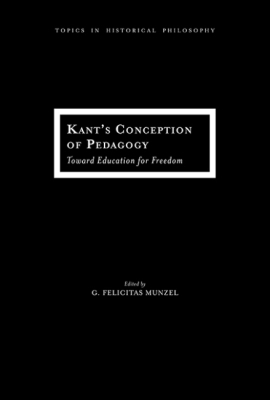
Kant's Conception of Pedagogy
Toward Education for Freedom
Seiten
2017
Northwestern University Press (Verlag)
978-0-8101-3562-8 (ISBN)
Northwestern University Press (Verlag)
978-0-8101-3562-8 (ISBN)
Although he was involved in the education debates of his time, it is widely held that in his mature philosophical writings Immanuel Kant is silent on the subject. In this groundbreaking book, G. Felicitas Munzel finds extant in Kant's writings the so-called missing critical treatise on education; it appears in the “Doctrines of Method” with which he concludes each of his major works.
Although he was involved in the education debates of his time, it is widely held that in his mature philosophical writings Immanuel Kant is silent on the subject. In her groundbreaking Kant’s Conception of Pedagogy, G. Felicitas Munzel finds extant in Kant’s writings the so-called missing critical treatise on education; it appears in the Doctrines of Method with which he concludes each of his major works. Here Kant identifies the fundamental principles for the cultivation of reason’s judgment when it comes to cognition, beauty, nature, and the exercise of morality while subject to the passions and inclinations that characterize the human experience. From her analysis, Munzel extrapolates principles for a cosmopolitan education that parallels the structure of Kant’s republican constitution for perpetual peace. With the formal principles in place, the argument concludes with a query of the material principles that would fulfill the formal conditions required for an education for freedom.
Although he was involved in the education debates of his time, it is widely held that in his mature philosophical writings Immanuel Kant is silent on the subject. In her groundbreaking Kant’s Conception of Pedagogy, G. Felicitas Munzel finds extant in Kant’s writings the so-called missing critical treatise on education; it appears in the Doctrines of Method with which he concludes each of his major works. Here Kant identifies the fundamental principles for the cultivation of reason’s judgment when it comes to cognition, beauty, nature, and the exercise of morality while subject to the passions and inclinations that characterize the human experience. From her analysis, Munzel extrapolates principles for a cosmopolitan education that parallels the structure of Kant’s republican constitution for perpetual peace. With the formal principles in place, the argument concludes with a query of the material principles that would fulfill the formal conditions required for an education for freedom.
G. Felicitas Munzel is an associate professor in the Program of Liberal Studies and the depart-ment of philosophy at the University of Notre Dame.
| Erscheinungsdatum | 10.08.2017 |
|---|---|
| Reihe/Serie | Topics in Historical Philosophy |
| Verlagsort | Evanston |
| Sprache | englisch |
| Maße | 152 x 228 mm |
| Gewicht | 620 g |
| Themenwelt | Geisteswissenschaften ► Philosophie ► Allgemeines / Lexika |
| Geisteswissenschaften ► Philosophie ► Geschichte der Philosophie | |
| Geisteswissenschaften ► Philosophie ► Philosophie der Neuzeit | |
| ISBN-10 | 0-8101-3562-0 / 0810135620 |
| ISBN-13 | 978-0-8101-3562-8 / 9780810135628 |
| Zustand | Neuware |
| Informationen gemäß Produktsicherheitsverordnung (GPSR) | |
| Haben Sie eine Frage zum Produkt? |
Mehr entdecken
aus dem Bereich

aus dem Bereich
die letzten Jahre der Philosophie und der Beginn einer neuen …
Buch | Hardcover (2024)
Klett-Cotta (Verlag)
CHF 39,20


