


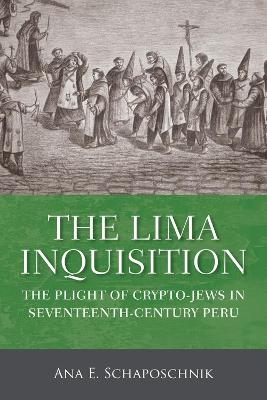
The Lima Inquisition
The Plight of Crypto-Jews in Seventeenth-Century Peru
Seiten
2017
University of Wisconsin Press (Verlag)
9780299313449 (ISBN)
University of Wisconsin Press (Verlag)
9780299313449 (ISBN)
Established in Peru in 1570, the Holy Office of the Inquisition operated there until 1820, prosecuting, torturing, and sentencing alleged heretics. Ana Schaposchnik offers a deeply researched history of the Inquisition's tribunal in the capital city of Lima, with a focus on cases of crypto-Judaism - the secret adherence to Judaism while publicly professing Christianity.
Established in Peru in 1570, the Holy Office of the Inquisition operated there until 1820, prosecuting, torturing, and sentencing alleged heretics. Ana Schaposchnik offers a deeply researched history of the Inquisition's tribunal in the capital city of Lima, with a focus on cases of crypto-Judaism—the secret adherence to Judaism while publicly professing Christianity.
Delving into the records of the tribunal, Schaposchnik brings to light the experiences of individuals on both sides of the process. Some prisoners, she discovers, developed a limited degree of agency as they managed to stall trials or mitigate the most extreme punishments. Training her attention on the accusers, Schaposchnik uncovers the agendas of specific inquisitors in bringing the condemned from the dungeons to the 1639 Auto General de Fe ceremony of public penance and execution. Through this fine-grained study of the tribunal's participants, Schaposchnik finds that the Inquisition sought to discipline and shape culture not so much through frequency of trials or number of sentences as through the potency of individual examples.
Established in Peru in 1570, the Holy Office of the Inquisition operated there until 1820, prosecuting, torturing, and sentencing alleged heretics. Ana Schaposchnik offers a deeply researched history of the Inquisition's tribunal in the capital city of Lima, with a focus on cases of crypto-Judaism—the secret adherence to Judaism while publicly professing Christianity.
Delving into the records of the tribunal, Schaposchnik brings to light the experiences of individuals on both sides of the process. Some prisoners, she discovers, developed a limited degree of agency as they managed to stall trials or mitigate the most extreme punishments. Training her attention on the accusers, Schaposchnik uncovers the agendas of specific inquisitors in bringing the condemned from the dungeons to the 1639 Auto General de Fe ceremony of public penance and execution. Through this fine-grained study of the tribunal's participants, Schaposchnik finds that the Inquisition sought to discipline and shape culture not so much through frequency of trials or number of sentences as through the potency of individual examples.
Ana E. Schaposchnik is an associate professor of history at DePaul University.
| Erscheinungsdatum | 06.07.2017 |
|---|---|
| Zusatzinfo | 1 table |
| Verlagsort | Wisconsin |
| Sprache | englisch |
| Maße | 152 x 228 mm |
| Gewicht | 420 g |
| Themenwelt | Geisteswissenschaften ► Geschichte ► Regional- / Ländergeschichte |
| Geschichte ► Teilgebiete der Geschichte ► Religionsgeschichte | |
| Geisteswissenschaften ► Religion / Theologie ► Christentum | |
| Geisteswissenschaften ► Religion / Theologie ► Judentum | |
| ISBN-13 | 9780299313449 / 9780299313449 |
| Zustand | Neuware |
| Informationen gemäß Produktsicherheitsverordnung (GPSR) | |
| Haben Sie eine Frage zum Produkt? |
Mehr entdecken
aus dem Bereich


aus dem Bereich
von der Antike bis zur Gegenwart
Buch | Softcover (2025)
C.H.Beck (Verlag)
CHF 16,80


