


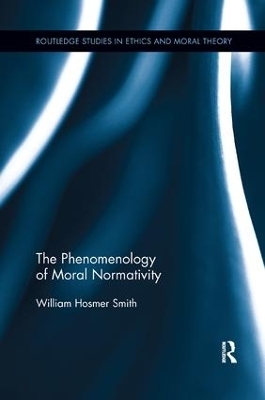
The Phenomenology of Moral Normativity
Seiten
2017
Routledge (Verlag)
9781138731493 (ISBN)
Routledge (Verlag)
9781138731493 (ISBN)
William H. Smith draws on both phenomenology and contemporary moral theory to argue that the source of moral normativity—that is, the justification of morality’s binding force—is the legitimate authority of other persons to hold us morally accountable and our self-responsible commitment to live up to that demand.
Why should I be moral? Philosophers have long been concerned with the legitimacy of morality’s claim on us—especially its ostensible aim to motivate certain actions of all persons unconditionally. This problem of moral normativity has received extensive treatment in analytic moral theory, but little attention has been paid to the potential contribution that phenomenology might make to this central debate in metaethics.
In The Phenomenology of Moral Normativity, William H. Smith takes up the question of morality’s legitimacy anew, drawing contemporary moral philosophers into conversation with the phenomenological philosophy of Husserl, Heidegger, and Levinas. Utilizing a two-part account of moral normativity, Smith contends that the ground of morality itself is second-personal—rooted in the ethical demand intrinsic to other persons —while the ground for particular moral-obligations is first-personal—rooted in the subject’s avowal or endorsement of certain moral norms within a concrete historical situation.
Thus, Smith argues, phenomenological analysis allows us to make sense of an idea that has long held intuitive appeal, but that modern moral philosophy has been unable to render satisfactorily: namely, that the normative source of valid moral claims is simply other persons and what we owe to them.
Why should I be moral? Philosophers have long been concerned with the legitimacy of morality’s claim on us—especially its ostensible aim to motivate certain actions of all persons unconditionally. This problem of moral normativity has received extensive treatment in analytic moral theory, but little attention has been paid to the potential contribution that phenomenology might make to this central debate in metaethics.
In The Phenomenology of Moral Normativity, William H. Smith takes up the question of morality’s legitimacy anew, drawing contemporary moral philosophers into conversation with the phenomenological philosophy of Husserl, Heidegger, and Levinas. Utilizing a two-part account of moral normativity, Smith contends that the ground of morality itself is second-personal—rooted in the ethical demand intrinsic to other persons —while the ground for particular moral-obligations is first-personal—rooted in the subject’s avowal or endorsement of certain moral norms within a concrete historical situation.
Thus, Smith argues, phenomenological analysis allows us to make sense of an idea that has long held intuitive appeal, but that modern moral philosophy has been unable to render satisfactorily: namely, that the normative source of valid moral claims is simply other persons and what we owe to them.
William H. Smith is Lecturer in Philosophy at Seattle University.
Introduction: The Problem of Moral Normativity Part 1: The First-Person 1. Moral Realism and Korsgaard’s Dilemma 2. Respect and Drummond’s Husserlian Metaethics Part 2: The Second-Person 3. Dignity and Darwall’s Second-Person Standpoint 4. Authority and Levinas’s Face-to-Face Part 3: Subjectivity and Responsibility 5. Nihilism and Heidegger’s Fundamental Ontology 6. A Phenomenological Theory of Moral Normativity
| Erscheinungsdatum | 22.04.2017 |
|---|---|
| Reihe/Serie | Routledge Studies in Ethics and Moral Theory |
| Verlagsort | London |
| Sprache | englisch |
| Maße | 152 x 229 mm |
| Gewicht | 453 g |
| Themenwelt | Geisteswissenschaften ► Philosophie ► Ethik |
| Geisteswissenschaften ► Philosophie ► Philosophie der Neuzeit | |
| ISBN-13 | 9781138731493 / 9781138731493 |
| Zustand | Neuware |
| Informationen gemäß Produktsicherheitsverordnung (GPSR) | |
| Haben Sie eine Frage zum Produkt? |
Mehr entdecken
aus dem Bereich



aus dem Bereich
Buch | Hardcover (2025)
Suhrkamp (Verlag)
CHF 32,15


