


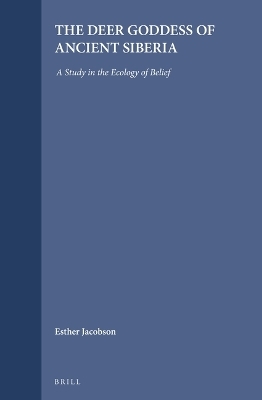
The Deer Goddess of Ancient Siberia
A Study in the Ecology of Belief
Seiten
1992
Brill (Verlag)
9789004096288 (ISBN)
Brill (Verlag)
9789004096288 (ISBN)
- Keine Verlagsinformationen verfügbar
- Artikel merken
This study examines the ecology of belief traced in rock carvings and monolithic stelae of the Neolithic period and Bronze Age and in the bronze, gold, and wood sculpture of the early Iron Age nomads of South Siberia.
Central to this study is the image of the deer within the iconography of the Early Nomads of South Siberia. By examining the symbolic structures revealed in the art and archaeology of the Early Nomads, the author challenges existing theories regarding Early Nomadic cosmology.
The reconstruction of meanings embedded in the deer image carries the investigation back to rock carvings, paintings, and monolithic stelae of South Siberia and northern Central Asia, from the Neolithic period down through the early Iron Age. The succession of images dominating that artistic tradition is considered against the background of cultures — including the Baykal Neolithic Afanasevo, Okunev, Andronovo, and Karasuk — evolving from a hunting-fishing dependency to a dependency on livestock. The archaic mythic traditions of specific Siberian groups are also found to lend critical detail to the changing symbolic systems of South Siberia.
Central to this study is the image of the deer within the iconography of the Early Nomads of South Siberia. By examining the symbolic structures revealed in the art and archaeology of the Early Nomads, the author challenges existing theories regarding Early Nomadic cosmology.
The reconstruction of meanings embedded in the deer image carries the investigation back to rock carvings, paintings, and monolithic stelae of South Siberia and northern Central Asia, from the Neolithic period down through the early Iron Age. The succession of images dominating that artistic tradition is considered against the background of cultures — including the Baykal Neolithic Afanasevo, Okunev, Andronovo, and Karasuk — evolving from a hunting-fishing dependency to a dependency on livestock. The archaic mythic traditions of specific Siberian groups are also found to lend critical detail to the changing symbolic systems of South Siberia.
Esther Jacobson is an art historian at the University of Oregon. She has published extensively in the fields of Chinese art history and the art history and culture of the early nomadic peoples of Siberia and Central Asia.
| Erscheint lt. Verlag | 1.11.1992 |
|---|---|
| Reihe/Serie | Numen Book Series ; 55 |
| Verlagsort | Leiden |
| Sprache | englisch |
| Maße | 155 x 235 mm |
| Gewicht | 626 g |
| Einbandart | Leinen |
| Themenwelt | Geschichte ► Allgemeine Geschichte ► Vor- und Frühgeschichte |
| Geisteswissenschaften ► Geschichte ► Regional- / Ländergeschichte | |
| Geisteswissenschaften ► Religion / Theologie ► Weitere Religionen | |
| ISBN-13 | 9789004096288 / 9789004096288 |
| Zustand | Neuware |
| Informationen gemäß Produktsicherheitsverordnung (GPSR) | |
| Haben Sie eine Frage zum Produkt? |
Mehr entdecken
aus dem Bereich


aus dem Bereich
auf den Spuren der frühen Zivilisationen
Buch | Hardcover (2023)
C.H.Beck (Verlag)
CHF 27,95
Erkennen. Bestimmen. Beschreiben
Buch | Softcover (2022)
Deutscher Kunstverlag
CHF 27,85


