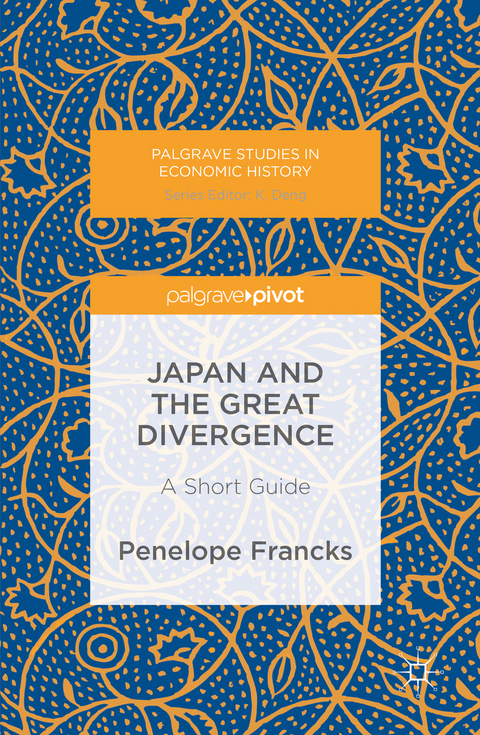
Japan and the Great Divergence (eBook)
123 Seiten
Palgrave Macmillan UK (Verlag)
978-1-137-57673-6 (ISBN)
This text offers an accessible guide to the ways in which our growing knowledge of development in early-modern and modernising Japan can throw light on the paths that industrialisation was eventually to take across the globe. It has long been taken as read that the industrial revolution was the product of some form of ‘European superiority’ dating back to at least early-modern times. In The Great Divergence, Kenneth Pomeranz challenged this assumption on the basis of his evidence that parts of eighteenth-century China were as well placed as northern Europe to achieve sustained economic growth, thus igniting what has been called ‘the single most important debate in recent global history’. Japan, as the only non-Western country to experience significant industrialisation before the Second World War, ought to provide crucial – and intriguing – evidence in the debate, but analysis of the Japanese case in such a context has remained limited. This work suggests ways of re-interpreting Japanese economic history in the light of the debate, so arguing that global historians and scholars of Japan have in fact much to say to each other within the comparative framework that the Great Divergence provides.
This text offers an accessible guide to the ways in which our growing knowledge of development in early-modern and modernising Japan can throw light on the paths that industrialisation was eventually to take across the globe. It has long been taken as read that the industrial revolution was the product of some form of 'European superiority' dating back to at least early-modern times. In The Great Divergence, Kenneth Pomeranz challenged this assumption on the basis of his evidence that parts of eighteenth-century China were as well placed as northern Europe to achieve sustained economic growth, thus igniting what has been called 'the single most important debate in recent global history'. Japan, as the only non-Western country to experience significant industrialisation before the Second World War, ought to provide crucial - and intriguing - evidence in the debate, but analysis of the Japanese case in such a context has remained limited. This work suggests ways of re-interpreting Japanese economic history in the light of the debate, so arguing that global historians and scholars of Japan have in fact much to say to each other within the comparative framework that the Great Divergence provides.
Penelope Francks is now Honorary Fellow of the University of Leeds, UK, where she was previously Reader in Japanese Studies and taught for many years on the history and economy of Japan and the rest of East Asia. Her research interests lie in Japanese economic history, especially rural development and, more recently, the history of consumption. She has published a range of books and journal articles on these topics.
| Erscheint lt. Verlag | 15.10.2016 |
|---|---|
| Reihe/Serie | Palgrave Studies in Economic History | Palgrave Studies in Economic History |
| Zusatzinfo | VIII, 123 p. |
| Verlagsort | London |
| Sprache | englisch |
| Themenwelt | Geschichte ► Teilgebiete der Geschichte ► Wirtschaftsgeschichte |
| Wirtschaft ► Allgemeines / Lexika | |
| Wirtschaft ► Betriebswirtschaft / Management ► Unternehmensführung / Management | |
| Wirtschaft ► Volkswirtschaftslehre | |
| Schlagworte | Early-Modern Japan • Economics • Global History • History • Industrial Revolution • Japan • Japanese Economic History • Kenneth Pomeranz • The Great Divergence |
| ISBN-10 | 1-137-57673-1 / 1137576731 |
| ISBN-13 | 978-1-137-57673-6 / 9781137576736 |
| Informationen gemäß Produktsicherheitsverordnung (GPSR) | |
| Haben Sie eine Frage zum Produkt? |
 PDF (Wasserzeichen)
DRM: Digitales Wasserzeichen
Dieses eBook enthält ein digitales Wasserzeichen und ist damit für Sie personalisiert. Bei einer missbräuchlichen Weitergabe des eBooks an Dritte ist eine Rückverfolgung an die Quelle möglich.
Dateiformat: PDF (Portable Document Format)
Mit einem festen Seitenlayout eignet sich die PDF besonders für Fachbücher mit Spalten, Tabellen und Abbildungen. Eine PDF kann auf fast allen Geräten angezeigt werden, ist aber für kleine Displays (Smartphone, eReader) nur eingeschränkt geeignet.
Systemvoraussetzungen:
PC/Mac: Mit einem PC oder Mac können Sie dieses eBook lesen. Sie benötigen dafür einen PDF-Viewer - z.B. den Adobe Reader oder Adobe Digital Editions.
eReader: Dieses eBook kann mit (fast) allen eBook-Readern gelesen werden. Mit dem amazon-Kindle ist es aber nicht kompatibel.
Smartphone/Tablet: Egal ob Apple oder Android, dieses eBook können Sie lesen. Sie benötigen dafür einen PDF-Viewer - z.B. die kostenlose Adobe Digital Editions-App.
Buying eBooks from abroad
For tax law reasons we can sell eBooks just within Germany and Switzerland. Regrettably we cannot fulfill eBook-orders from other countries.
aus dem Bereich