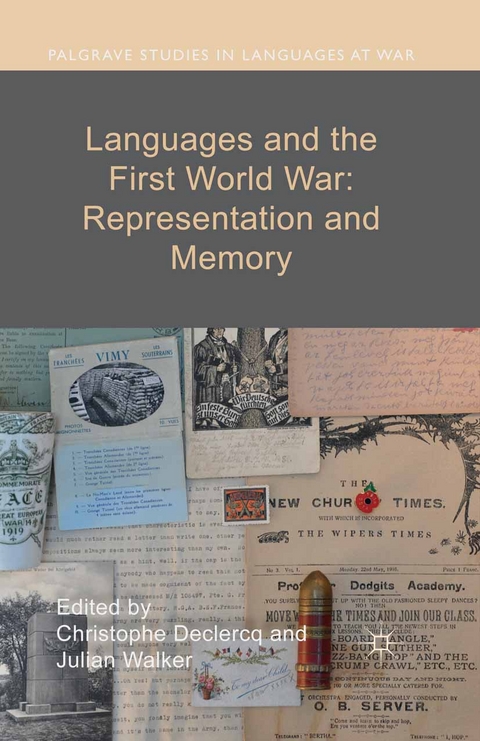
Languages and the First World War: Representation and Memory (eBook)
XII, 256 Seiten
Palgrave Macmillan UK (Verlag)
978-1-137-55036-1 (ISBN)
With several terms from the First World War still present in modern speech, Languages and the First World War presents over 30 essays by international academics investigating the linguistic aspects of the 1914-18 conflict. The first of the two volumes covers language change and documentation during the period of the war, while the second examines the representation and the memory of the war. Communicating in a Transnational War examines languages at the front, including the subject of interpretation, translation and parallels between languages; communication with the home front; propaganda and language manipulation; and recording language during the war. Representation and Memory examines historiographical issues; the nature of representing the war in letters and diaries; the documentation of language change; the language of representing the war in reportage and literature; and the language of remembering the war. Covered in the process are slang, censorship, soldiers' phrasebooks, code-switching, borrowing terms, the problems facing multilingual armies, and gendered language.
Julian Walker is a British Library educator, an artist and writer. His books on language include Discovering Words, Team Talk: Sporting Words and their Origins and Trench Talk. Christophe Declercq is a lecturer in translation (University College London, UK and University of Antwerp, Belgium) who has been working on Belgian refugees in Britain for well over a decade. On the subject, he has spoken widely at conferences in both Britain and Belgium, has worked with the BBC and VRT (Belgian television) and manages several social media outlets.
AcknowledgementsPART I: THE HISTORIAN'S PROBLEMS1. Problems and challenges of a historical approach2. Translation, interpretation and mistranslation: Belgian exiles and 'reformed' soldiers, their records and problems encountered by English language researchersPART II: REPRESENTING THE PRESENT3. 'Fake Belgium' Linguistic issues in the diary of Father Achiel Van Walleghem (1914-1919)4. Out of the Trenches: The Rhetoric of Letters from the Western FrontPART III: LANGUAGE USE AND CHANGE5. 'Aussie': code-switching in an Australian soldiers' magazine – an overview6. From Antwerp to Britain and back again: the language of the Belgian refugee in Britain during the First World War7. Language Changes in the Jewish Community in Kosovo and Metohija after the Balkan Wars (1912-1913) and the First World War (1914-1918)PART IV: LITERATURE AND REPRESENTATION8. 'Excursion into a Foreign Language': Frederic Manning and Ford Madox Ford9. 14 / 1914. On Jean Échenoz's Great War, meta-discourse and the English reception10. 'The Language of Espionage: Mata Hari and the creation of the spy-courtesan'PART V: COMMEMORATION AND MEMORY11. ''Here is our blood. When are our rights?' Flemish Graffiti and the Great War'12. The Languages of Remembrance: An Attempt at a Taxonomy13. Wartime citations in Ernest Weekley's An Etymological Dictionary of Modern English (1921) and contemporary dictionaries14. War Discourse: still talking about the First World War in Britain, 1914-2014
| Erscheint lt. Verlag | 19.5.2016 |
|---|---|
| Reihe/Serie | Palgrave Studies in Languages at War | Palgrave Studies in Languages at War |
| Zusatzinfo | XII, 256 p. |
| Verlagsort | London |
| Sprache | englisch |
| Themenwelt | Geschichte ► Allgemeine Geschichte ► Neuzeit (bis 1918) |
| Geschichte ► Allgemeine Geschichte ► 1918 bis 1945 | |
| Geisteswissenschaften ► Sprach- / Literaturwissenschaft ► Sprachwissenschaft | |
| Technik | |
| Schlagworte | Austro-Hungarian • British • Code-switching • conflict • English • First World War • French • German • Great War • Interpreting • language • Linguistics • Military • Sociolinguistics • soldiers' language • Translation • trench slang • war • Western Front • World War One |
| ISBN-10 | 1-137-55036-8 / 1137550368 |
| ISBN-13 | 978-1-137-55036-1 / 9781137550361 |
| Informationen gemäß Produktsicherheitsverordnung (GPSR) | |
| Haben Sie eine Frage zum Produkt? |
 PDF (Wasserzeichen)
DRM: Digitales Wasserzeichen
Dieses eBook enthält ein digitales Wasserzeichen und ist damit für Sie personalisiert. Bei einer missbräuchlichen Weitergabe des eBooks an Dritte ist eine Rückverfolgung an die Quelle möglich.
Dateiformat: PDF (Portable Document Format)
Mit einem festen Seitenlayout eignet sich die PDF besonders für Fachbücher mit Spalten, Tabellen und Abbildungen. Eine PDF kann auf fast allen Geräten angezeigt werden, ist aber für kleine Displays (Smartphone, eReader) nur eingeschränkt geeignet.
Systemvoraussetzungen:
PC/Mac: Mit einem PC oder Mac können Sie dieses eBook lesen. Sie benötigen dafür einen PDF-Viewer - z.B. den Adobe Reader oder Adobe Digital Editions.
eReader: Dieses eBook kann mit (fast) allen eBook-Readern gelesen werden. Mit dem amazon-Kindle ist es aber nicht kompatibel.
Smartphone/Tablet: Egal ob Apple oder Android, dieses eBook können Sie lesen. Sie benötigen dafür einen PDF-Viewer - z.B. die kostenlose Adobe Digital Editions-App.
Buying eBooks from abroad
For tax law reasons we can sell eBooks just within Germany and Switzerland. Regrettably we cannot fulfill eBook-orders from other countries.
aus dem Bereich