


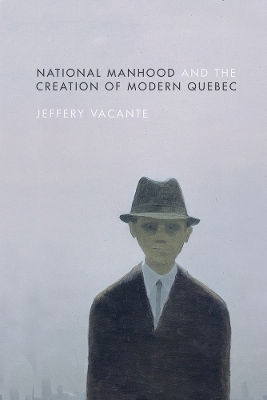
National Manhood and the Creation of Modern Quebec
Seiten
2017
University of British Columbia Press (Verlag)
978-0-7748-3463-6 (ISBN)
University of British Columbia Press (Verlag)
978-0-7748-3463-6 (ISBN)
This perceptive intellectual history of masculinity in nineteenth- and twentieth-century Quebec explores how the concept of manhood shaped French Canadian culture and an emerging Quebec nationalism.
This intellectual history explores how the idea of manhood shaped French Canadian culture and Quebec's nationalist movement. During the latter half of the nineteenth century, Quebec was an agrarian society, and masculinity was rooted in the land and the family and informed by Catholic principles of piety and self-restraint. As the industrial era took hold, a new model was forged, built on the values of secularism and individualism.
Jeffery Vacante's perceptive analysis reveals how French Canadian intellectuals defined masculinity in response to imperialist English Canadian ideals. This "national manhood" would be disentangled from the workplace, the family, and the land and tied instead to one's cultural identity. The new formulation was crucial in the larger struggle to modernize Quebec's institutions while preserving French Canadian community, faith, and culture. It offered French Canadian men a way to remodel themselves, participate in industrial modernity, and still assert cultural authority.
This intellectual history explores how the idea of manhood shaped French Canadian culture and Quebec's nationalist movement. During the latter half of the nineteenth century, Quebec was an agrarian society, and masculinity was rooted in the land and the family and informed by Catholic principles of piety and self-restraint. As the industrial era took hold, a new model was forged, built on the values of secularism and individualism.
Jeffery Vacante's perceptive analysis reveals how French Canadian intellectuals defined masculinity in response to imperialist English Canadian ideals. This "national manhood" would be disentangled from the workplace, the family, and the land and tied instead to one's cultural identity. The new formulation was crucial in the larger struggle to modernize Quebec's institutions while preserving French Canadian community, faith, and culture. It offered French Canadian men a way to remodel themselves, participate in industrial modernity, and still assert cultural authority.
Jeffery Vacante is an assistant professor in the Department of History at the University of Western Ontario. He is an intellectual and gender historian whose research focuses on modern Quebec. His work has appeared in some of Canada's leading journals, including Canadian Historical Review, Journal of Canadian Studies, Left History, and University of Toronto Quarterly.
Introduction
1 The Roots of National Manhood
2 Reinforcing Heterosexual Manhood
3 The Decline of the French Canadian Race
4 War and Manhood
5 The Revitalization of National History
6 The Critique of National Manhood
Conclusion
Notes; Index
| Erscheinungsdatum | 23.06.2017 |
|---|---|
| Verlagsort | Vancouver |
| Sprache | englisch |
| Maße | 152 x 229 mm |
| Gewicht | 500 g |
| Themenwelt | Sachbuch/Ratgeber ► Geschichte / Politik ► Allgemeines / Lexika |
| Geisteswissenschaften ► Geschichte ► Regional- / Ländergeschichte | |
| Sozialwissenschaften ► Soziologie ► Gender Studies | |
| ISBN-10 | 0-7748-3463-3 / 0774834633 |
| ISBN-13 | 978-0-7748-3463-6 / 9780774834636 |
| Zustand | Neuware |
| Informationen gemäß Produktsicherheitsverordnung (GPSR) | |
| Haben Sie eine Frage zum Produkt? |
Mehr entdecken
aus dem Bereich


aus dem Bereich
Handbuch zum Lesen des Himmels
Buch | Hardcover (2025)
Harpercollins (Verlag)
CHF 30,80
historische Porträts von George Washington bis Donald Trump
Buch | Softcover (2025)
C.H.Beck (Verlag)
CHF 33,55


