


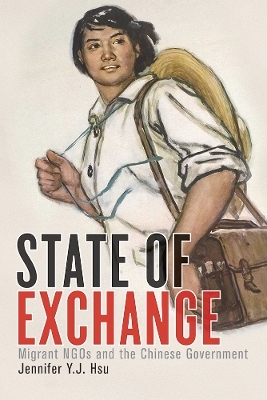
State of Exchange
Migrant NGOs and the Chinese Government
Seiten
2017
University of British Columbia Press (Verlag)
978-0-7748-3364-6 (ISBN)
University of British Columbia Press (Verlag)
978-0-7748-3364-6 (ISBN)
This exploration of the interactive relationship between Chinese NGOs and the Chinese state provides fresh insights into how the Chinese government operates and why it needs non-governmental organizations to survive.
Non-governmental organizations have increased dramatically in China since the 1970s, despite operating in a restrictive authoritarian environment. With labour migrants moving to the cities en masse in search of higher wages and better standards of living, the central and local states now permit migrant NGOs to deliver community services to workers in cities such as Beijing and Shanghai. Engaging a new conceptual framework, Jennifer Hsu reveals how NGOs are interacting with the layers and spaces of the state and navigating a complex web of government bodies, lending stability to, and forming mutually beneficial relationships with, the state. Interacting with the layers and spaces of the Chinese state, NGOs conduct and scale up their programs, while the state engages with NGOs as a means to remain relevant and further legitimize its own interests.
Non-governmental organizations have increased dramatically in China since the 1970s, despite operating in a restrictive authoritarian environment. With labour migrants moving to the cities en masse in search of higher wages and better standards of living, the central and local states now permit migrant NGOs to deliver community services to workers in cities such as Beijing and Shanghai. Engaging a new conceptual framework, Jennifer Hsu reveals how NGOs are interacting with the layers and spaces of the state and navigating a complex web of government bodies, lending stability to, and forming mutually beneficial relationships with, the state. Interacting with the layers and spaces of the Chinese state, NGOs conduct and scale up their programs, while the state engages with NGOs as a means to remain relevant and further legitimize its own interests.
Jennifer Y.J. Hsu is an assistant professor in the Department of Political Science at the University of Alberta. She has published in various journals including Journal of Contemporary China, Progress in Development Studies, The China Quarterly, Third World Quarterly, and Urban Studies. Her recent publications include the coauthored book HIV/AIDS in China – The Economic and Social Determinants and the coedited volume NGO Governance and Management in China.
Introduction
1 Moving Towards a Spatial Framework
2 Understanding Non-Governmental Organizations in China
3 Symbolic Cooperation
4 Asymmetric Cooperation
5 Strategic Cooperation
6 Foray in Spaces New and Old
Conclusion
Appendices; Notes; References; Index
| Erscheinungsdatum | 17.02.2017 |
|---|---|
| Reihe/Serie | Contemporary Chinese Studies |
| Zusatzinfo | 3 b&w photos, 8 tables |
| Verlagsort | Vancouver |
| Sprache | englisch |
| Maße | 152 x 229 mm |
| Gewicht | 460 g |
| Themenwelt | Sachbuch/Ratgeber ► Geschichte / Politik ► Allgemeines / Lexika |
| Geisteswissenschaften ► Geschichte ► Regional- / Ländergeschichte | |
| Sozialwissenschaften ► Pädagogik ► Sozialpädagogik | |
| Sozialwissenschaften ► Politik / Verwaltung | |
| Sozialwissenschaften ► Soziologie | |
| ISBN-10 | 0-7748-3364-5 / 0774833645 |
| ISBN-13 | 978-0-7748-3364-6 / 9780774833646 |
| Zustand | Neuware |
| Informationen gemäß Produktsicherheitsverordnung (GPSR) | |
| Haben Sie eine Frage zum Produkt? |
Mehr entdecken
aus dem Bereich



aus dem Bereich
Handbuch zum Lesen des Himmels
Buch | Hardcover (2025)
Harpercollins (Verlag)
CHF 30,80
historische Porträts von George Washington bis Donald Trump
Buch | Softcover (2025)
C.H.Beck (Verlag)
CHF 33,55


