


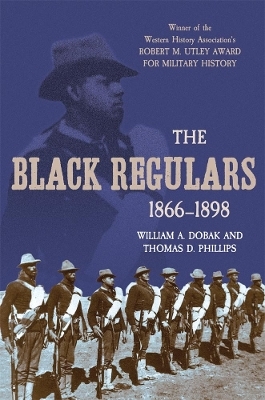
The Black Regulars, 1866-1898
Seiten
2017
University of Oklahoma Press (Verlag)
978-0-8061-5753-5 (ISBN)
University of Oklahoma Press (Verlag)
978-0-8061-5753-5 (ISBN)
Black soldiers first entered the regular army of the United States in the summer of 1866. This book uses army correspondence, court-martial transcripts, and pension applications to tell who these men were, often in their own words
Black soldiers first entered the regular army of the United States in the summer of 1866. While their segregated regiments served in the American West for the following three decades, the promise of Reconstruction gave way to the repressiveness of Jim Crow. But black men found a degree of equality in the service: the army treated them no worse than it did their white counterparts.
The Black Regulars uses army correspondence, court-martial transcripts, and pension applications to tell who these men were, often in their own words: how they were recruited and how their officers were selected; how the black regiments survived hostile congressional hearings and stringent budget cuts; how enlisted men spent their time, both on and off duty; and how regimental chaplains tried to promote literacy through the army's schools. The authors shed new light on the military justice system, relations between black troops and their mostly white civilian neighbors, their professional reputations, and what veterans faced when they left the army for civilian life.
Black soldiers first entered the regular army of the United States in the summer of 1866. While their segregated regiments served in the American West for the following three decades, the promise of Reconstruction gave way to the repressiveness of Jim Crow. But black men found a degree of equality in the service: the army treated them no worse than it did their white counterparts.
The Black Regulars uses army correspondence, court-martial transcripts, and pension applications to tell who these men were, often in their own words: how they were recruited and how their officers were selected; how the black regiments survived hostile congressional hearings and stringent budget cuts; how enlisted men spent their time, both on and off duty; and how regimental chaplains tried to promote literacy through the army's schools. The authors shed new light on the military justice system, relations between black troops and their mostly white civilian neighbors, their professional reputations, and what veterans faced when they left the army for civilian life.
William A. Dobak, retired from the National Archives, Washington, D.C., is the author of Fort Riley and Its Neighbors: Military Money and Economic Growth, 1853-1895 and Freedom by the Sword: The U.S. Colored Troops, 1862-1867. Thomas D. Phillips holds a Ph.D. in history from the University of Wisconsin, Madison.
| Erscheinungsdatum | 15.01.2017 |
|---|---|
| Zusatzinfo | 19 black & white illustrations, 2 maps |
| Verlagsort | Oklahoma |
| Sprache | englisch |
| Maße | 152 x 229 mm |
| Gewicht | 517 g |
| Themenwelt | Sachbuch/Ratgeber ► Geschichte / Politik ► Allgemeines / Lexika |
| Geschichte ► Allgemeine Geschichte ► Neuzeit (bis 1918) | |
| Geisteswissenschaften ► Geschichte ► Regional- / Ländergeschichte | |
| Geschichte ► Teilgebiete der Geschichte ► Militärgeschichte | |
| ISBN-10 | 0-8061-5753-4 / 0806157534 |
| ISBN-13 | 978-0-8061-5753-5 / 9780806157535 |
| Zustand | Neuware |
| Informationen gemäß Produktsicherheitsverordnung (GPSR) | |
| Haben Sie eine Frage zum Produkt? |
Mehr entdecken
aus dem Bereich


aus dem Bereich
Geschichte einer wilden Handlung
Buch | Hardcover (2024)
C.H.Beck (Verlag)
CHF 47,60


