


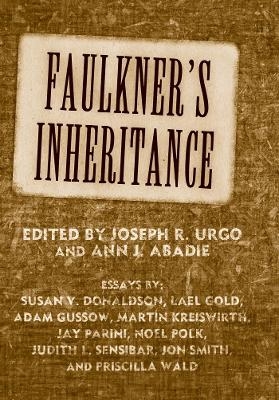
Faulkner's Inheritance
Seiten
2017
University Press of Mississippi (Verlag)
978-1-4968-1313-8 (ISBN)
University Press of Mississippi (Verlag)
978-1-4968-1313-8 (ISBN)
William Faulkner's life was rich in what he saw and read, and he seems to have remembered all of it and put it to use in his fiction. Faulkner's Inheritance is a collection of essays that examines the influences on Faulkner's fiction, including his own family history, Jim Crow laws, contemporary fashion, popular culture, and literature.
Essays by Susan V. Donaldson, Lael Gold, Adam Gussow, Martin Kreiswirth, Jay Parini, Noel Polk, Judith L. Sensibar, Jon Smith, and Priscilla Wald William Faulkner once said that the writer ""collects his material all his life from everything he reads, from everything he listens to, everything he sees, and he stores that away in sort of a filing cabinet . . . in my case it's not anything near as neat as a filing case; it's more like a junk box."" Faulkner tended to be quite casual about his influences. For example, he referred to the South as ""not very important to me. I just happen to know it, and don't have time in one life to learn another one and write at the same time."" His Christian background, according to him, was simply another tool he might pick up on one of his visits to ""the lumber room"" that would help him tell a story.
Sometimes he claimed he never read James Joyce's Ulysses or had never heard of Thomas Mann--writers he would elsewhere declare as ""the two great men in my time."" Sometimes he expressed annoyance at readers who found esoteric theory in his fiction, when all he wanted them to find was Faulkner: ""I have never read [Freud]. Neither did Shakespeare. I doubt if Melville did either, and I'm sure Moby-Dick didn't.""
Nevertheless, Faulkner's life was rich in what he did, saw, and read, and he seems to have remembered all of it and put it to use in his fiction. Faulkner's Inheritance is a collection of essays that examines the influences on Faulkner's fiction, including his own family history, Jim Crow laws, contemporary fashion, popular culture, and literature.
Essays by Susan V. Donaldson, Lael Gold, Adam Gussow, Martin Kreiswirth, Jay Parini, Noel Polk, Judith L. Sensibar, Jon Smith, and Priscilla Wald William Faulkner once said that the writer ""collects his material all his life from everything he reads, from everything he listens to, everything he sees, and he stores that away in sort of a filing cabinet . . . in my case it's not anything near as neat as a filing case; it's more like a junk box."" Faulkner tended to be quite casual about his influences. For example, he referred to the South as ""not very important to me. I just happen to know it, and don't have time in one life to learn another one and write at the same time."" His Christian background, according to him, was simply another tool he might pick up on one of his visits to ""the lumber room"" that would help him tell a story.
Sometimes he claimed he never read James Joyce's Ulysses or had never heard of Thomas Mann--writers he would elsewhere declare as ""the two great men in my time."" Sometimes he expressed annoyance at readers who found esoteric theory in his fiction, when all he wanted them to find was Faulkner: ""I have never read [Freud]. Neither did Shakespeare. I doubt if Melville did either, and I'm sure Moby-Dick didn't.""
Nevertheless, Faulkner's life was rich in what he did, saw, and read, and he seems to have remembered all of it and put it to use in his fiction. Faulkner's Inheritance is a collection of essays that examines the influences on Faulkner's fiction, including his own family history, Jim Crow laws, contemporary fashion, popular culture, and literature.
Joseph R. Urgo is provost and vice chancellor for Academic Affairs at the University of North Carolina at Asheville. Ann J. Abadie, Oxford, Mississippi, was associate director of the Center for the Study of Southern Culture at the University of Mississippi and coeditor of numerous scholarly collections from the Faulkner and Yoknapatawpha Conference.
| Erscheinungsdatum | 10.08.2017 |
|---|---|
| Reihe/Serie | Faulkner and Yoknapatawpha Series |
| Verlagsort | Jackson |
| Sprache | englisch |
| Maße | 152 x 228 mm |
| Gewicht | 280 g |
| Themenwelt | Literatur ► Essays / Feuilleton |
| Literatur ► Lyrik / Dramatik | |
| Geisteswissenschaften ► Sprach- / Literaturwissenschaft ► Anglistik / Amerikanistik | |
| Geisteswissenschaften ► Sprach- / Literaturwissenschaft ► Literaturwissenschaft | |
| ISBN-10 | 1-4968-1313-8 / 1496813138 |
| ISBN-13 | 978-1-4968-1313-8 / 9781496813138 |
| Zustand | Neuware |
| Informationen gemäß Produktsicherheitsverordnung (GPSR) | |
| Haben Sie eine Frage zum Produkt? |
Mehr entdecken
aus dem Bereich



aus dem Bereich
Poetik eines sozialen Urteils
Buch | Hardcover (2023)
De Gruyter (Verlag)
CHF 83,90


