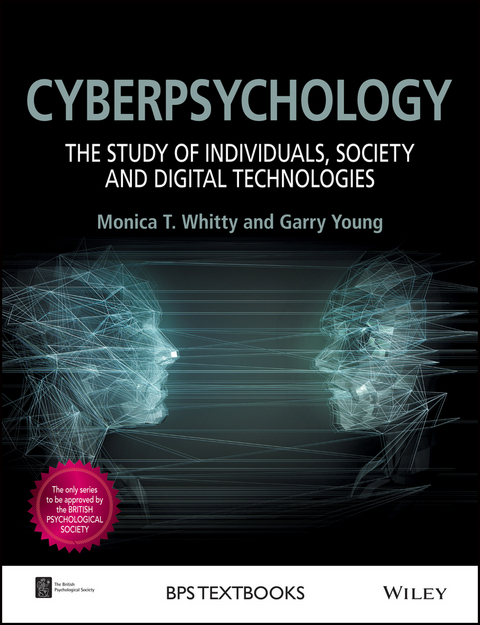
Cyberpsychology (eBook)
An important new textbook for an exciting area of contemporary psychological study and research???
The field of cyberpsychology examines the psychology of interactions between individuals, societies and digital technologies. This engaging and accessible textbook offers a complete introduction to the subject. The authors outline key theories, provide critical assessments, identify areas in need of further research, and discuss ways to use digital technologies as a research tool. They also include a wealth of real life examples, activities and discussion questions for students at undergraduate and graduate levels.
Cyberpsychology provides up-to-date coverage of a wide range of topics relating to online behaviour, and considers the potential impact of these interactions offline:
- online identity
- online dating and relationships
- pornography
- cyberbullying
- children???s use of the Internet
- online games and gambling
- deception
- online crime
Monica T. Whitty is Professor of Human Factors in Cyber Security in WMG at the University of Warwick, UK. Her research focus is on cybersecurity, cybercrime and online behaviour. She is a co-author or co-editor of several books, and has published widely on cybersecurity, mass-marketing fraud, insider threat, cyberstalking, online identity, cyber-relationships, cyberethics, online surveillance and taboos in video games.
Garry Young is Senior Lecturer in Psychology at Nottingham Trent University, UK. His research and teaching focus on the ethics of enacting real-life taboos within virtual environments, the phenomenology of delusions, and embodied cognition. He has published widely on ethics in video games, notions of self in cyberspace, the Capgras and Cotard delusions, and differences between procedural and declarative knowledge.
Monica T. Whitty is Professor of Human Factors in Cyber Security in WMG at the University of Warwick, UK. Her research focus is on cybersecurity, cybercrime and online behaviour. She is a co-author or co-editor of several books, and has published widely on cybersecurity, mass-marketing fraud, insider threat, cyberstalking, online identity, cyber-relationships, cyberethics, online surveillance and taboos in video games. Garry Young is Senior Lecturer in Psychology at Nottingham Trent University, UK. His research and teaching focus on the ethics of enacting real-life taboos within virtual environments, the phenomenology of delusions, and embodied cognition. He has published widely on ethics in video games, notions of self in cyberspace, the Capgras and Cotard delusions, and differences between procedural and declarative knowledge.
List of Tables, Figures and Boxes x
Chapter 1 Introduction 1
Chapter 2 The 'Self ' in Cyberspace 9
Chapter 3 Online Relationships 23
Chapter 4 Online Dating 39
Chapter 5 Online Sexual Activities 51
Chapter 6 Internet Infidelity 62
Chapter 7 Children's and Teens' Use of Digital Technologies 73
Chapter 8 Online Education 86
Chapter 9 Leisure and Entertainment 101
Chapter 10 Online Gaming and Gambling 114
Chapter 11 Online Deception 128
Chapter 12 Online Crimes: Scams, Fraud and Illegal Downloads 141
Chapter 13 Online Crimes: Cyberharassment, Hate Crimes and Cyberwarfare 156
Chapter 14 Online Crimes: Child Pornography and Paedophilia 170
Chapter 15 Online Support and Health Care 187
Chapter 16 Concluding Thoughts 200
References 203
Index 240
1
Introduction
Digital technologies play important roles in both our everyday and working lives and will continue to increase in importance in the future. Given this importance it is no wonder that cyberpsychology has emerged as a new subdiscipline within psychology and is being taught in many mainstream psychology degrees as well as disciplines such as media and communications, philosophy, sociology, criminology and security studies. Well‐regarded, high‐impact journals have been available for some time that focus solely on cyberpsychology. Conferences have also been designed to focus on this topic and are growing in popularity. Cyberpsychology master’s courses are sprouting up across the globe and the number of students drawn to these courses continues to increase – most likely because the Internet continues to grow and affect people’s lives in new, challenging and exciting ways.
Cyberpsychology is the study of individuals, societies and digital technologies and the psychology of how these interact. Cyberpsychology applies psychological theory to explain how individuals interact in cyberspace and how these interactions might affect our offline lives. It offers a new way to define the self and society. In this book, we have attempted to cover the breadth and depth of cyberpsychology, although as the discipline expands it is likely to incorporate new and exciting areas and foci.
This book is intended as a textbook for both undergraduate and postgraduate students in psychology as well as other relevant degrees that incorporate psychology into their syllabuses. It aims to set out key theories and empirical research conducted within the field of cyberpsychology. It does so by also considering real‐world problems and events, and considers how theories in this field might shed further light on our understanding of these issues. Moreover, it engages readers with novel and relevant issues – encouraging them to critically evaluate the current literature and to take their own personal stance on particular issues.
We begin the book by focusing on the complex issue of defining the ‘Self’ in cyberspace, and present the argument that the Internet has changed the way we view and understand the self. In Chapter 2, we start by considering traditional theories of the self – for example, trait theory, social identity theory, possible selves, a social constructionist approach and a postmodern view of the self. We follow this with a history of how the self has been understood in cyberspace. In this chapter we acknowledge Turkle’s early work, which theorized that individuals could explore and gain new insights about identity within cyberspace. Other theorists who embraced these utopian views about the Internet are also mentioned in this chapter, with particular reference to feminist theorists, such as Haraway. We note, however, that Turkle has in more recent times rejected her own earlier claims and now takes the opposite view, arguing that digital technologies can lead to a new sense of solitude. Gergen’s theory on the saturated self is also highlighted here, as is his view that new technologies have led to a fragmentation of the self. We briefly outline the ways in which traditional theories of the self have been applied to how the self might be presented in cyberspace – for example, considering Goffman’s ‘performing self’, the theory of ‘possible selves’ and social identity theory. We conclude the chapter by noting that there are few places where users can be visually anonymous, and we therefore suggest that theories of the self online need to consider differences between spaces where users are visually anonymous and those where they present images of themselves, as well as the choices they make to visually present themselves.
In Chapter 3, we set out some of the theories and classic studies that have examined online relationships – both between friends and romantic. We begin by setting out some of the well‐known theories on relationship development that explain how relationships develop in the physical realm, such as social evolutionary theory, social penetration theory, exchange theory and equity theory. We then move on to examine how these theories might be used to explain the development of online relationships, and point out some of their shortcomings. Given these shortcomings, theories have been developed to explain the uniqueness of some relationships initiated and developed in cyberspace compared with the physical world. Theories such as the ‘disinhibition effect’, social presence theory, social information processing theory and hyperpersonal communication theory are outlined. We explain how these theories have emerged and how they have been applied to explain online relating. We also provide a brief history of online relating and detail some of the ways in which relating has changed as technology has developed – especially from a more textual space to a space with greater bandwidth and less visual anonymity.
Online dating has changed from a stigmatized method for finding a date to a popular matching method for people in many countries across a range of ages. Chapter 4 focuses specifically on this phenomenon, and picks up on some of the theories outlined in Chapter 3 to examine how relationship initiation and development differ from but also share commonalities with relationships formed in other places online and in the physical realm. We examine research that has found personality differences relating to use of online dating; for example, some studies have found that shy individuals are more likely to use dating sites compared with more socially confident individuals. We also explore the notion that the self is commodified on online dating sites and that how one is presented is, in part, dependent on which aspects are more likely to draw in desirable dates (this motivation sometimes leads to deception, where daters lie about certain aspects of themselves, such as height and weight). We also go through the stages involved in the online dating process, noting that a new wave of dating apps is changing users’ experiences of this process.
In Chapter 5 we consider online sexual activities. We note that, even in the early days of the Internet, people engaged in cybersex, in the form of erotic textual communication. This chapter outlines some of the well‐cited papers that consider why individuals partake in cybersex. The Triple A Engine, for example, is a model put forward by Cooper and his colleges to argue that the Internet’s affordability, anonymity and accessibility initially led some individuals to be drawn to this space to engage in sexual activities. Cooper believed that some of these people became cybersex compulsives. This chapter further outlines some of the problems associated with cybersex as well as some of its liberating aspects. One of the problems, which continues to exist in contemporary times, is that the Internet enables risky offline sexual encounters, with research revealing correlations between locating sexual partners online and contracting sexually transmitted infections (STIs). Sexting, described in this chapter, is also an activity that is problematic and sometimes illegal. On the flip side, however, the Internet provides sexual health information, which is easy to access, without the perceived embarrassment of asking a doctor, thereby potentially preventing the transmission of sexual diseases.
As we discuss in Chapter 6, some people perceive Internet infidelity to be a genuine betrayal that can have real repercussions in couples’ lives. We define Internet infidelity based on current theories and empirical findings. We examine the sexual and emotional aspects of relationship transgressions both online and offline. This chapter also presents a critical examination of the theories that explain why men and women become jealous in the physical world (e.g., social evolutionary theory and the social cognitive approach) and whether these theories can be applied to explain jealousy about seemingly equivalent activities in cyberspace. Although there is a dearth of research available on Internet infidelity, the chapter points out some possible qualitative differences between online and offline affairs. Online affairs, for example, are potentially easier to split off from people’s everyday lives – making it easier for people engaging in an affair to rationalize that it is not a relationship transgression. We also consider whether having cybersex with an avatar might constitute ‘real’ betrayal. Here, we provide some real‐life examples in which people have felt hurt and betrayed by their partners’ cybersex activities in Second Life.
There has been much talk over the years about the digital divide. Some discuss this with respect to a divide between social classes, while others consider differences between ages (e.g., digital natives vs. digital immigrants). Chapter 7 focuses on digital natives – children’s and teens’ use of digital technologies. It does not, however, simply address the ease with which young people have appropriated digital technologies into their lives. In addition, it considers the issues young people have had to deal with since before there was an Internet (e.g., identity, sexuality, activism) and how these issues are dealt with in cyberspace. We examine here whether the use of digital technologies might be harmful or empowering for young people and detail empirical findings that support both views. A balanced view is provided, pointing out both the risks...
| Erscheint lt. Verlag | 21.10.2016 |
|---|---|
| Reihe/Serie | BPS Textbooks in Psychology |
| BPS Textbooks in Psychology | BPS Textbooks in Psychology |
| Sprache | englisch |
| Themenwelt | Geisteswissenschaften ► Psychologie ► Sozialpsychologie |
| Schlagworte | Psychologie • Psychology • Social Psychology • Sozialpsychologie |
| ISBN-13 | 9781118321126 / 9781118321126 |
| Informationen gemäß Produktsicherheitsverordnung (GPSR) | |
| Haben Sie eine Frage zum Produkt? |
 EPUB (Adobe DRM)
Kopierschutz: Adobe-DRM
Adobe-DRM ist ein Kopierschutz, der das eBook vor Mißbrauch schützen soll. Dabei wird das eBook bereits beim Download auf Ihre persönliche Adobe-ID autorisiert. Lesen können Sie das eBook dann nur auf den Geräten, welche ebenfalls auf Ihre Adobe-ID registriert sind.
Details zum Adobe-DRM
Dateiformat: EPUB (Electronic Publication)
EPUB ist ein offener Standard für eBooks und eignet sich besonders zur Darstellung von Belletristik und Sachbüchern. Der Fließtext wird dynamisch an die Display- und Schriftgröße angepasst. Auch für mobile Lesegeräte ist EPUB daher gut geeignet.
Systemvoraussetzungen:
PC/Mac: Mit einem PC oder Mac können Sie dieses eBook lesen. Sie benötigen eine
eReader: Dieses eBook kann mit (fast) allen eBook-Readern gelesen werden. Mit dem amazon-Kindle ist es aber nicht kompatibel.
Smartphone/Tablet: Egal ob Apple oder Android, dieses eBook können Sie lesen. Sie benötigen eine
Geräteliste und zusätzliche Hinweise
Buying eBooks from abroad
For tax law reasons we can sell eBooks just within Germany and Switzerland. Regrettably we cannot fulfill eBook-orders from other countries.
aus dem Bereich