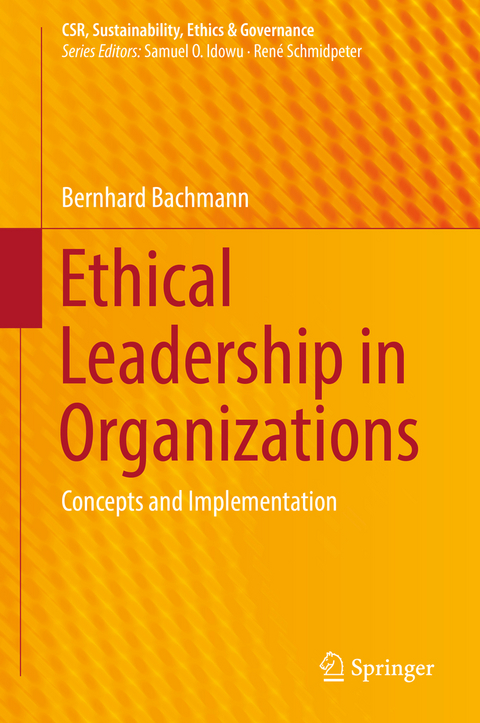
Ethical Leadership in Organizations (eBook)
XVII, 203 Seiten
Springer International Publishing (Verlag)
978-3-319-42942-7 (ISBN)

This book links ethical leadership theory to the implementation of improved leadership practices, particularly in highly operational environments. It builds on the recognition that bad forms of leadership lead to declining motivation and consequently to problems in the social climate and quality of work in organizations and the personal health of employees. It is based on a qualitative study from 100 in-depth interviews using inductive categorization, retrieving deep, rich and unprompted data from a highly developed and advanced production facility.
The book reviews the current state of research in this field and describes the setup of the underlying study, linking it to the author's professional experience. It discusses the research design, its testing and its adaption to organizational practice. The book presents the findings of the study, introduces specific issues arising from the analysis, then critically discusses the interpretation of the findings and matches these with theoretical concepts. One finding of the study is that CSR and ethics are too often implemented with a focus on governance, process and reporting, without looking at leadership on all levels as the critical component. Finally it discusses the conclusions and implications derived from the findings. Overall, the book critically assesses how ethical leadership can be practically implemented in business organizations as a means of transforming organizations into better-governed institutions that exhibit ethical behavior.Bernhard Bachmann received his Doctorate in Business Administration from Edinburgh Napier University, UK. He is an independent consultant and analyst working at Bachmann Analytics, Governance & Training GmbH, and visiting lecturer at several universities.
Bernhard Bachmann received his Doctorate in Business Administration from Edinburgh Napier University, UK. He is an independent consultant and analyst working at Bachmann Analytics, Governance & Training GmbH, and visiting lecturer at several universities.
Foreword by Prof Dr James F. O´Kane, Dean of The Business School, Edinburgh Napier University 6
Foreword by the Author 8
Contents 10
List of Acronyms and Abbreviations 13
List of Figures 14
List of Tables 15
Chapter 1: Business Ethics Are Not Working 16
1.1 Business Ethics and CSR Are on the Rise 19
1.2 Business Ethics Are Today´s Order Winning Criteria 21
1.3 Why Is Progress in Business Ethics so Slow? 22
1.4 Structure of the Book 24
1.5 It´s Leadership, Not Regulations and Process: Contributions to Management Science and Practice 25
Chapter 2: The Implementation of Business Ethics Explored: 11 ``Key Themes´´ or Building Blocks 27
2.1 Ethical Theory and Values 28
2.2 Sustainability: The ``Triple Bottom Line´´ 28
2.3 Governance: Aiming at ESG Criteria 29
2.4 Responsibility and Society: Corporate Social Responsibility, Corporate Citizenship 31
2.5 Globalisation: Blessing or Curse? 33
2.6 Ethical Decision Making: Values, Facts and Ethical Dilemmas 34
2.7 Ethical Stakeholder Management 35
2.8 Ethical Treatment of Employees 36
2.9 Ethical Treatment of Customers, Consumers, and Clients 37
2.10 Ethical Treatment of Suppliers and Ethical Sourcing 38
2.11 Ethical Treatment of Competitors 39
Chapter 3: Literature Review: The Evolution of Ethical Leadership 40
3.1 Introduction: Ethical Leadership: A Neglected Approach 42
3.1.1 Foundations and Perspectives of Ethics and Morale 44
3.1.2 Foundations of Integrity and Trust, or: Why Is Noone Researching Integrity and Trust? 50
3.2 The Evolution of Ethical Leadership Concepts 53
3.3 Embedding Ethical Leadership Concepts and Processes in Organisations 56
3.3.1 Factoring in Operational Environment and Context 57
3.3.2 Factoring in the Role of Corporate Culture 58
3.3.3 Factoring in Real Transformational Change 60
3.3.4 Embedding Ethical Leadership by Process 64
3.3.5 Embedding Ethical Leadership by Leadership Behaviour: The Importance of Role Modelling 66
3.3.6 Embedding Ethical Leadership by Establishing an Ethical Culture 68
3.3.7 Embedding Ethical Leadership by Establishing an Ethical Climate 69
3.4 The Neglected Role of the Middle Manager: The Influence of CEOs Is Highly Overrated 71
3.5 Summary: Don´t Write Rulebooks, Lead! 73
3.6 Implications and Emergent Themes for the Research Agenda and the Research Questions 74
Chapter 4: Research Methodology and Methods 77
4.1 Organisations Are Full of Multiple Truths 78
4.2 The Research Ethics of Researching Perceived Leadership 81
4.3 Development of Research Methods and Research Design 83
4.3.1 Concepts of Measuring Ethical Leadership 83
4.3.1.1 PLIS Instrument (Craig and Gustafson) 84
4.3.1.2 Brown and Treviño´s Ethical Leadership Scale (ELS) 86
4.3.1.3 The Corporate Ethical Virtues Model 87
4.3.1.4 The ``Integrity Thermometer´´ 88
4.3.2 The Pilot Study and Results from the Field Tests 89
4.4 Focus Groups Are Seriously Flawed 93
4.5 A Better Kind of In-Depth Interviews 94
4.6 The Concept of Inductive Categorisation 97
4.7 Considerations on the Quality of Qualitative Research 99
4.8 Limitations of the Chosen Research Design 101
Chapter 5: Research Data Collection and Analysis Framework 105
5.1 Organisational Context of the Researched Company 105
5.2 Ensuring Right Sample Size and High Quality 107
5.3 In-Depth Interviews Validation of Issues and Narratives 112
5.4 Data Coding 113
5.5 Analysis Method Framework 116
Chapter 6: The Effects of Bad Leadership: Results and Findings from the Data 119
6.1 Situational Context and Operational Governance 120
6.2 Quality vs. Speed and New Product Development (NPD) 123
6.3 Internal Competition 125
6.4 Leadership Culture 127
6.5 Favouritism and Nepotism 131
6.6 Appreciation 133
6.7 Integrity 135
6.8 Trust 137
6.9 Organisational Culture and Leadership Culture 138
6.10 Corporate and Work Climate 139
6.11 Team Spirit 141
6.12 Employee Motivation 142
6.13 Implications for Co-Operation 144
6.14 Poor and Bad Leadership Makes Ill 145
6.15 Summary 149
Chapter 7: Discussion of the Findings: The Absence of Unethical Leadership Is Already a Success 152
7.1 Findings in the Light of the Literature Review Discussion 153
7.1.1 Morale and Integrity 154
7.1.2 The Evolution of Ethical Leadership 155
7.1.3 Operational Context 157
7.1.4 Transformational Change 157
7.1.5 Process Implementation 158
7.1.6 Changing Organisational Culture and Climate 159
7.1.7 Role Modelling and the Role of Middle Managers 160
7.2 Revisiting the Research Framework Model 162
7.3 Emerging Issues from the Findings in Light of Recent Theory 164
Chapter 8: Conclusions and Implications of this Research Study 170
8.1 Conclusions on the Research Questions 170
8.2 Limitations of the Study 174
8.3 Ethical Leadership Is the Driver to CSR Implementation: Contributions of this Study to Current Research and Knowledge 176
8.4 Suggestions and Potential for Further Research 178
8.5 Practical Implications: Middle Managers Are Essential: An Approach of Establishing an Ethical Leadership Climate 179
About the Author 181
Appendix: Interview Questions and Interviewing Process 182
References 193
| Erscheint lt. Verlag | 6.9.2016 |
|---|---|
| Reihe/Serie | CSR, Sustainability, Ethics & Governance | CSR, Sustainability, Ethics & Governance |
| Zusatzinfo | XVII, 203 p. 22 illus., 1 illus. in color. |
| Verlagsort | Cham |
| Sprache | englisch |
| Themenwelt | Geisteswissenschaften ► Philosophie ► Allgemeines / Lexika |
| Wirtschaft ► Betriebswirtschaft / Management ► Personalwesen | |
| Wirtschaft ► Betriebswirtschaft / Management ► Unternehmensführung / Management | |
| Schlagworte | applied leadership • Corporate Social Responsibility • cost thinking • ethical change • ethical leadership theory • ethical transformation • improved leadership practice • inductive categorization • leading production workforce • role modelling |
| ISBN-10 | 3-319-42942-6 / 3319429426 |
| ISBN-13 | 978-3-319-42942-7 / 9783319429427 |
| Informationen gemäß Produktsicherheitsverordnung (GPSR) | |
| Haben Sie eine Frage zum Produkt? |
 PDF (Wasserzeichen)
DRM: Digitales Wasserzeichen
Dieses eBook enthält ein digitales Wasserzeichen und ist damit für Sie personalisiert. Bei einer missbräuchlichen Weitergabe des eBooks an Dritte ist eine Rückverfolgung an die Quelle möglich.
Dateiformat: PDF (Portable Document Format)
Mit einem festen Seitenlayout eignet sich die PDF besonders für Fachbücher mit Spalten, Tabellen und Abbildungen. Eine PDF kann auf fast allen Geräten angezeigt werden, ist aber für kleine Displays (Smartphone, eReader) nur eingeschränkt geeignet.
Systemvoraussetzungen:
PC/Mac: Mit einem PC oder Mac können Sie dieses eBook lesen. Sie benötigen dafür einen PDF-Viewer - z.B. den Adobe Reader oder Adobe Digital Editions.
eReader: Dieses eBook kann mit (fast) allen eBook-Readern gelesen werden. Mit dem amazon-Kindle ist es aber nicht kompatibel.
Smartphone/Tablet: Egal ob Apple oder Android, dieses eBook können Sie lesen. Sie benötigen dafür einen PDF-Viewer - z.B. die kostenlose Adobe Digital Editions-App.
Buying eBooks from abroad
For tax law reasons we can sell eBooks just within Germany and Switzerland. Regrettably we cannot fulfill eBook-orders from other countries.
aus dem Bereich